How to Choose Creatine Without Paying for Hype
Creatine monohydrate has the clearest evidence for repeated hard efforts, and a disclosed amount lets you compare products on the same cost basis.
If your goal is strength, power, or repeated short bursts of effort, start by comparing products that clearly name creatine monohydrate and state how much they contain. The strongest general performance evidence concerns high-intensity activity, not endurance. Compare prices using the same amount of disclosed creatine, then check testing details separately. A “for women” label or added ingredients don’t establish a better result. 1
Start with the kind of training you do
Creatine helps supply energy for short, intense muscle efforts. Research summarized by the NIH Office of Dietary Supplements generally finds benefits for high-intensity, intermittent activity, including measures of strength and power. It finds little value for endurance sports. If your goal is repeated sprints or getting stronger in the weight room, creatine is a more relevant purchase to consider than if your goal is a long, steady run. Individual results can vary. 1
That evidence doesn’t identify a winning brand. It gives you a way to judge what a product is promising against the outcome you care about.
Look past the front of the container
Check the form first. The women’s studies described below tested creatine monohydrate. They did not compare it with other marketed forms, so they can’t tell you that another form works better, worse, or the same. Choosing monohydrate keeps your purchase closer to the form used in those studies. 3 4 6
Find the creatine amount. Read the amount of creatine monohydrate per labeled serving, not just the weight of a scoop. In a product with other ingredients, those two figures may not mean the same thing. If a proprietary blend gives only its combined weight and hides the creatine amount, you can’t calculate how much creatine the container provides. The NIH notes that amounts in these blends can vary and that research on a single ingredient cannot establish the effects or safety of an unstudied combination. 1
Treat testing as a separate question. If a package makes a testing claim, look for details you can verify for that specific product, such as what was tested and who performed the testing. That information helps you assess the claim about the product; it isn’t proof that the product will improve your workout.
Compare cost for the same amount of creatine
A lower price per tub, scoop, or capsule isn’t necessarily a lower price for the creatine you’re comparing. Pick one common basis. For example, you can compare the cost per 5 grams of disclosed creatine monohydrate. Five grams is the upper end of the typical daily dose range cited in the NIH fact sheet; here, it’s a price-comparison yardstick, not an instruction to take that amount. 1
First, multiply the labeled creatine monohydrate per serving by the number of servings in the container. Divide that total by 5 grams to find the number of 5-gram-equivalent amounts. Then divide the container price by that number. Use the same basis for every product. An equivalent amount is a calculation, not necessarily one scoop or a practical number of capsules. If the creatine amount isn’t disclosed, you can’t make this comparison from the label. Price per equivalent amount also tells you nothing by itself about testing or effectiveness.
What the research in women adds
Women have been studied, though the findings don’t point to a special formula. In a randomized study of 39 women, creatine monohydrate did not change a heart-rate-variability measure of recovery. Researchers did find a menstrual-phase interaction for one repeated-sprint fatigue measure, but that result does not establish a cycle-based product or timing strategy. 3
Results also depend on what was tested. An eight-week pilot study of 17 resistance-trained women found no greater gains in lean mass or measured performance when creatine monohydrate was added to whey protein than with whey alone. A different, short-term study of 22 college-age women reported improvements in some quadriceps performance measures. Neither result promises a particular outcome from a product on the shelf. 4 6
Research in older adults does not settle a postmenopause-specific product choice. One trial in adults over 65 included men and women and found greater gains in some measures with creatine monohydrate plus resistance training than with placebo plus training; it did not report whether participants were postmenopausal. A separate trial in adults 60 and older tested creatine with HMB alongside exercise, so its results cannot be credited to creatine alone. These studies do not establish different product needs during pregnancy, postpartum, perimenopause, or postmenopause. 5 2
Finally, consider a tradeoff that matters to some athletes: creatine can raise body weight through water retention. That isn’t the same as showing a gain in body fat, but a change on the scale may matter if you compete by weight or monitor weight during training. 1
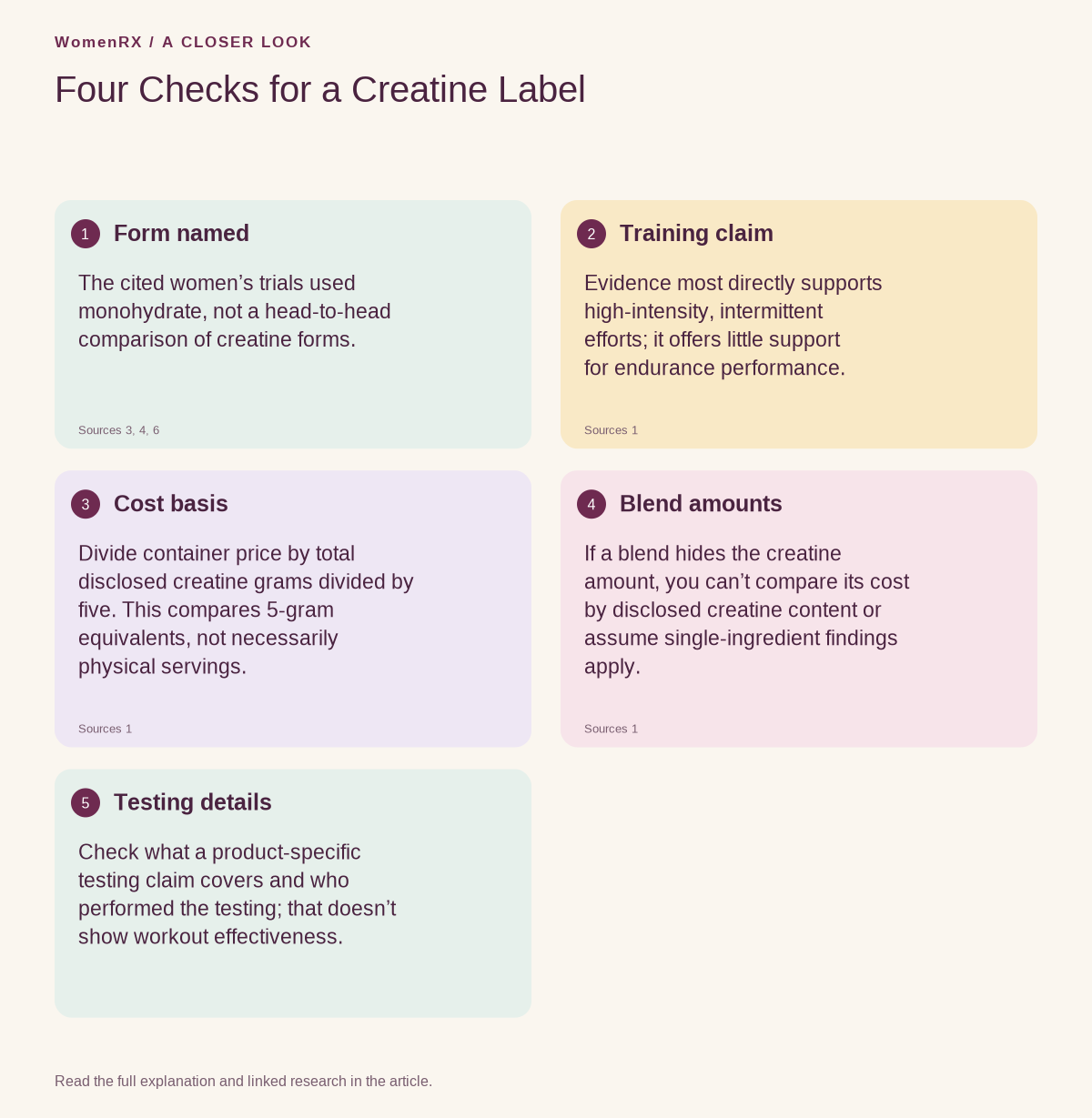
Four Checks for a Creatine Label
Form named: The cited women’s trials used monohydrate, not a head-to-head comparison of creatine forms.346
Training claim: Evidence most directly supports high-intensity, intermittent efforts; it offers little support for endurance performance.1
Cost basis: Divide container price by total disclosed creatine grams divided by five. This compares 5-gram equivalents, not necessarily physical servings.1
Blend amounts: If a blend hides the creatine amount, you can’t compare its cost by disclosed creatine content or assume single-ingredient findings apply.1
Testing details: Check what a product-specific testing claim covers and who performed the testing; that doesn’t show workout effectiveness.
Read the figure as text
Read these features together: the studied form, the outcome you want, the amount you can price, and the claims that need separate scrutiny.- Form named: The cited women’s trials used monohydrate, not a head-to-head comparison of creatine forms.346
- Training claim: Evidence most directly supports high-intensity, intermittent efforts; it offers little support for endurance performance.1
- Cost basis: Divide container price by total disclosed creatine grams divided by five. This compares 5-gram equivalents, not necessarily physical servings.1
- Blend amounts: If a blend hides the creatine amount, you can’t compare its cost by disclosed creatine content or assume single-ingredient findings apply.1
- Testing details: Check what a product-specific testing claim covers and who performed the testing; that doesn’t show workout effectiveness.
Sources you can check
- Dietary Supplements for Exercise and Athletic Performance - Health Professional Fact SheetAccessed 2026-09-25Return to first citation
- Combined creatine and β-hydroxy-β-methylbutyrate supplementation with integral conditioning exercise enhances functional performance and metabolic health in physically active older adults: A randomized controlled crossover trial.Ramos-Hernández R, Busto N, Miguel-Ortega Á, Martínez-Ferrán M, Santamaría-Peláez M, Saiz-Rodríguez M, Mielgo-Ayuso J. · Aging clinical and experimental research · 2026Return to first citation
- The Effects of Creatine Monohydrate Loading on Exercise Recovery in Active Women throughout the Menstrual Cycle.Gordon AN, Moore SR, Patterson ND, Hostetter ME, Cabre HE, Hirsch KR, Hackney AC, Smith-Ryan AE. · Nutrients · 2023Return to first citation
- A Pilot Study Examining the Effects of 8-Week Whey Protein versus Whey Protein Plus Creatine Supplementation on Body Composition and Performance Variables in Resistance-Trained Women.Wilborn CD, Outlaw JJ, Mumford PW, Urbina SL, Hayward S, Roberts MD, Taylor LW, Foster CA. · Annals of nutrition & metabolism · 2016Return to first citation
- Creatine supplementation enhances isometric strength and body composition improvements following strength exercise training in older adults.Brose A, Parise G, Tarnopolsky MA. · The journals of gerontology. Series A, Biological sciences and medical sciences · 2003Return to first citation
- Short-term creatine supplementation improves maximum quadriceps contraction in women.Kambis KW, Pizzedaz SK. · International journal of sport nutrition and exercise metabolism · 2003Return to first citation