How to Choose Creatine for Strength Training
Creatine monohydrate is the form to compare first if your goal is strength training, but the size of any benefit depends on the outcome and the women studied.
If you’re considering creatine for strength training, start by comparing products labeled creatine monohydrate. Research in postmenopausal women suggests modest average gains in lean mass and leg-press strength, while a small trial in experienced trainees found no added benefit over training alone. Neither result guarantees what you’ll experience, and training studies don’t establish broader wellness benefits. 1 3
Start with the outcome you want
Creatine is worth considering if you’re doing resistance training and hoping to improve strength or lean mass. That’s a narrower question than whether it helps with weight loss, hormones, or general wellness. Findings about training don’t establish those broader benefits.
The ingredient name to look for is creatine monohydrate. In a 14-day randomized trial involving 29 healthy adults, including 12 women, monohydrate increased muscle creatine content. Creatyl-L-leucine, a different compound marketed in this category, did not. Participants also completed supervised resistance exercise, but the study measured muscle creatine stores, not whether one form led to greater long-term strength gains. It didn’t compare every form on the shelf. 4
That gives you a reason to favor the studied form over an unfamiliar one. It doesn’t mean any particular tub has been shown to work, or that a more elaborate blend will work better.
What have studies found in women?
The answer changes with the group and the outcome. In a 10-week randomized trial of 26 experienced resistance-trained women, both the creatine and placebo groups gained strength and lean body mass while training. Creatine did not add a statistically significant improvement in those outcomes. That’s useful information for someone who already lifts, though one small trial cannot predict every trainee’s result. 1
For postmenopausal women, a 2026 systematic review and meta-analysis brought together seven randomized trials involving 608 women. In the five trials with lean-mass data from 338 women, the average difference favored creatine over placebo by 0.37 kg. In three trials with leg-press data from 111 women, the average difference was 7.5 kg. Those figures are differences between groups across trials, not gains you should expect personally. The review found no overall change in bone density. 3
The review found more favorable results when creatine was combined with resistance training; trials using lower amounts without training showed no measurable effect. That’s a distinction between study conditions, not a dosing instruction. Most trials in the review had some risk-of-bias concerns, so the averages are useful without being a promise. 3
These studies also don’t tell us whether creatine works differently during cycling years or perimenopause. The trained-women trial and the postmenopausal trials answer different questions; neither establishes a special need for creatine at a particular life stage. 1 3
Compare labels without mistaking a claim for evidence
When you have two products in hand, check the ingredient list before the marketing on the front. Does it name creatine monohydrate? Can you tell how much of that ingredient is in a serving, or is it mixed into a blend whose individual amounts aren’t clear? A combination-trial result doesn’t automatically show that creatine alone produced the benefit. For example, one trial compared whey protein alone, creatine plus whey protein, and a three-ingredient combination of creatine, whey protein, and conjugated linoleic acid. Its reported greater strength gains were for the three-ingredient group compared with the other groups combined; that finding doesn’t establish a benefit from creatine alone. 2
Product testing is a separate question from whether the ingredient can help with training. If a label advertises independent testing, look for who performed it, what was checked, and whether the claim applies to the product or lot you’re buying. Don’t treat a testing claim as proof of a strength benefit. The exercise trials do not rank brands or verify the contents of products currently for sale.
Put safety findings in their proper setting
In the postmenopausal trials reviewed, reported adverse events were mild and similar to placebo, and kidney-related lab measures were unchanged. Those findings are reassuring within the trial settings, but they don’t establish safety for people with kidney conditions. If you have a kidney condition, it’s reasonable to get advice specific to your health before adding creatine. 3
Pregnancy and postpartum use are different questions. The training studies discussed here did not assess those periods, so their results shouldn’t be used to assume a benefit or establish safety while pregnant or breastfeeding. If you’re considering creatine then, bring that specific question to your pregnancy or postpartum care team. 1 3 4
For a strength-training goal, the practical comparison is straightforward: choose a clearly labeled form with relevant research, keep your expectations tied to training outcomes, and evaluate product-quality claims separately.
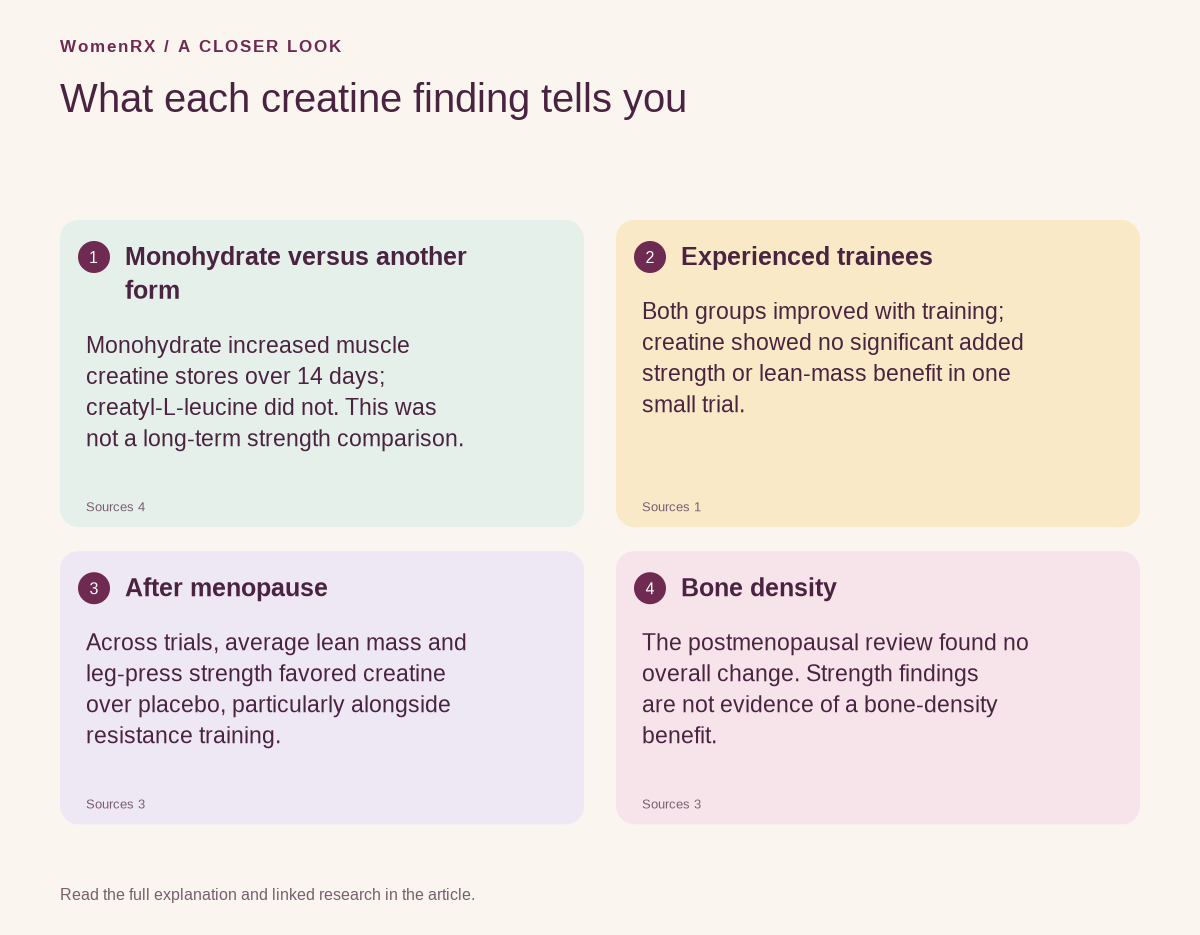
What each creatine finding tells you
Monohydrate versus another form: Monohydrate increased muscle creatine stores over 14 days; creatyl-L-leucine did not. This was not a long-term strength comparison.4
Experienced trainees: Both groups improved with training; creatine showed no significant added strength or lean-mass benefit in one small trial.1
After menopause: Across trials, average lean mass and leg-press strength favored creatine over placebo, particularly alongside resistance training.3
Bone density: The postmenopausal review found no overall change. Strength findings are not evidence of a bone-density benefit.3
Read the figure as text
The form, population, and measured outcome determine what a study can help you decide.- Monohydrate versus another form: Monohydrate increased muscle creatine stores over 14 days; creatyl-L-leucine did not. This was not a long-term strength comparison.4
- Experienced trainees: Both groups improved with training; creatine showed no significant added strength or lean-mass benefit in one small trial.1
- After menopause: Across trials, average lean mass and leg-press strength favored creatine over placebo, particularly alongside resistance training.3
- Bone density: The postmenopausal review found no overall change. Strength findings are not evidence of a bone-density benefit.3
More questions, answered
Will creatine improve bone density after menopause?
The 2026 review of randomized trials in postmenopausal women found no overall change in bone density. Its findings on lean mass and leg-press strength should not be read as evidence of a bone-density benefit. 3
Sources you can check
- Effects of creatine monohydrate supplementation on body composition and strength indices in experienced resistance trained women.Ferguson TB, Syrotuik DG. · Journal of strength and conditioning research · 2006Return to first citation
- Conjugated linoleic acid combined with creatine monohydrate and whey protein supplementation during strength training.Cornish SM, Candow DG, Jantz NT, Chilibeck PD, Little JP, Forbes S, Abeysekara S, Zello GA. · International journal of sport nutrition and exercise metabolism · 2009Return to first citation
- Creatine monohydrate for lean mass, strength, and bone density in postmenopausal women: a systematic review and meta-analysis.Naddafha S, Antonio J, Kreider RB, Stout JR. · Journal of the International Society of Sports Nutrition · 2026Return to first citation
- Creatine Monohydrate Supplementation, but not Creatyl-L-Leucine, Increased Muscle Creatine Content in Healthy Young Adults: A Double-Blind Randomized Controlled Trial.Askow AT, Paulussen KJM, McKenna CF, Salvador AF, Scaroni SE, Hamann JS, Ulanov AV, Li Z, Paluska SA, Beaudry KM, De Lisio M, Burd NA. · International journal of sport nutrition and exercise metabolism · 2022Return to first citation