Does Creatine Improve Strength in Women?
Creatine may add to some strength-training gains, but results in women are mixed and depend on which strength test a study uses.
Creatine taken alongside resistance training has improved some strength measures in pooled adult studies, including bench or chest press and squat. But those averages don’t establish the same benefit for women: the review’s sex-based analyses found significant gains for several measures in men, not women. Trials in postmenopausal and frail older women also found no extra strength gain over exercise alone. 2 3 5
Creatine can support strength gains for some people training with weights, but the evidence doesn’t show that women can expect a reliable boost. The clearest way to read the research is to look at the specific test, whether participants trained, and whether results were reported separately for women.
What the strength tests show
A 2025 systematic review and meta-analysis combined 69 studies with 1,937 adults. Across studies that paired creatine with resistance training, the creatine groups had a small average advantage over placebo groups on bench or chest press strength (1.43 kg) and squat strength (5.64 kg). Those are pooled differences between groups, not a promise that an individual woman will lift that much more. 2
The results weren’t the same for every test. The review found no statistically significant advantage for handgrip strength or leg press strength when creatine was combined with exercise training. Power tests, such as vertical jump and Wingate peak power, measure performance too, but they aren’t the same as a direct measure of how much weight someone can lift. 2
That distinction matters in practice. A study showing a change in a squat test answers a different question from one measuring grip strength, walking speed, or muscle creatine content. A result on one test shouldn’t be taken as proof that strength improved across the board.
The women-specific results are less convincing
The meta-analysis included studies of men and women, but its sex-based subgroup analysis reported significant improvements for several strength and power outcomes in men, not women. That doesn’t prove creatine cannot help women. It does mean the pooled gains shouldn’t be presented as established benefits for women, especially because the review calls for more well-powered studies in underrepresented groups, including women. 2
Evidence in older women illustrates the uncertainty. In a two-year randomized trial, 237 postmenopausal women followed a resistance-training and walking program while taking creatine or placebo. Both groups increased their bench-press and hack-squat one-repetition maximum, but creatine did not add a significant strength benefit over placebo. 3
A separate 16-week trial in pre-frail and frail older adults included 154 women and 46 men. Its women-only supplement comparisons found that creatine did not add to resistance-training improvements in muscle function. This population and training context are specific, so the result doesn’t settle what might happen in younger or more trained women. 5
A 2026 trial in 103 older adults, including 57 women, reported additional strength and function benefits when creatine was combined with resistance training. But its abstract does not report whether women had the same results as men, so it can’t establish a women-specific effect. 1
Don’t confuse a short-term marker with strength
Some studies measure whether creatine changes muscle creatine content rather than whether a person gets stronger. For example, a 14-day trial in healthy adults, including women and men, found that creatine monohydrate increased muscle creatine content. It did not report a strength outcome, so that finding shows a change in the measured muscle marker, not proof of a strength gain over two weeks. 4
When you read a short trial, check whether it measured an actual performance test, such as a one-repetition maximum, or only a marker related to creatine uptake. Then check whether participants trained and whether the comparison was creatine plus training versus the same training plus placebo. Those details help separate the supplement’s added effect from gains that training itself can produce.
What this means if you’re weighing a trial
If your main goal is to improve a lift, the evidence supports a cautious answer: creatine may offer an added benefit on some measures, but a consistent added strength benefit in women has not been demonstrated. Results from mixed-sex studies, older women, and frail older adults don’t all answer the same question. Age, training status, and the strength test differ, and findings from one group shouldn’t automatically be applied to another.
A useful comparison is your goal against the outcome a study measured. If you care about a particular lift, evidence for that lift is more relevant than a change in muscle creatine content, walking speed, or grip strength. And when a study reports only combined results for women and men, treat it as evidence about adults overall, not a women-specific result.
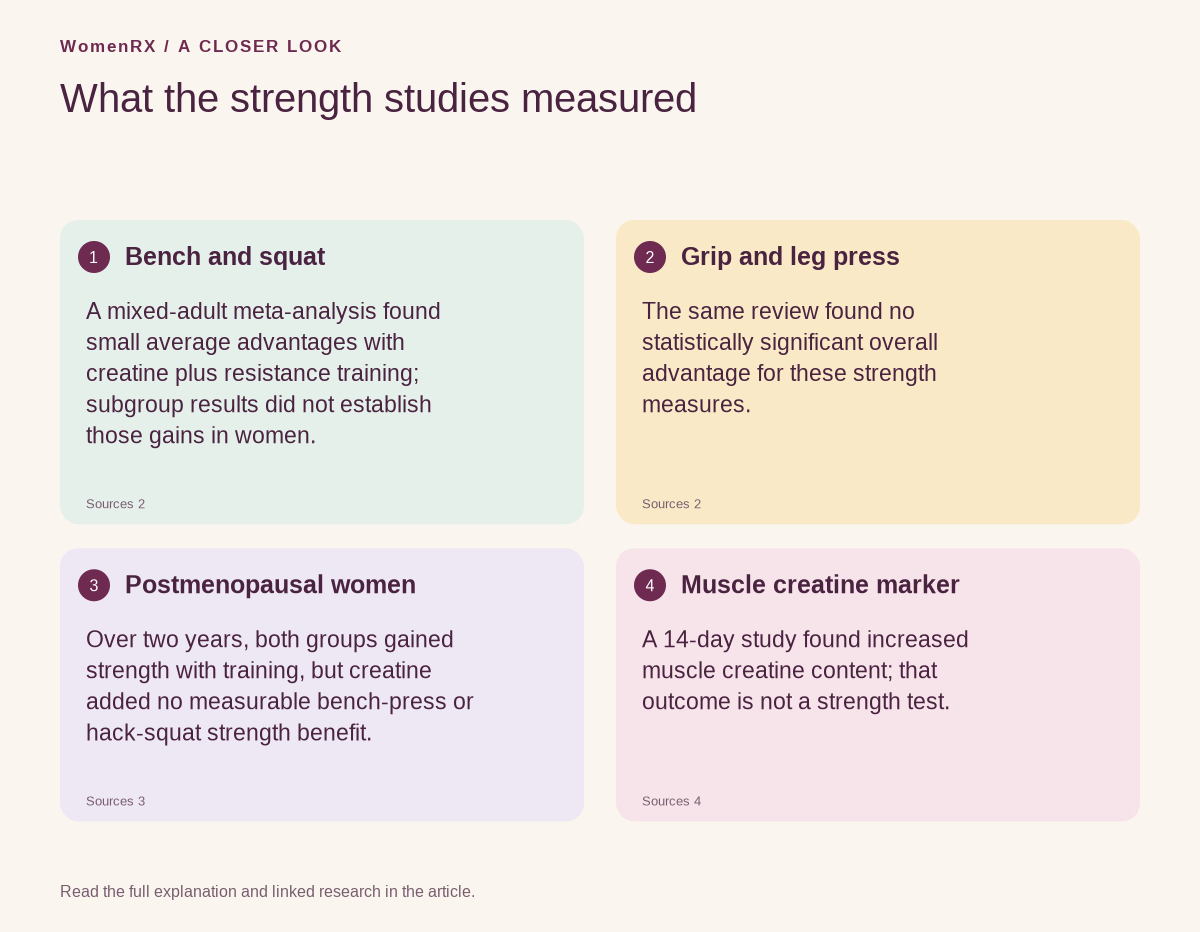
What the strength studies measured
Bench and squat: A mixed-adult meta-analysis found small average advantages with creatine plus resistance training; subgroup results did not establish those gains in women.2
Grip and leg press: The same review found no statistically significant overall advantage for these strength measures.2
Postmenopausal women: Over two years, both groups gained strength with training, but creatine added no measurable bench-press or hack-squat strength benefit.3
Muscle creatine marker: A 14-day study found increased muscle creatine content; that outcome is not a strength test.4
Read the figure as text
These examples show why a result for one test or population may not answer whether creatine improves strength for women generally.- Bench and squat: A mixed-adult meta-analysis found small average advantages with creatine plus resistance training; subgroup results did not establish those gains in women.2
- Grip and leg press: The same review found no statistically significant overall advantage for these strength measures.2
- Postmenopausal women: Over two years, both groups gained strength with training, but creatine added no measurable bench-press or hack-squat strength benefit.3
- Muscle creatine marker: A 14-day study found increased muscle creatine content; that outcome is not a strength test.4
Sources you can check
- Effects of high-load, velocity-intentional variable resistance training combined with creatine supplementation on neuroplasticity, oxidative stress, inflammation, physical function, cognitive performance and quality of life in older adults: A randomized, double-blind, placebo-controlled trial.Fernandez-Garrido J, Martin EG, Saez-Berlanga A, Gargallo-Bayo P, Gene-Morales J, Alix-Fages C, Jiménez-Martínez P, Caballero O, Salvador-Palmer R, Colado JC. · Experimental gerontology · 2026Return to first citation
- The Effects of Creatine Supplementation on Upper- and Lower-Body Strength and Power: A Systematic Review and Meta-Analysis.Kazeminasab F, Kerchi AB, Sharafifard F, Zarreh M, Forbes SC, Camera DM, Lanhers C, Wong A, Nordvall M, Bagheri R, Dutheil F. · Nutrients · 2025Return to first citation
- A 2-yr Randomized Controlled Trial on Creatine Supplementation during Exercise for Postmenopausal Bone Health.Chilibeck PD, Candow DG, Gordon JJ, Duff WRD, Mason R, Shaw K, Taylor-Gjevre R, Nair B, Zello GA. · Medicine and science in sports and exercise · 2023Return to first citation
- Creatine Monohydrate Supplementation, but not Creatyl-L-Leucine, Increased Muscle Creatine Content in Healthy Young Adults: A Double-Blind Randomized Controlled Trial.Askow AT, Paulussen KJM, McKenna CF, Salvador AF, Scaroni SE, Hamann JS, Ulanov AV, Li Z, Paluska SA, Beaudry KM, De Lisio M, Burd NA. · International journal of sport nutrition and exercise metabolism · 2022Return to first citation
- Supplement-based nutritional strategies to tackle frailty: A multifactorial, double-blind, randomized placebo-controlled trial.Roschel H, Hayashi AP, Fernandes AL, Jambassi-Filho JC, Hevia-Larraín V, de Capitani M, Santana DA, Gonçalves LS, de Sá-Pinto AL, Lima FR, Sapienza MT, Duarte AJS, Pereira RMR, Phi... · Clinical nutrition (Edinburgh, Scotland) · 2021Return to first citation