Does Creatine Help Women Build Muscle?
Creatine may add a modest boost to resistance-training gains for postmenopausal women, but a lean-mass reading isn’t the same as a direct measure of muscle size.
In postmenopausal women, studies suggest creatine can add to resistance-training gains in lean mass and some strength measures. The average lean-mass difference in one meta-analysis was small, and individual trials didn’t all find an added benefit. These studies measured outcomes such as lean mass and lifting strength, not simply how much larger muscles became. Evidence is less specific for younger women. 1 3
A “muscle gain” can mean several things
Creatine may support gains from resistance training, but the result depends on what a study measures. Lean mass, muscle size, strength in a particular lift, and everyday physical function are related, but they aren’t interchangeable outcomes.
In particular, a lean-mass result doesn’t directly show how much new contractile muscle a person gained. Creatine may increase water within muscle, so a higher lean-mass reading shouldn’t automatically be read as larger muscle fibers. Strength tests add another perspective, but a better one-repetition maximum in a leg press or bench press is evidence about that lift, not a direct measure of muscle size or everyday function. 1 2
What studies in older women found
A 24-week randomized trial compared creatine, resistance training, both together, and neither in older women. The group taking creatine while training had a greater increase in appendicular lean mass than each of the other groups. For leg-press strength, the combined group improved by 19.9%, compared with 15% in the training-only group, but that difference between the two groups wasn’t statistically significant. Bench-press strength improved more in the combined group than in the other groups. So the trial found an added benefit for some outcomes, not every measure of strength. 1
A systematic review and meta-analysis of seven randomized trials in postmenopausal women found an average 0.37 kg greater change in lean mass with creatine across five trials involving 338 women. The confidence interval was 0.05 to 0.69 kg. Across three trials involving 111 women, leg-press strength was an average 7.5 kg higher with creatine; the confidence interval was 2.2 to 12.8 kg. These are pooled averages, not a forecast for an individual. The review found that benefits were most evident when creatine was paired with resistance training, while results varied between individual trials. 3
That variation matters. In the postmenopausal review, one trial found added gains with resistance training, while another using elastic-band training did not find an added effect on muscle mass or function. The studies don’t establish that one type of training explains the difference. They do show why a result from one routine shouldn’t be treated as a promise for all routines. 3
How far do the findings reach?
The women-specific findings here come from older or postmenopausal participants. They don’t establish whether creatine’s effects differ in younger women who still have menstrual cycles, or whether cycle stage changes the response. The postmenopausal review reported a small average lean-mass benefit, but its risk-of-bias assessment found that most trials had some concerns, and the pooled estimate doesn’t mean every study or participant had the same result. 1 3
A broader meta-analysis of 22 resistance-training trials in older adults found an average 1.37 kg greater increase in lean tissue with creatine, as well as improvements in chest- and leg-press strength. Those studies included both men and women, so the overall estimate can’t tell you the effect specifically in women. 2
For your own goal, match the outcome to the question you care about. If you want to know whether you’re getting stronger, a strength result is more relevant than a change in lean mass alone. If you’re asking whether creatine makes muscles visibly larger, the women-specific findings described here don’t directly answer that: they focus on lean mass, strength, and function rather than directly measured muscle size. 1 3
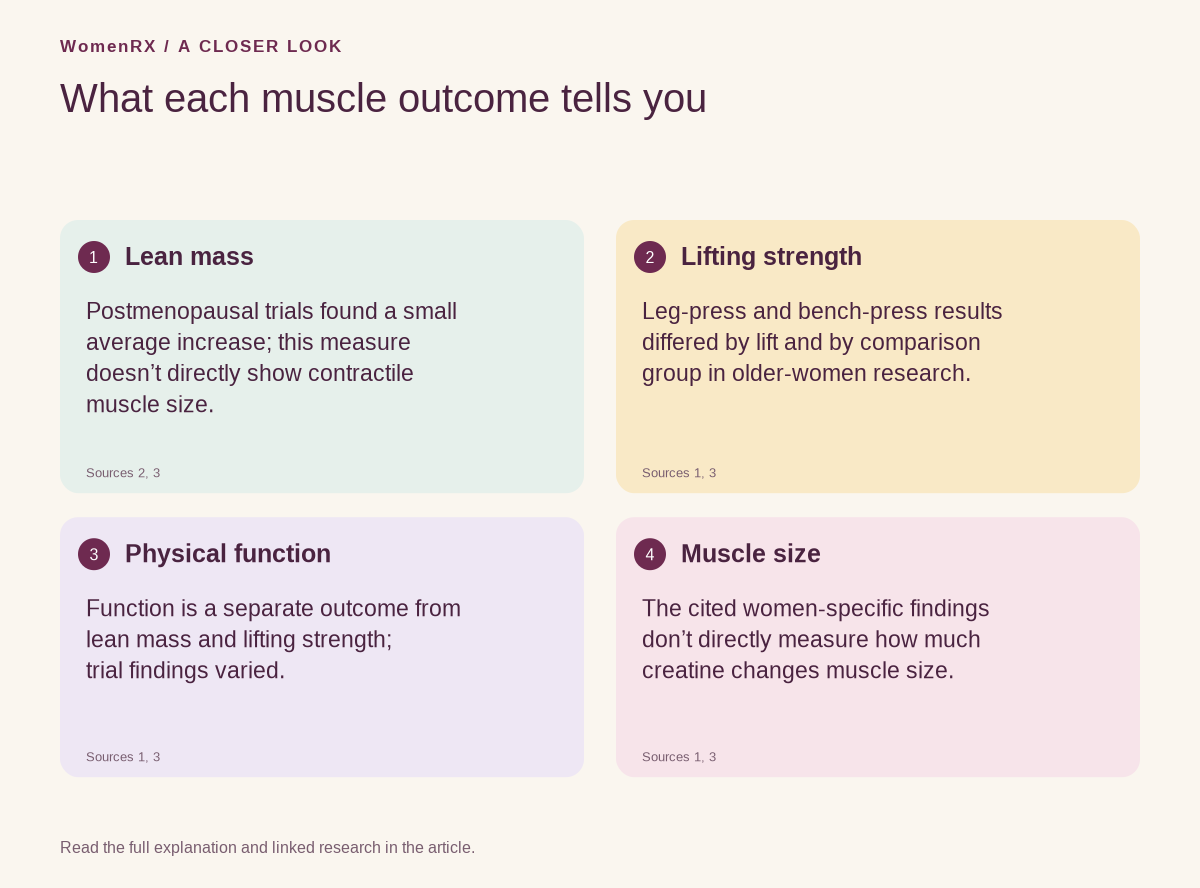
What each muscle outcome tells you
Lean mass: Postmenopausal trials found a small average increase; this measure doesn’t directly show contractile muscle size.23
Lifting strength: Leg-press and bench-press results differed by lift and by comparison group in older-women research.13
Physical function: Function is a separate outcome from lean mass and lifting strength; trial findings varied.13
Muscle size: The cited women-specific findings don’t directly measure how much creatine changes muscle size.13
Read the figure as text
Creatine studies measure different outcomes. This comparison shows what each result can indicate, and what it doesn’t establish by itself.- Lean mass: Postmenopausal trials found a small average increase; this measure doesn’t directly show contractile muscle size.23
- Lifting strength: Leg-press and bench-press results differed by lift and by comparison group in older-women research.13
- Physical function: Function is a separate outcome from lean mass and lifting strength; trial findings varied.13
- Muscle size: The cited women-specific findings don’t directly measure how much creatine changes muscle size.13
More questions, answered
Does a lean-mass increase mean I gained that much muscle?
Not necessarily. Lean mass isn’t a direct measurement of contractile muscle size, and creatine may increase water within muscle. It’s useful to consider the result alongside strength or function outcomes rather than treating it as a precise measure of new muscle tissue. 1 2
Do these findings apply to women who still have periods?
The women-specific trial and meta-analysis described here focus on older or postmenopausal women. They don’t establish whether the effects differ for women who still have menstrual cycles or by cycle stage. 1 3
Sources you can check
- Creatine supplementation and resistance training in vulnerable older women: a randomized double-blind placebo-controlled clinical trial.Gualano B, Macedo AR, Alves CR, Roschel H, Benatti FB, Takayama L, de Sá Pinto AL, Lima FR, Pereira RM. · Experimental gerontology · 2014Return to first citation
- Effect of creatine supplementation during resistance training on lean tissue mass and muscular strength in older adults: a meta-analysis.Chilibeck PD, Kaviani M, Candow DG, Zello GA. · Open access journal of sports medicine · 2017Return to first citation
- Creatine monohydrate for lean mass, strength, and bone density in postmenopausal women: a systematic review and meta-analysis.Naddafha S, Antonio J, Kreider RB, Stout JR. · Journal of the International Society of Sports Nutrition · 2026Return to first citation