Creatine and Muscle Size: What Changes, and When
Creatine can affect water and lean-mass measurements, but a change on the scale isn’t the same as gaining body fat or suddenly looking bulky.
Creatine research measures body water, body composition, strength, and function rather than whether someone looks bulkier. Some trials found changes in water or lean-mass measurements; another found no significant body-weight change. Longer-term research suggests creatine can add to lean-tissue gains when paired with resistance training, but these findings can’t predict how any one woman will look. 2 4 6
The scale can change for more than one reason
A scale measures your total body weight, which includes water, fat, muscle, and bone. So a change in weight after starting creatine, by itself, can’t tell you what changed or whether your appearance will change. 1
In a four-week randomized trial of 20 physically active vegans, the creatine group had a greater increase in total body water than the placebo group, alongside a smaller increase in measured skeletal muscle mass. The study included five women in each group, but it was small and specific to vegan adults; it can’t tell us how much weight or visible change an individual woman should expect. 2
Other results show why it’s better not to assume everyone will see a scale increase. In a six-week trial of 20 healthy young adults, including four women in each group, neither the creatine nor placebo group had significant pre-to-post changes in body mass, total body water, or the other listed body-composition measures. 4
Water-related weight isn’t body fat. And a change in a body-composition reading called “lean mass” isn’t necessarily all new contractile muscle: in a study of people with rheumatoid arthritis, the increase in lean mass occurred alongside an increase in intracellular water. That finding comes from a specific clinical population, so it shouldn’t be treated as a prediction for healthy women. 3
Training changes what longer-term studies can tell you
Creatine and resistance training are often studied together. In a meta-analysis of 22 randomized trials involving 721 older adults, both men and women, creatine taken during resistance training was associated with an average 1.37 kg greater increase in lean tissue mass than placebo over studies lasting 7 to 52 weeks. That pooled result is a group average, not a personal forecast; the combined-sex finding cannot establish the size of the effect in women specifically. 6
A 24-week trial focused specifically on vulnerable older women illustrates the role of training. The group combining creatine with resistance training increased appendicular lean mass more than the placebo, creatine-only, and placebo-plus-training groups. Changes in fat mass didn’t significantly differ between groups. Some strength results favored the combined group, but not every comparison did: for leg-press strength, its increase wasn’t significantly different from the placebo-plus-training group. 5
These studies help distinguish a possible water-related scale change from gradual adaptation during training. They don’t establish what a particular appearance change would be, or that every extra unit of measured lean mass is new muscle tissue. The training program, study duration, population, and measurement method all matter when interpreting results. 3 5 6
What this means for your appearance goals
If your main concern is looking bulkier, the studies discussed above can’t tell you whether you would look different: they measured body composition, water, strength, or function, not appearance. Some people may notice a change in body weight; others may not. 2 4 5
A useful way to interpret a change is to separate three questions: Did your scale weight change? Did a body-composition measure change, and what exactly did it measure? Did your strength or training performance change over time? Those are related questions, but they aren’t interchangeable. For example, a short-term increase in total body water does not establish fat gain, and a longer-term lean-mass difference in a training study doesn’t tell you how visible the change will be. 1 2 6
Among the studies discussed above, the women-only trial involved vulnerable older women. The cited findings from mixed-sex studies are combined results, so they cannot establish a women-specific effect. Together, these findings don’t establish a special response for women or show whether effects differ across cycling years, perimenopause, postmenopause, pregnancy, or postpartum. 2 4 5 6
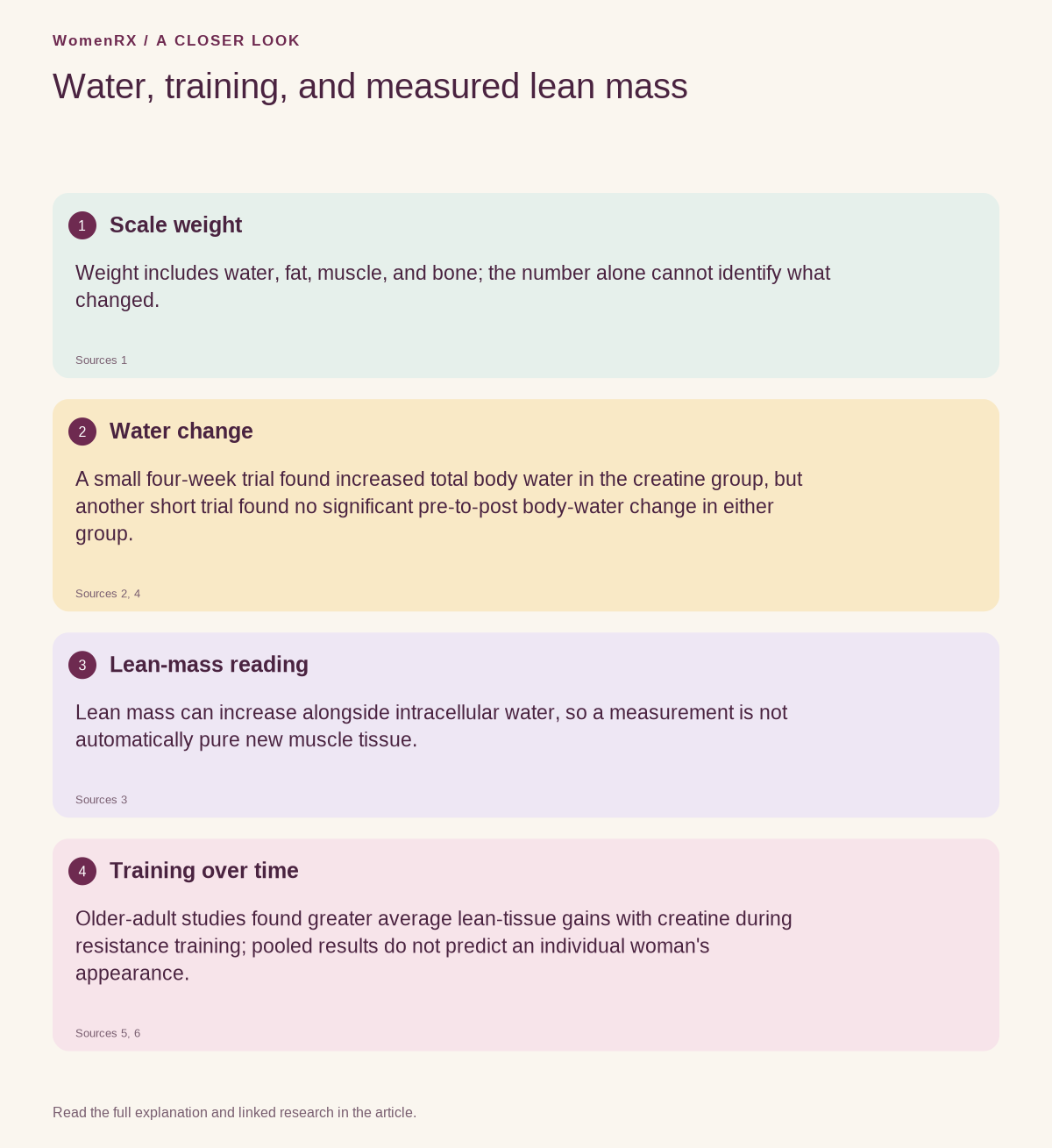
Water, training, and measured lean mass
Scale weight: Weight includes water, fat, muscle, and bone; the number alone cannot identify what changed.1
Water change: A small four-week trial found increased total body water in the creatine group, but another short trial found no significant pre-to-post body-water change in either group.24
Lean-mass reading: Lean mass can increase alongside intracellular water, so a measurement is not automatically pure new muscle tissue.3
Training over time: Older-adult studies found greater average lean-tissue gains with creatine during resistance training; pooled results do not predict an individual woman's appearance.56
Read the figure as text
These are related but distinct ways a body or a measurement may change. The figure separates scale weight from water shifts and longer-term training outcomes.- Scale weight: Weight includes water, fat, muscle, and bone; the number alone cannot identify what changed.1
- Water change: A small four-week trial found increased total body water in the creatine group, but another short trial found no significant pre-to-post body-water change in either group.24
- Lean-mass reading: Lean mass can increase alongside intracellular water, so a measurement is not automatically pure new muscle tissue.3
- Training over time: Older-adult studies found greater average lean-tissue gains with creatine during resistance training; pooled results do not predict an individual woman's appearance.56
More questions, answered
Does a higher scale reading mean I gained fat?
Not necessarily. Body weight includes water as well as fat, muscle, and bone. A scale reading alone can’t identify which component changed. 1
Do studies show the same results for women at every life stage?
These findings don’t establish that. One trial studied vulnerable older women; the cited findings from mixed-sex studies give combined results that cannot establish an effect for women specifically. They also cannot tell us whether responses differ during cycling years, perimenopause, postmenopause, pregnancy, or postpartum. 2 4 5 6
Sources you can check
- Body Weight: MedlinePlusAccessed 2026-09-25Return to first citation
- Does creatine supplementation improve strength and power in physically active individuals on a vegan diet? a randomized, triple-blind, placebo-controlled trial.López-Moreno M, Muñoz A, Aguilar-Navarro M, Gutiérrez-Hellín J, Franco-Andrés A, López-López P, Crespo-Cañizares A, Marrero-Fernández P, Forbes SC. · European journal of applied physiology · 2026Return to first citation
- Can Creatine Supplementation Improve Body Composition and Objective Physical Function in Rheumatoid Arthritis Patients? A Randomized Controlled Trial.Wilkinson TJ, Lemmey AB, Jones JG, Sheikh F, Ahmad YA, Chitale S, Maddison PJ, O'brien TD. · Arthritis care & research · 2016Return to first citation
- Low-dose creatine supplementation enhances fatigue resistance in the absence of weight gain.Rawson ES, Stec MJ, Frederickson SJ, Miles MP. · Nutrition (Burbank, Los Angeles County, Calif.) · 2011Return to first citation
- Creatine supplementation and resistance training in vulnerable older women: a randomized double-blind placebo-controlled clinical trial.Gualano B, Macedo AR, Alves CR, Roschel H, Benatti FB, Takayama L, de Sá Pinto AL, Lima FR, Pereira RM. · Experimental gerontology · 2014Return to first citation
- Effect of creatine supplementation during resistance training on lean tissue mass and muscular strength in older adults: a meta-analysis.Chilibeck PD, Kaviani M, Candow DG, Zello GA. · Open access journal of sports medicine · 2017Return to first citation