Creatine and Weight Loss: Read Beyond the Scale
Creatine can add to body weight during resistance training without a significant change in fat mass, so the scale alone can’t show whether you’ve lost fat.
Creatine isn’t established as a stand-alone fat-loss aid. In a meta-analysis, people doing resistance training gained more lean mass and body weight with creatine than with training alone, but the difference in fat mass wasn’t significant. So a higher scale reading doesn’t automatically mean fat gain, and it can’t tell you how much changed in fat, lean tissue, or water. 21
A scale reading is total weight, not a body-composition report
Your body weight includes fat, muscle, bone, and water. A scale combines them into one number; it can’t show which component changed. 1 That matters if you start creatine while training: a change in total weight, by itself, doesn’t tell you whether fat mass went up or down.
Water is one part of body weight, but the research discussed below doesn’t show how much of an individual person’s weight change after starting creatine is water. The more useful point is that studies have found changes in lean mass and total weight without finding a significant difference in fat mass.
What the creatine and training studies found
A meta-analysis combined 63 studies with 1,489 participants. Compared with resistance training alone, resistance training plus creatine led to greater increases in lean mass and body weight. The difference in fat mass was not statistically significant, while body-fat percentage fell slightly. 2
Those outcomes aren’t interchangeable. Fat mass is an estimate of the amount of fat; body-fat percentage describes fat relative to total body mass. If lean mass increases, the percentage can fall even when a study doesn’t find a clear difference in fat mass. The meta-analysis therefore doesn’t show that creatine directly burns fat. It shows a change in body composition when creatine is added to resistance training, with no significant fat-mass difference versus training alone. 2
That comparison also sets a boundary on the weight-loss claim: the meta-analysis tested creatine alongside resistance training, not creatine as a stand-alone way to lose weight. Its findings fit better with creatine as a training supplement than as a direct fat-loss aid. 2
What to compare when fat loss is your goal
Scale weight tells you about total body mass. It’s useful as one measure, but it can’t identify fat loss or gain on its own. 1
Fat mass is more directly related to the question “Did my amount of body fat change?” In the meta-analysis, creatine plus resistance training did not produce a statistically significant difference in fat mass compared with training alone. 2
Lean mass is a separate body-composition outcome. The meta-analysis found a greater increase in lean mass with creatine plus training. That may help explain why total weight can rise without a clear increase in fat mass, but it doesn’t mean that weight alone reveals what happened. 2
Waist circumference can add another perspective: MedlinePlus notes that fat concentrated around the abdomen is relevant to health risk. It isn’t a direct measurement of total fat mass, so use it as a complement rather than a substitute for a body-composition measure. 1
For a practical read on progress, compare measures that match your goal rather than treating one scale reading as the verdict. If the goal is fat loss, look for information about fat mass where you have a reliable way to measure it; consider waist circumference as a separate measure, and keep training progress in view if maintaining strength or lean mass matters to you. These measures answer different questions, so they may not all move in the same direction.
What the studies can say about women
A 12-week randomized trial analyzed 64 adults ages 45 to 65, including 40 women. In the exercise-and-diet groups, participants lost fat, and those taking creatine gained fat-free mass; body-fat percentage fell more in the creatine-plus-exercise group than in the listed comparison groups. But the reported findings don’t separate women’s results from men’s, so they don’t establish a women-specific effect. 3
The larger meta-analysis explored whether participant characteristics, including gender, changed body-composition outcomes. It found no consistent moderators for those outcomes. Neither source answers whether menstrual-cycle timing, perimenopause, or menopause changes the scale or body-composition response to creatine. 23
The useful takeaway is straightforward: if your weight changes while you’re taking creatine and training, don’t label that change fat gain or fat loss based on the scale alone. The available training evidence points to a possible increase in lean mass and total weight, but not a significant difference in fat mass compared with training alone. 2
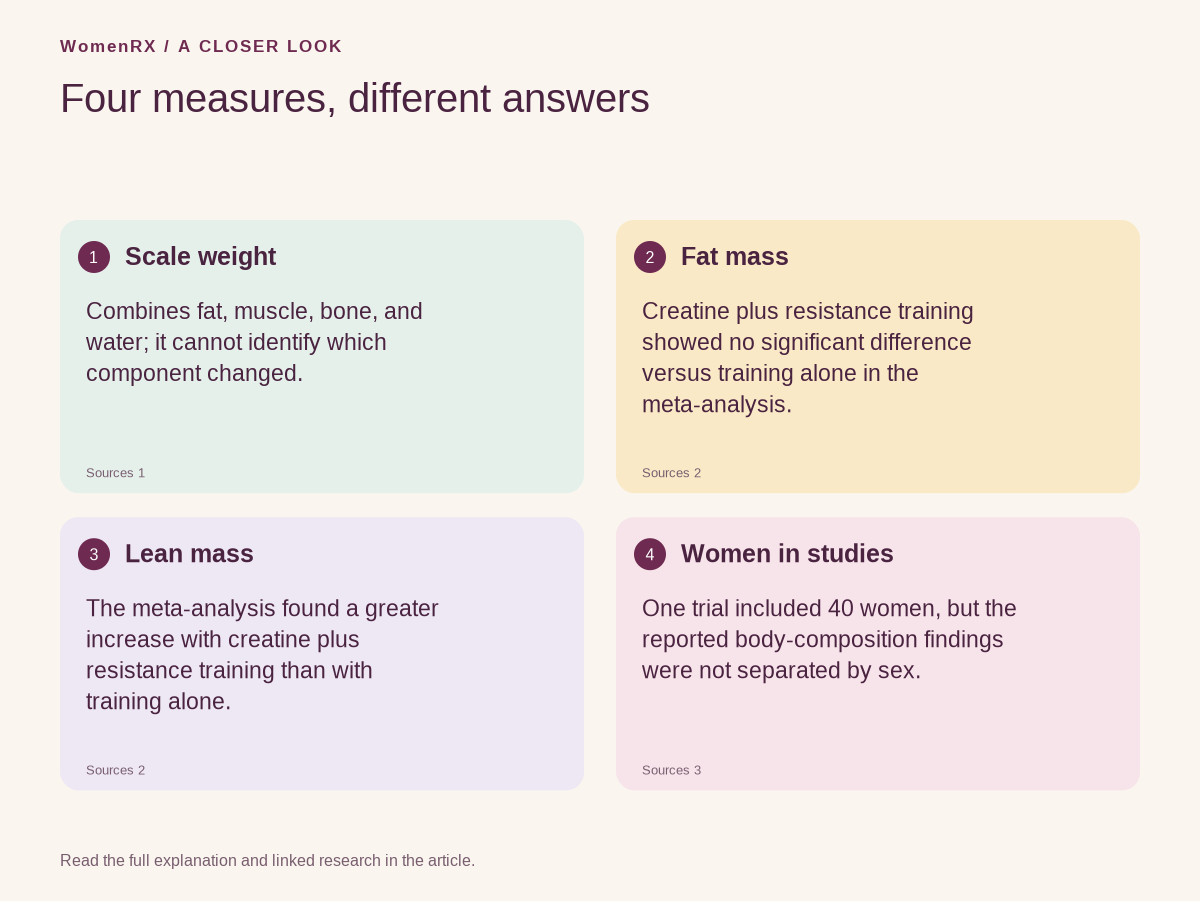
Four measures, different answers
Scale weight: Combines fat, muscle, bone, and water; it cannot identify which component changed.1
Fat mass: Creatine plus resistance training showed no significant difference versus training alone in the meta-analysis.2
Lean mass: The meta-analysis found a greater increase with creatine plus resistance training than with training alone.2
Women in studies: One trial included 40 women, but the reported body-composition findings were not separated by sex.3
Read the figure as text
Scale weight, fat mass, lean mass, and waist circumference describe different things. The creatine findings are from studies that paired the supplement with resistance training.- Scale weight: Combines fat, muscle, bone, and water; it cannot identify which component changed.1
- Fat mass: Creatine plus resistance training showed no significant difference versus training alone in the meta-analysis.2
- Lean mass: The meta-analysis found a greater increase with creatine plus resistance training than with training alone.2
- Women in studies: One trial included 40 women, but the reported body-composition findings were not separated by sex.3
Sources you can check
- Body Weight: MedlinePlusAccessed 2026-09-25Return to first citation
- Resistance training combined with creatine supplementation: a three-level meta-analysis of multidimensional outcomes from strength enhancement to body composition remodeling.Wang H, Wang H, Xin X, Yi Z. · Journal of the International Society of Sports Nutrition · 2026Return to first citation
- Effects of creatine supplementation with and without exercise and diet intervention on body composition, cognitive function, and markers of health in middle-aged and older adults.Chun J, Liu Y, Kibler GL, Lee H, Babakhani K, Rhoades N, Bivins I, Ko J, Dickerson B, Gonzalez DE, Sowinski RJ, Rasmussen CJ, Kreider RB. · Journal of the International Society of Sports Nutrition · 2026Return to first citation