Weight and Health in Your 60s: Look Beyond the Scale
A weight-loss goal makes the most sense when it supports your health and everyday abilities without crowding out strength, nourishment, or bone health.
Weight loss isn’t automatically helpful or harmful in your 60s. If you’re considering it, weigh the reason for the change against your strength, mobility, nutrition, health conditions, and bone health. Studies of some older adults with overweight or obesity suggest intentional, supervised weight loss may improve function and some health outcomes, but it can also affect muscle and bone. Weight loss you didn’t intend deserves a different conversation than a planned goal. 4 5
Start with why your weight is changing
A planned effort to lose weight and weight loss that happens without trying aren’t the same situation. In a review of research on older adults, unintentional loss was more likely to be related to coexisting illness and to affect metabolically active tissue, including muscle, more than fat. If you’re losing weight unexpectedly, tell your clinician rather than assuming it’s a successful diet. 4
If you’re considering intentional weight loss, begin with the health or daily-life concern you hope it will address. For example, you might be weighing weight management against a condition you live with, or asking whether moving around would feel easier. Studies of older adults with overweight or obesity describe possible benefits for physical function and cardiometabolic health, alongside potential effects on muscle and bone. 4 5
Ask what you want to protect
Think about the abilities that matter in your ordinary week: walking your usual route, climbing stairs, carrying groceries, or getting up from a chair. These are examples to make the discussion concrete, not a diagnostic test. The older-adult review describes maintaining muscle strength as particularly relevant to preventing functional decline. It also reports that supervised weight-loss interventions in older adults with overweight or obesity have improved function and quality-of-life outcomes. 4
Bone health belongs in the same conversation. Bone density tends to decrease with age, and lower density can mean weaker bones and a greater chance of fracture. Reviews of intentional weight loss in older adults with overweight or obesity have found bone-related downsides; resistance exercise alongside weight loss may help mitigate loss of bone and muscle, though it doesn’t make the tradeoff disappear. 1 5
If you’re postmenopausal, that doesn’t dictate one weight goal. It does make it reasonable to include your bone health and personal fracture-risk history in an individualized discussion. A bone-density scan can measure bone density and help assess fracture risk. 1
Make room for nourishment and strength
Older adults may need fewer calories than when they were younger, while still needing enough nutrients; some need more protein. That makes a restrictive approach worth examining for what it leaves you able to eat, not just what it removes. Ask how a weight-management plan would preserve a balanced diet and support your strength, especially if your appetite, chewing, swallowing, or ability to prepare meals has changed. 2
Resistance training is a useful part of the discussion when weight loss is planned. A review of older-adult research reports benefits of resistance training for strength and notes that strength maintenance matters for function. The exact activity that fits depends on your health and abilities. If you’ve been diagnosed with osteoporosis, talk with your clinician before starting a new exercise program to make sure it’s suitable for you. 4 3
A practical way to weigh the decision
Before making a plan, try putting the conversation in four parts:
- Reason: What health concern or daily-life goal is prompting weight loss?
- Function: What abilities do you want to maintain or improve?
- Nourishment: Can you still eat a balanced diet and get enough nutrients?
- Health context: Have you had weight loss without trying, a recent medication change, or a condition that could affect eating, strength, or bone health?
Bring a list of medications and recent changes to the conversation. Ask whether any might be relevant to your weight change, without assuming a medicine is the cause. That question is particularly useful if the change was unplanned or if eating or physical function has shifted.
A reasonable goal is personal, not automatic. For some older adults with overweight or obesity, intentional weight loss under clinical supervision may improve function or cardiometabolic health. For others, protecting strength, nutrition, or bone health may take priority. Consider the outcome you care about, not only what the scale says. 4 2
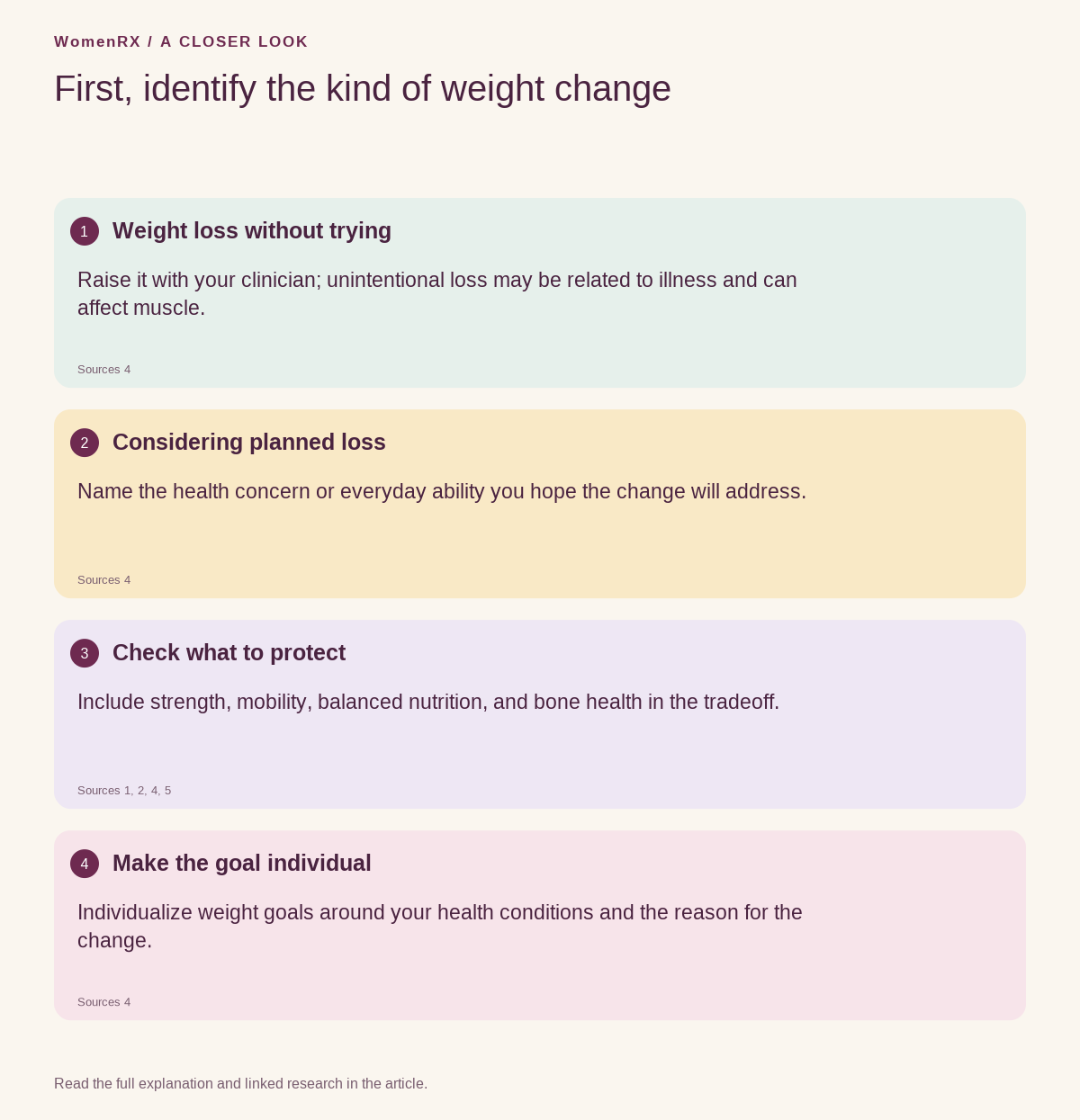
First, identify the kind of weight change
Weight loss without trying: Raise it with your clinician; unintentional loss may be related to illness and can affect muscle.4
Considering planned loss: Name the health concern or everyday ability you hope the change will address.4
Check what to protect: Include strength, mobility, balanced nutrition, and bone health in the tradeoff.1245
Make the goal individual: Individualize weight goals around your health conditions and the reason for the change.4
Read the figure as text
A short decision path separates unplanned weight loss from an intentional goal, then brings function, nourishment, and bone health into the discussion.- Weight loss without trying: Raise it with your clinician; unintentional loss may be related to illness and can affect muscle.4
- Considering planned loss: Name the health concern or everyday ability you hope the change will address.4
- Check what to protect: Include strength, mobility, balanced nutrition, and bone health in the tradeoff.1245
- Make the goal individual: Individualize weight goals around your health conditions and the reason for the change.4
More questions, answered
Should everyone try to lose weight in their 60s?
No. Research in older adults with overweight or obesity describes potential benefits as well as possible muscle and bone costs; it doesn’t establish one goal for everyone. The reason for weight change, health conditions, nutrition, and function all matter. 4 5
What if I’m losing weight without trying?
Treat that differently from a planned weight-loss goal and bring it up with your clinician. Research reviews note that unintentional loss in older adults may be related to coexisting illness and can affect muscle. 4
Sources you can check
- Bone Density | Bone Mineral Density | BMD | MedlinePlusAccessed 2026-09-25Return to first citation
- Nutrition for Older Adults: MedlinePlusAccessed 2026-09-25Return to first citation
- Osteoporosis - Prevention - NHSAccessed 2026-09-25Return to first citation
- Obesity pharmacotherapy in older adults: a narrative review of evidence.Henney AE, Wilding JPH, Alam U, Cuthbertson DJ. · International journal of obesity (2005) · 2025Return to first citation
- Is Weight Loss Harmful for Skeletal Health in Obese Older Adults?Papageorgiou M, Kerschan-Schindl K, Sathyapalan T, Pietschmann P. · Gerontology · 2020Return to first citation