Weight and Health in Your 50s: Menopause, Muscle, and Individual Differences
A scale shows total weight, not whether that change reflects fat, muscle, fluid, or a shift in strength and health.
Weight changes in your 50s are worth interpreting alongside menopause symptoms and history, activity, health conditions, and medications, not as a menopause effect by default. Scale weight is only one measure: waist size, strength, daily function, and health markers can add context. 1 Menopausal hormone therapy can help with certain menopause symptoms and prevent bone loss, but shouldn’t be used to treat central obesity. 3 4
Start with more than the scale
Body weight combines fat, muscle, bone, and water. It can show that something has changed, but not what changed. BMI has similar limits: it doesn’t distinguish fat from muscle or bone. Waist circumference and health history can add useful context, particularly because fat carried around the abdomen is associated with higher risk of heart disease and type 2 diabetes. 1
A change on the scale can matter, but it isn’t the whole health story. For example, if your weight is steady while lifting, carrying groceries, or getting up from a chair feels harder, strength and function deserve attention too. If your clothes fit differently but your weight hasn’t changed, body composition may be one part of the picture. Those examples are prompts for considering what has changed, not diagnostic tests.
Menopause can be part of the picture, not the whole explanation
Midlife weight and fat distribution can be influenced by aging, changing estrogen levels after menopause, and other factors. Central fat distribution is common in midlife, but that does not mean every woman will gain weight or experience the same changes. A review of midlife research specifically cautions against using menopausal hormone therapy to treat central obesity. 3
It’s more useful to consider your actual menopause history and symptoms than to assume that age alone explains a change. Research comparing premenopausal, perimenopausal, and postmenopausal women has reported differences in lean mass and abdominal fat, but one retrospective study can’t establish that menopause caused those differences. Age and lifestyle may also have contributed. 6
Sleep disruption or mood symptoms can also make healthy routines harder to maintain, according to the midlife review. That gives you a practical distinction: if symptoms are affecting sleep or daily life, they may deserve attention in their own right, even if weight is not the main concern. 3
Look at strength and function alongside body composition
A small randomized trial followed 55 healthy postmenopausal women for 12 weeks. The groups assigned to resistance training increased measured skeletal muscle mass and strength; adding a high-protein diet did not show a clear extra benefit over training alone in this study. The result supports paying attention to strength, not just pounds, but it doesn’t establish one program or diet as best for every woman. 5
You can think about function in everyday terms: has your ability to carry, climb, lift, or rise from a chair changed? These aren’t substitutes for a formal assessment. They can help clarify whether your priority is changing weight, preserving or rebuilding strength, or understanding a new limitation.
Don’t treat weight loss as automatically beneficial without considering the broader context, including muscle and bone health. In a prospective study of 18,326 middle-aged women, self-reported weight loss since age 20 was associated with later fracture risk. The study did not report whether the weight loss was intentional, and this observational finding does not show that intentional weight loss, or weight loss itself, caused fractures. 2
Match the next step to the change you notice
If the change is gradual, it may help to compare several kinds of information over time: weight, waist fit or measurement, strength and daily function, menopause symptoms, activity, health conditions, and medicines. BMI or weight alone can miss changes in muscle and fat distribution. 1
If weight is changing suddenly or without trying, MedlinePlus advises talking with a health care provider. Some medicines can contribute to unexpected weight loss, and heart failure is one possible cause of sudden weight gain. The next useful step is to review the change and your health context, rather than assuming menopause is responsible. 1
If you’re considering menopausal hormone therapy, separate that decision from a weight-loss goal. The North American Menopause Society’s position statement describes hormone therapy as an effective treatment for bothersome hot flashes and genitourinary symptoms and as a way to prevent bone loss and fracture. It recommends individualizing treatment based on benefits and risks; the midlife weight review says hormone therapy shouldn’t be used to treat central obesity. 3 4
A useful question to bring to a conversation about your health is: “Which change matters most for my health right now: weight, waist, strength, function, symptoms, or a health marker?” That can make the next step more specific than a goal based on the scale alone.
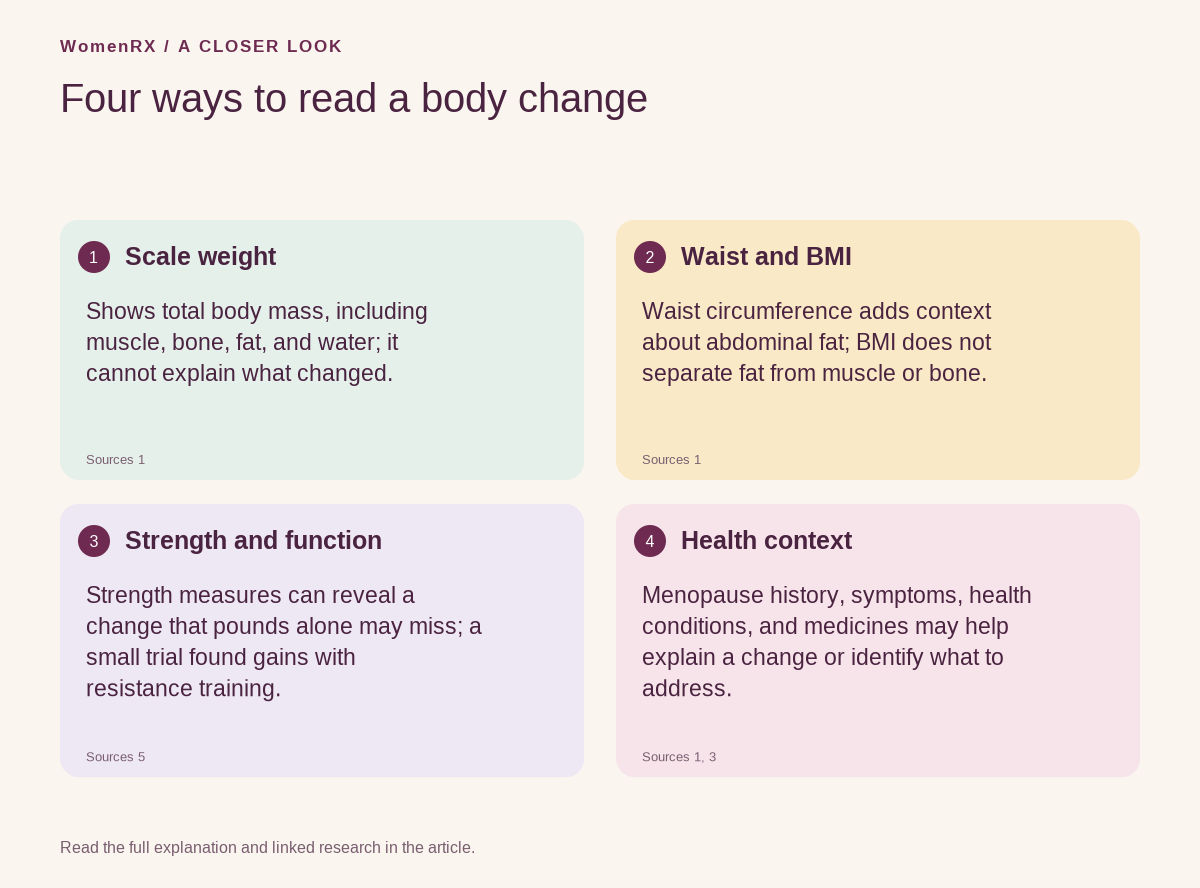
Four ways to read a body change
Scale weight: Shows total body mass, including muscle, bone, fat, and water; it cannot explain what changed.1
Waist and BMI: Waist circumference adds context about abdominal fat; BMI does not separate fat from muscle or bone.1
Strength and function: Strength measures can reveal a change that pounds alone may miss; a small trial found gains with resistance training.5
Health context: Menopause history, symptoms, health conditions, and medicines may help explain a change or identify what to address.13
Read the figure as text
Scale weight is one signal. These measures can help distinguish a change in total weight from shifts in body composition, function, or health context.- Scale weight: Shows total body mass, including muscle, bone, fat, and water; it cannot explain what changed.1
- Waist and BMI: Waist circumference adds context about abdominal fat; BMI does not separate fat from muscle or bone.1
- Strength and function: Strength measures can reveal a change that pounds alone may miss; a small trial found gains with resistance training.5
- Health context: Menopause history, symptoms, health conditions, and medicines may help explain a change or identify what to address.13
More questions, answered
Does menopause hormone therapy help with weight loss?
Menopausal hormone therapy shouldn’t be used as a treatment for central obesity. It may be considered for bothersome menopause symptoms or prevention of bone loss, with benefits and risks assessed individually. 3 4
What if my weight changes without trying?
A sudden, unexpected gain or loss is a reason to talk with a health care provider. Weight alone can’t identify the cause, and health conditions or medicines may be relevant. 1
Sources you can check
- Body Weight: MedlinePlusAccessed 2026-09-25Return to first citation
- Early menopause and weight loss are significant factors associated with risk of future fracture in middle-aged women.Moberg L, Hamrefors V, Fedorowski A, Rogmark C. · BMC musculoskeletal disorders · 2022Return to first citation
- Weight Gain in Women at Midlife: A Concise Review of the Pathophysiology and Strategies for Management.Kapoor E, Collazo-Clavell ML, Faubion SS. · Mayo Clinic proceedings · 2017Return to first citation
- The 2022 hormone therapy position statement of The North American Menopause Society.“The 2022 Hormone Therapy Position Statement of The North American Menopause Society” Advisory Panel. · Menopause (New York, N.Y.) · 2022Return to first citation
- Analysis of combinatory effects of free weight resistance training and a high-protein diet on body composition and strength capacity in postmenopausal women - A 12-week randomized controlled trial.Ioannidou P, Dóró Z, Schalla J, Wätjen W, Diel P, Isenmann E. · The journal of nutrition, health & aging · 2024Return to first citation
- The Impact of the Menopausal Transition on Body Composition and Abdominal Fat Redistribution.Szeliga A, Chedraui P, Meczekalski B. · Journal of clinical medicine · 2026Return to first citation