Does Menopause Hormone Therapy Cause Weight Gain?
Trials don’t show one predictable weight effect across hormone therapy regimens, and some measured body fat as well as scale weight.
In the small comparative trials available, systemic menopause hormone therapy did not produce a consistent pattern of weight gain versus comparison groups. A two-year placebo-controlled trial found no between-group difference in weight or measured fat outcomes for one combination. Other studies tested different regimens and comparators, so their results can’t predict exactly what will happen with a different prescription. 456
What the comparison groups show
A change on the scale while you’re taking hormone therapy doesn’t, by itself, show that the medicine caused it. The more useful question is whether people assigned to a particular regimen changed differently from people assigned to placebo, no hormone therapy, or another regimen.
In a randomized, double-blind trial, 76 postmenopausal women were assigned to daily conjugated estrogens plus medroxyprogesterone acetate or placebo. The analysis included 51 women who completed the two-year study. Researchers found no difference between the groups over time in weight or in measured total, abdominal, and under-the-skin fat. This is a direct comparison with placebo, but it applies to that regimen and the women studied, not every hormone therapy prescription. 4
A different randomized study followed 246 menopausal women for one year, comparing two continuous combined regimens: conjugated estrogens with medroxyprogesterone acetate, or estradiol with norethindrone acetate. Both groups received hormone therapy, so the study can’t tell you how either regimen compares with no hormone treatment. Its abstract reports no weight gain recorded in the estradiol-norethindrone group. 5
A small, open-label, two-year study compared low-dose conjugated estrogens plus medroxyprogesterone acetate and calcium with calcium alone in 60 postmenopausal women aged 45 to 56. At the two-year assessment, 23 women in the hormone-therapy group and 15 in the control group remained. The hormone-therapy group had a 1.3% increase in body weight from baseline, which the study did not find statistically significant; the control group had a reported 3% weight gain. With substantial dropout and few women assessed at the end, these results are a limited basis for predicting an individual outcome. 6
One-year prescribing information for a different combination, estradiol plus levonorgestrel, reported weight gain as a treatment-emergent event in 6 of 212 women (2.8%), compared with 10 of 204 women (4.9%) taking estradiol alone. The study recorded events regardless of whether researchers considered them related to treatment. These figures describe reported events, not how much weight women gained or whether the combination caused it. 2
Weight and body shape aren’t the same measure
Scale weight includes more than fat. A weight result alone can’t tell you whether abdominal fat, fat under the skin, muscle, or another part of body composition changed. 1
That distinction matters when reading the two-year placebo-controlled trial: it measured several types of fat as well as weight, and found no difference between the treatment and placebo groups in those outcomes over time. Most of the other comparisons described above focused on weight, so they don’t answer the same body-composition question. 456
A practical takeaway when weighing treatment
Taken together, these studies don’t support a simple rule that systemic menopause hormone therapy causes weight gain. They also don’t establish that it prevents weight gain. The trials were relatively small and tested different combinations, comparison groups, and durations. The North American Menopause Society’s position statement likewise says hormone therapy’s overall risks vary with factors such as formulation, dose, route, duration, timing, and whether a progestogen is used. That reinforces why one study’s weight result shouldn’t be treated as a forecast for another regimen. 3
If weight or body shape changes after starting therapy, it’s reasonable to distinguish what you’ve noticed: a change on the scale, a change in how clothes fit around your waist, or both. Those observations aren’t interchangeable, and the available trials don’t establish that any one change is caused by treatment.
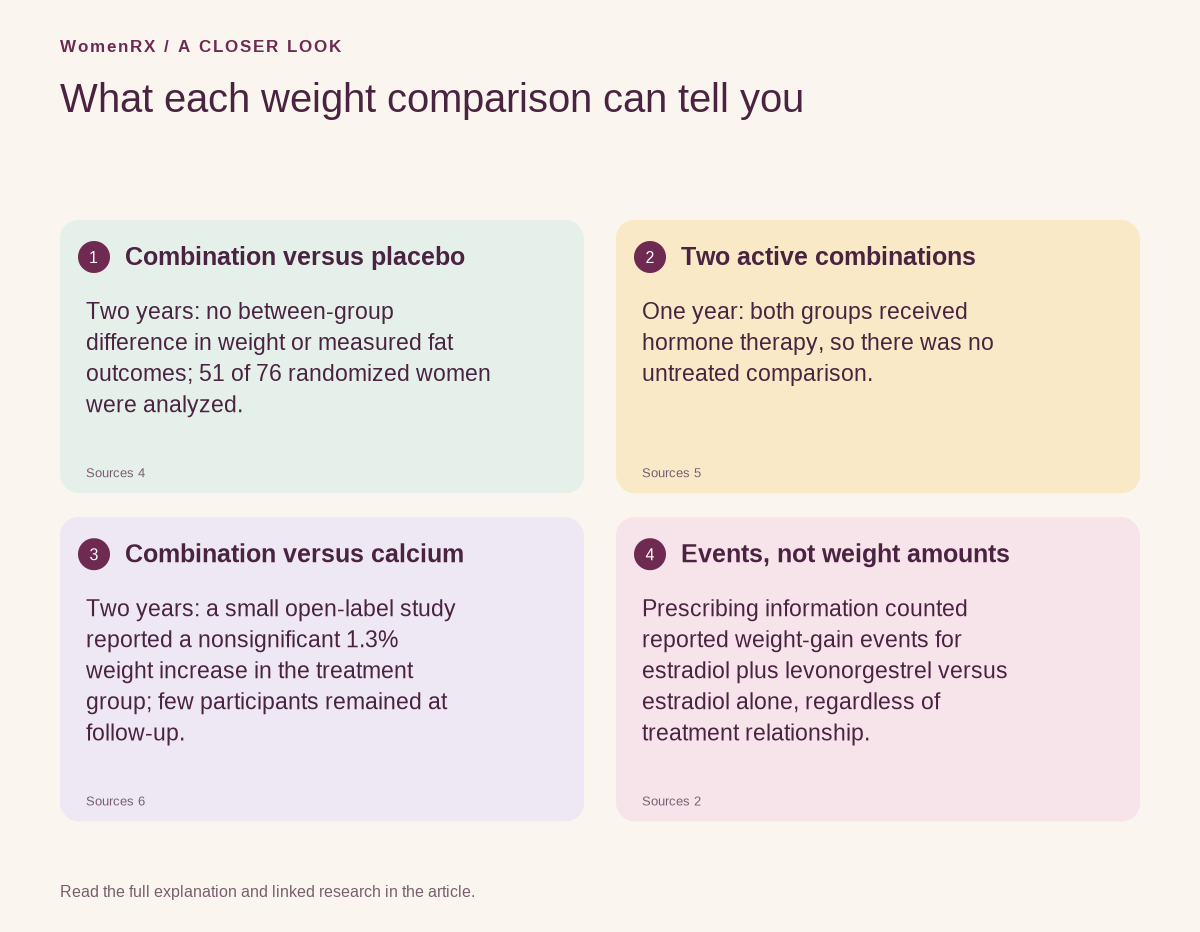
What each weight comparison can tell you
Combination versus placebo: Two years: no between-group difference in weight or measured fat outcomes; 51 of 76 randomized women were analyzed.4
Two active combinations: One year: both groups received hormone therapy, so there was no untreated comparison.5
Combination versus calcium: Two years: a small open-label study reported a nonsignificant 1.3% weight increase in the treatment group; few participants remained at follow-up.6
Events, not weight amounts: Prescribing information counted reported weight-gain events for estradiol plus levonorgestrel versus estradiol alone, regardless of treatment relationship.2
Read the figure as text
Treatment, comparator, duration, and measurement all shape how to interpret a study’s weight result.- Combination versus placebo: Two years: no between-group difference in weight or measured fat outcomes; 51 of 76 randomized women were analyzed.4
- Two active combinations: One year: both groups received hormone therapy, so there was no untreated comparison.5
- Combination versus calcium: Two years: a small open-label study reported a nonsignificant 1.3% weight increase in the treatment group; few participants remained at follow-up.6
- Events, not weight amounts: Prescribing information counted reported weight-gain events for estradiol plus levonorgestrel versus estradiol alone, regardless of treatment relationship.2
More questions, answered
Does hormone therapy prevent weight gain?
The comparative trials described here don’t establish that systemic hormone therapy reliably prevents weight gain. One small study found no significant weight increase from baseline in its treatment group, but its comparator, design, and participant dropouts limit what it can show. 6
Sources you can check
- Body Weight: MedlinePlusAccessed 2026-09-25Return to first citation
- CLIMARA PRO (ESTRADIOL AND LEVONORGESTREL) PATCH [BAYER HEALTHCARE PHARMACEUTICALS INC.] | US prescribing information and patient instructionsAccessed 2026-09-25Return to first citation
- The 2022 hormone therapy position statement of The North American Menopause Society.“The 2022 Hormone Therapy Position Statement of The North American Menopause Society” Advisory Panel. · Menopause (New York, N.Y.) · 2022Return to first citation
- The effect of hormone replacement therapy on body composition, body fat distribution, and insulin sensitivity in menopausal women: a randomized, double-blind, placebo-controlled trial.Sites CK, L'Hommedieu GD, Toth MJ, Brochu M, Cooper BC, Fairhurst PA. · The Journal of clinical endocrinology and metabolism · 2005Return to first citation
- Comparison of two forms of continuous combined hormone replacement therapy with respect to metabolic effects.Tugrul S, Yildirim G, Pekin O, Uslu H, Kutlu T, Eren S. · Archives of gynecology and obstetrics · 2007Return to first citation
- Effects of low-dose continuous combined conjugated estrogens and medroxyprogesterone acetate on menopausal symptoms, body weight, bone density, and metabolism in postmenopausal women.Gambacciani M, Ciaponi M, Cappagli B, Genazzani AR. · American journal of obstetrics and gynecology · 2001Return to first citation