Progesterone for Weight Loss: What the Evidence Shows
Progesterone has a specific role in some menopause hormone regimens, but it isn’t an established weight-loss treatment.
No. Menopause guidance describes hormone therapy for symptoms such as hot flashes and for preventing bone loss, not as a weight-loss treatment. A progestogen may be paired with systemic estrogen to protect the uterine lining when the uterus is present. That protective role is different from reducing body weight, and findings about one progestogen shouldn’t automatically be applied to another. 2 5

A prescription role isn’t a weight-loss effect
Progesterone is not an established treatment for weight loss during menopause. Menopause guidance describes hormone therapy as a treatment for bothersome symptoms and, in some cases, for preventing bone loss. It does not identify progesterone as a way to reduce body weight. That doesn’t prove no study has ever examined weight; it does mean the guidance cited here doesn’t support taking it for that purpose. 4 5
The distinction matters if you’re already taking it. A medicine can have a useful, specific role in a treatment plan without being a weight-loss medicine. If weight is changing, the scale also reflects water, muscle, bone, and fat, as well as everyday factors such as diet. A change on the scale by itself doesn’t show that progesterone caused weight loss or gain. 1
Why a progestogen may accompany estrogen
For someone who still has a uterus and uses systemic estrogen, a progestogen may be included to protect the endometrium, the lining of the uterus, from overgrowth. In a survey of 514 obstetricians and gynecologists in India, most respondents chose systemic estrogen plus a progestogen for a menopause-symptom scenario involving a woman with a uterus; the paper describes endometrial protection as part of the rationale. This is a different treatment goal from weight reduction. 2
Uterine status therefore helps explain why a regimen may include a progestogen. If you’ve had a hysterectomy, the reason of protecting the uterine lining generally no longer applies, but the right hormone plan still depends on the individual circumstances and the reason for treatment. Don’t add, stop, or change a prescribed hormone based on a hoped-for change on the scale.
Progesterone and progestins aren’t identical
“Progestogen” is an umbrella term that includes progesterone and synthetic progesterone-like medicines called progestins. Menopause hormone therapy can combine estrogen with progesterone or with a progestin. 3
Those categories shouldn’t be treated as interchangeable when interpreting research. A finding about a particular medicine or combination would not, by itself, establish a weight effect for every other progestogen. The menopause guidance cited here describes hormone therapy’s symptom and bone-related roles, but does not establish progesterone or progestins as weight-loss treatments. 3 5
What to clarify if you’re taking it
The useful question isn’t simply, “Does progesterone work?” Ask what your specific prescription is intended to do. For example, is it part of a regimen with systemic estrogen, and is the goal to protect the uterine lining as well as treat menopause symptoms? Confirm the exact medicine, since “progesterone” and “progestin” can refer to different substances. 2 3
If weight change is your main concern, separate that question from the reason the hormone was prescribed. Menopause guidance recognizes weight loss as one possible nonhormonal approach for vasomotor symptoms, but that is not evidence that progesterone causes weight loss. 6 If your weight is changing unexpectedly, weight alone can’t identify the cause; a clinician can help assess it in the context of your health and medications. 1
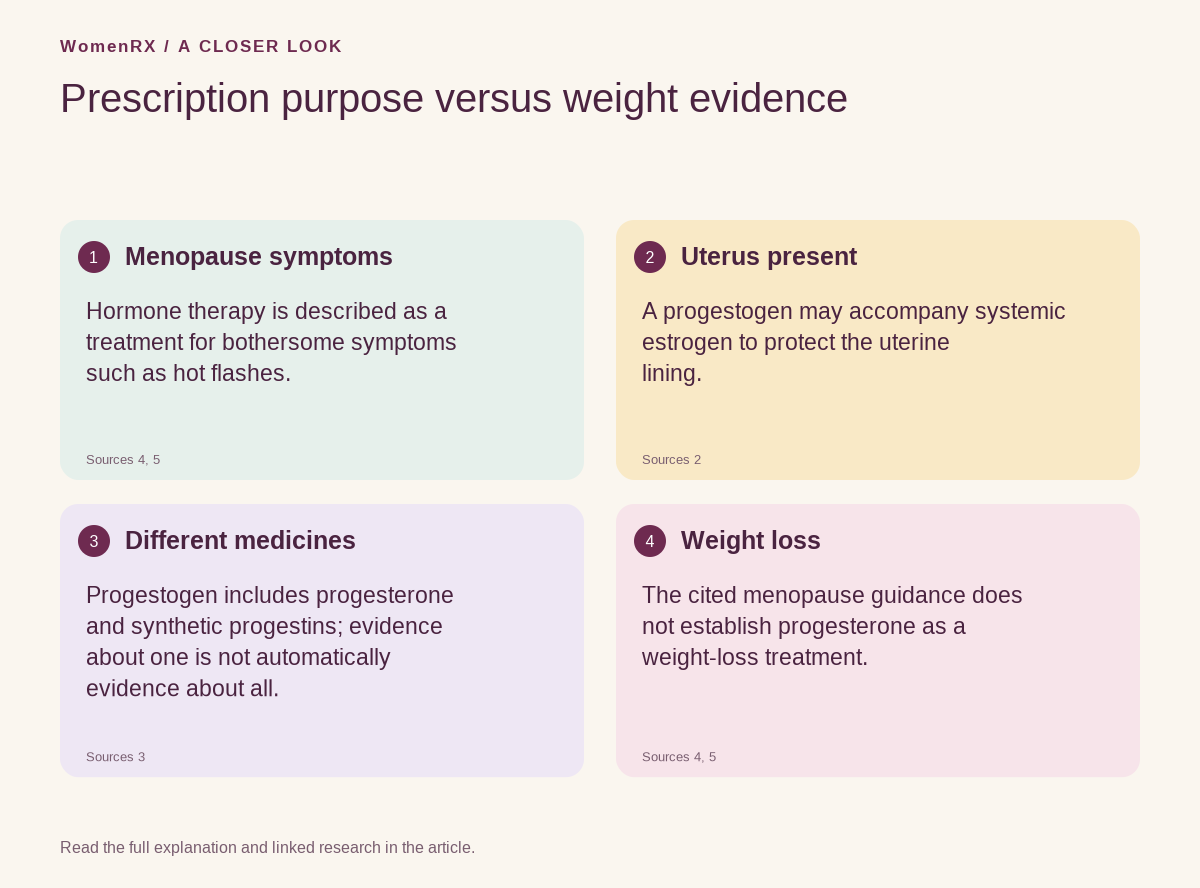
Prescription purpose versus weight evidence
Menopause symptoms: Hormone therapy is described as a treatment for bothersome symptoms such as hot flashes.45
Uterus present: A progestogen may accompany systemic estrogen to protect the uterine lining.2
Different medicines: Progestogen includes progesterone and synthetic progestins; evidence about one is not automatically evidence about all.3
Weight loss: The cited menopause guidance does not establish progesterone as a weight-loss treatment.45
Read the figure as text
These distinctions show what a progestogen may be doing in a menopause regimen and what the cited guidance does, and does not, establish about weight.- Menopause symptoms: Hormone therapy is described as a treatment for bothersome symptoms such as hot flashes.45
- Uterus present: A progestogen may accompany systemic estrogen to protect the uterine lining.2
- Different medicines: Progestogen includes progesterone and synthetic progestins; evidence about one is not automatically evidence about all.3
- Weight loss: The cited menopause guidance does not establish progesterone as a weight-loss treatment.45
More questions, answered
Does a progesterone prescription mean it was prescribed for weight loss?
Not necessarily. In a menopause regimen with systemic estrogen, a progestogen may be prescribed to protect the uterine lining when the uterus is present. That purpose is separate from weight reduction. 2
Can research on one progestogen be applied to all of them?
Not automatically. Progestogen includes progesterone and synthetic progestins, and results about one medicine or regimen don’t establish the same effect for the others. 3
Sources you can check
- Body Weight: MedlinePlusAccessed 2026-09-25Return to first citation
- Understanding the Knowledge, Attitudes, and Practices of Young Obstetricians and Gynecologists (OBGYNs) in Menopause Management: Unveiling Insights From India.Gudidevuni JD, Thakre A, Bondia A, Bhanushali M. · Cureus · 2025Return to first citation
- Menopausal hormone therapy and risk of sarcoidosis: a population-based nested case-control study in Sweden.Dehara M, Kullberg S, Bixo M, Sachs MC, Grunewald J, Arkema EV. · European journal of epidemiology · 2024Return to first citation
- Management of Menopausal Symptoms: A Review.Crandall CJ, Mehta JM, Manson JE. · JAMA · 2023Return to first citation
- The 2022 hormone therapy position statement of The North American Menopause Society.“The 2022 Hormone Therapy Position Statement of The North American Menopause Society” Advisory Panel. · Menopause (New York, N.Y.) · 2022Return to first citation
- The 2023 nonhormone therapy position statement of The North American Menopause Society.Menopause (New York, N.Y.) · 2023Return to first citation