When Is Progesterone Used in Menopause Hormone Therapy?
The main reason to add progesterone or another progestogen is to protect the uterine lining when you use systemic estrogen and still have a uterus.
If you have a uterus and use systemic estrogen, a progestogen is generally included to protect the uterine lining from estrogen-driven stimulation. Micronized progesterone is one option; other progestogens, including a levonorgestrel-releasing intrauterine device, may also be considered. If your uterus has been removed, this particular reason for adding a progestogen generally no longer applies. The choice depends on your situation and formulation. 2 3 4
The reason estrogen and a progestogen may go together
Systemic estrogen can help with menopause symptoms, but it also stimulates the lining of the uterus, called the endometrium. When the uterus is present, adding a progestogen helps protect that lining. This is the main reason progesterone may be part of a menopause hormone therapy plan, rather than a requirement for everyone who uses hormones. 2 4
If you’ve had your uterus removed, there’s no uterine lining to protect, so this particular reason for adding a progestogen generally doesn’t apply. Your surgical history and the specific treatment being considered still matter when discussing a plan.
Progesterone is one kind of progestogen
“Progestogen” is the broader term for medicines that act like progesterone at the uterine lining. Micronized progesterone is progesterone itself, prepared for use as a medicine. Synthetic progestins are another category of progestogens; these can also provide endometrial protection when paired with estrogen. 4
That distinction can make treatment discussions clearer: a clinician might say “progestogen” when talking about the protective role, then discuss which specific medicine or formulation could fit. The options aren’t automatically interchangeable. Menopause hormone therapy’s benefits and risks vary with factors such as hormone type, dose, route, duration, and whether a progestogen is used, so the plan is individualized and revisited over time. 1
The form matters, not just the name
Micronized progesterone is one option. A levonorgestrel-releasing intrauterine device is another progestogen-based approach that has been studied for endometrial protection alongside estrogen. A review of studies in peri- and postmenopausal women using estrogen found that the device prevented endometrial hyperplasia at least as effectively as oral or vaginal progesterone forms. That finding doesn’t establish that one option is best for every person. 3
Route matters, too. A systematic review concluded that transdermal micronized progesterone does not provide endometrial protection. So, if you’re comparing products described as progesterone, ask whether that specific form has evidence for protecting the uterine lining when used with systemic estrogen. 2
The evidence doesn’t give a single best choice for everyone. It supports the protective role of a progestogen for people with a uterus using systemic estrogen, but choices among types and formulations call for a discussion of your medical history and treatment preferences. 1 2
Useful questions for your treatment discussion
You can make the conversation more specific by asking:
- Does my surgery history mean I still have a uterus?
- Is the estrogen being considered systemic, or is it a different type of treatment?
- Which progestogen and formulation are being proposed, and is that form intended to protect the uterine lining?
- How will we review whether this plan is still the right fit for me?
These questions help connect the reason for adding a progestogen to the details that determine which approach is being discussed.
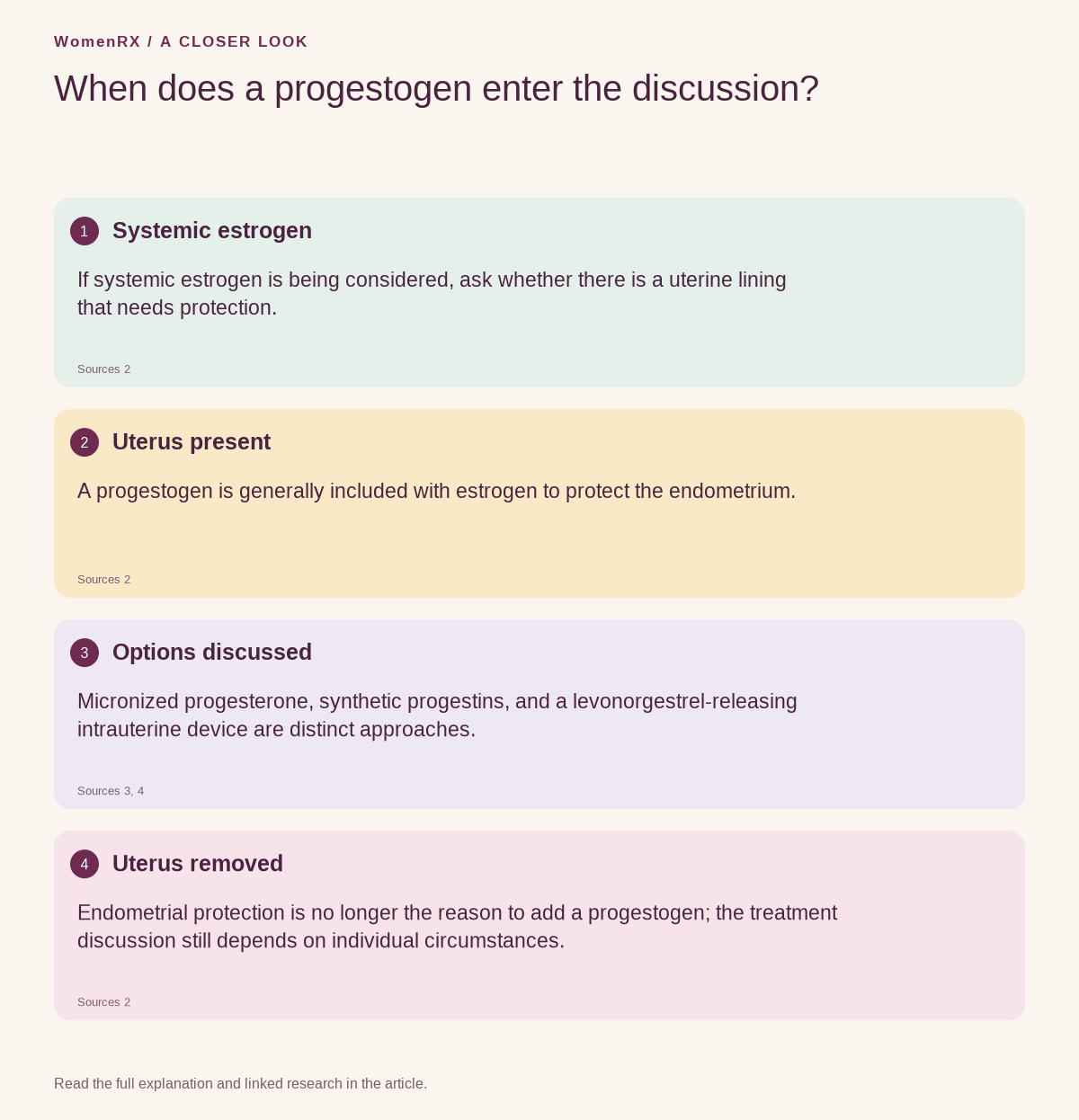
When does a progestogen enter the discussion?
Systemic estrogen: If systemic estrogen is being considered, ask whether there is a uterine lining that needs protection.2
Uterus present: A progestogen is generally included with estrogen to protect the endometrium.2
Options discussed: Micronized progesterone, synthetic progestins, and a levonorgestrel-releasing intrauterine device are distinct approaches.34
Uterus removed: Endometrial protection is no longer the reason to add a progestogen; the treatment discussion still depends on individual circumstances.2
Read the figure as text
This decision path shows how uterus status and systemic estrogen relate to the endometrial-protection question.- Systemic estrogen: If systemic estrogen is being considered, ask whether there is a uterine lining that needs protection.2
- Uterus present: A progestogen is generally included with estrogen to protect the endometrium.2
- Options discussed: Micronized progesterone, synthetic progestins, and a levonorgestrel-releasing intrauterine device are distinct approaches.34
- Uterus removed: Endometrial protection is no longer the reason to add a progestogen; the treatment discussion still depends on individual circumstances.2
More questions, answered
Is progesterone the only option for endometrial protection?
No. Micronized progesterone is one option; synthetic progestins and a levonorgestrel-releasing intrauterine device are other progestogen-based approaches discussed in the literature. The best fit depends on the treatment plan and the person. 3 4
Does any progesterone product protect the uterine lining?
No. A systematic review concluded that transdermal micronized progesterone does not provide endometrial protection. Ask about the specific formulation rather than relying on the word “progesterone” alone. 2
Sources you can check
- The 2022 hormone therapy position statement of The North American Menopause Society.“The 2022 Hormone Therapy Position Statement of The North American Menopause Society” Advisory Panel. · Menopause (New York, N.Y.) · 2022Return to first citation
- The impact of micronized progesterone on the endometrium: a systematic review.Stute P, Neulen J, Wildt L. · Climacteric : the journal of the International Menopause Society · 2016Return to first citation
- Benefits of Levonorgestrel Intrauterine Device Use vs. Oral or Transdermal Progesterone for Postmenopausal Women Using Estrogen Containing Hormone Therapy.Clark K, Westberg SM. · Innovations in pharmacy · 2019Return to first citation
- Estradiol and Micronized Progesterone: A Narrative Review About Their Use as Hormone Replacement Therapy.Foschi M, Groccia G, Rusce ML, Medaglia C, Aio C, Sponzilli A, Setti V, Battipaglia C, Genazzani AD. · Journal of clinical medicine · 2025Return to first citation