When can estrogen be used without a progestogen in menopause therapy?
The key question is whether estrogen could stimulate a uterine lining, which depends on what tissue remains and whether treatment is systemic or low-dose vaginal.
For systemic estrogen, a person with a uterus generally needs a progestogen to protect the uterine lining. If the entire uterus has been removed, there’s no uterine lining to protect, so a progestogen isn’t needed for that purpose; other reasons for prescribing one may still matter. Low-dose vaginal estrogen is different: a progestogen generally isn’t needed for endometrial protection with these preparations. 1 5 6

Start with the treatment’s purpose and route
The progestogen question is mainly about the endometrium, the lining inside the uterus. Systemic estrogen reaches tissues throughout the body, including that lining. With a uterus in place, estrogen without endometrial protection can raise the risk of endometrial overgrowth (hyperplasia). A Cochrane review of 46 studies found that unopposed estrogen was associated with increased hyperplasia in postmenopausal women across the studied doses and treatment periods of one to three years. 2 5
That’s why a progestogen is generally included with systemic estrogen when someone has a uterus. It can be part of a combined product or prescribed separately. The exact regimen depends on the prescribed treatment; don’t assume a different progestogen, route, or schedule offers the same protection. 1 5
If your uterus was removed
If the entire uterus was removed, there’s no uterine lining for systemic estrogen to stimulate, so a progestogen isn’t needed for endometrial protection. That answers the lining-protection question, not every question about which hormone regimen is right for you. Menopause therapy decisions can also depend on treatment goals and individual factors, and the balance of benefits and risks varies with the hormone, dose, route, timing, and duration. 1 3
If you’ve had a hysterectomy, confirm exactly what was removed and why a progestogen is included, if you’re prescribed one. If the operation didn’t remove the entire uterus, or your medical history makes the reason unclear, ask your prescriber to explain the plan before changing it.
Low-dose vaginal estrogen is a different case
Low-dose vaginal estrogen is used for symptoms such as vaginal dryness and discomfort, rather than to provide systemic treatment for symptoms such as hot flashes. A review of local vaginal estrogen found support for endometrial safety with low-dose treatment and described the general recommendation that a progestogen isn’t needed for endometrial protection with these regimens. The review’s safety findings covered studies of up to one year, so don’t apply that conclusion automatically to a different dose or product. 3 6
If you’re unsure whether your prescription is low-dose vaginal estrogen or a systemic product, check the exact product and route with your prescriber or pharmacist. “Vaginal” alone doesn’t tell you enough to assume that every product has the same endometrial considerations.
A useful check before changing your prescription
Before stopping or adding a progestogen, ask: “Is this estrogen systemic or low-dose vaginal, and do I still have a uterus?” If you do have a uterus and use systemic estrogen, ask how the prescribed progestogen protects the lining and whether it is part of a combined product or a separate prescription. A levonorgestrel-releasing intrauterine system is one approach discussed in a clinical review of endometrial protection during estrogen therapy, but whether it fits your situation is a prescriber-level decision. 4
New, persistent, or recurring abnormal bleeding deserves follow-up rather than an unsupervised hormone change. Product information advises evaluation of persistent or recurring abnormal bleeding in postmenopausal women, and advises people using a combined estrogen-progesterone product to report vaginal bleeding. 1 2
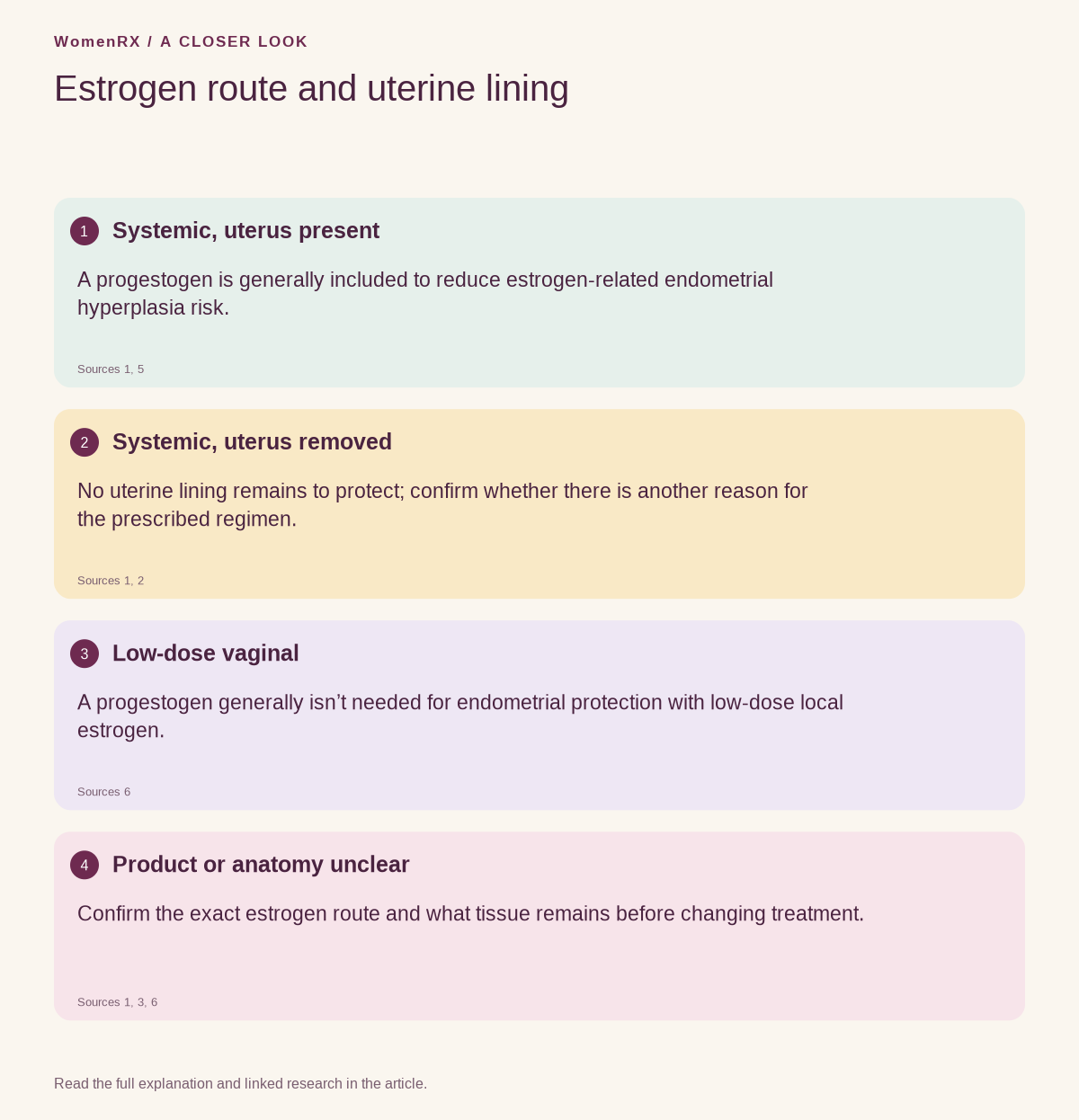
Estrogen route and uterine lining
Systemic, uterus present: A progestogen is generally included to reduce estrogen-related endometrial hyperplasia risk.15
Systemic, uterus removed: No uterine lining remains to protect; confirm whether there is another reason for the prescribed regimen.12
Low-dose vaginal: A progestogen generally isn’t needed for endometrial protection with low-dose local estrogen.6
Product or anatomy unclear: Confirm the exact estrogen route and what tissue remains before changing treatment.136
Read the figure as text
Use the treatment route and whether a uterine lining remains to frame the progestogen conversation.- Systemic, uterus present: A progestogen is generally included to reduce estrogen-related endometrial hyperplasia risk.15
- Systemic, uterus removed: No uterine lining remains to protect; confirm whether there is another reason for the prescribed regimen.12
- Low-dose vaginal: A progestogen generally isn’t needed for endometrial protection with low-dose local estrogen.6
- Product or anatomy unclear: Confirm the exact estrogen route and what tissue remains before changing treatment.136
More questions, answered
Does the route of estrogen matter?
Yes. Systemic estrogen can affect the uterine lining, so a progestogen is generally used for protection when a uterus is present. Low-dose vaginal estrogen is a separate case; available review evidence supports using it without a progestogen for endometrial protection. Don’t assume the same conclusion applies to every vaginal product or dose. 2 6
Sources you can check
- BIJUVA (ESTRADIOL AND PROGESTERONE) CAPSULE [MAYNE PHARMA] | US prescribing information and patient instructionsAccessed 2026-09-25Return to first citation
- CLIMARA PRO (ESTRADIOL AND LEVONORGESTREL) PATCH [BAYER HEALTHCARE PHARMACEUTICALS INC.] | US prescribing information and patient instructionsAccessed 2026-09-25Return to first citation
- The 2022 hormone therapy position statement of The North American Menopause Society.“The 2022 Hormone Therapy Position Statement of The North American Menopause Society” Advisory Panel. · Menopause (New York, N.Y.) · 2022Return to first citation
- The levonorgestrel-releasing intrauterine system for endometrial protection during estrogen replacement therapy: a clinical review.Depypere H, Inki P. · Climacteric : the journal of the International Menopause Society · 2015Return to first citation
- Hormone therapy in postmenopausal women and risk of endometrial hyperplasia.Furness S, Roberts H, Marjoribanks J, Lethaby A. · The Cochrane database of systematic reviews · 2012Return to first citation
- Reviewing the options for local estrogen treatment of vaginal atrophy.Lindahl SH. · International journal of women's health · 2014Return to first citation