Why Systemic Estrogen Often Comes With a Progestogen
When you have a uterus, the pairing is meant to protect its lining, not simply to balance your hormones.
If you have a uterus and use systemic estrogen for menopause symptoms, a progestogen is generally added to reduce the risk of abnormal growth of the uterine lining. The protection depends on the actual regimen, not just the presence of an ingredient called progesterone. After hysterectomy, this lining-protection reason usually doesn’t apply; low-dose vaginal estrogen is a different treatment question. 4 6 2
What the progestogen is protecting
Systemic estrogen reaches tissues throughout the body, including the endometrium, the lining inside your uterus. Estrogen can stimulate that lining to grow. If it isn’t adequately opposed, abnormal growth called endometrial hyperplasia can develop; hyperplasia may be a precursor to endometrial cancer. An appropriate progestogen regimen reduces the risk of hyperplasia. 1 4
That’s the reason for the pairing. In a Cochrane review of 46 studies, unopposed estrogen was associated with more endometrial hyperplasia across the doses studied and treatment periods of one to three years. The review concluded that postmenopausal hormone therapy for someone with an intact uterus should include a progestogen to reduce this risk. 4
A progestogen isn’t added because estrogen is inherently incomplete or because every woman needs progesterone. It has a specific job when there’s a uterine lining exposed to systemic estrogen.
Protection depends on the regimen
“Progestogen” is a category that includes progesterone and other compounds. Products and schedules aren’t interchangeable simply because they contain one. The Cochrane review found reassuring hyperplasia results for certain studied estrogen-progestogen combinations, but differences between studies limited many comparisons. Menopause guidance likewise notes that hormone-therapy risks vary with the type, dose, duration, and route of treatment, as well as whether a progestogen is used. 4 2
So if a prescribed progestogen isn’t working for you, the question isn’t just whether you can leave it out. Ask what is intended to protect your lining with your particular systemic estrogen prescription. Stopping the progestogen while continuing estrogen would remove the protection that was prescribed for that purpose. 4
If you can’t take the proposed progestogen
There may be more to discuss than keeping the same plan or giving up on symptom treatment. A review of menopausal hormone therapy describes different progestogens and ways of providing them, including an intrauterine levonorgestrel route. That doesn’t mean any particular device, product, or schedule will provide adequate protection alongside your estrogen. It makes the specific combination worth discussing. 5 4
You could ask: “Is a different progestogen or delivery method appropriate with this estrogen, and how would we know it protects my uterine lining?” If a suitable protective approach isn’t workable, ask whether a different treatment plan would address the symptoms you’re treating instead of continuing systemic estrogen without protection. 4 2
For example, if vaginal or urinary symptoms are your main concern, low-dose vaginal estrogen is an option identified in menopause guidance when systemic hormone therapy isn’t indicated. Ask about the specific local product and dose rather than applying the systemic-estrogen rule to it automatically. If hot flashes or night sweats are the main concern, evidence-supported nonhormonal options include cognitive behavioral therapy, clinical hypnosis, and certain prescription medicines. These treat symptoms; they don’t protect the lining while you continue systemic estrogen. 2 3 4
When the uterus isn’t there
After a hysterectomy, a progestogen generally isn’t needed for endometrial protection, because the uterine lining is gone. Your other health circumstances can still affect the treatment choice. For example, product information notes that residual endometriosis after hysterectomy may be a reason to consider adding a progestin. 6 1
If you have persistent or recurring unusual bleeding after menopause, raise it with your prescriber rather than assuming it’s an expected effect of hormone therapy. Combined estrogen-progestin product information calls for evaluation of persistent or recurring unexplained bleeding. 1
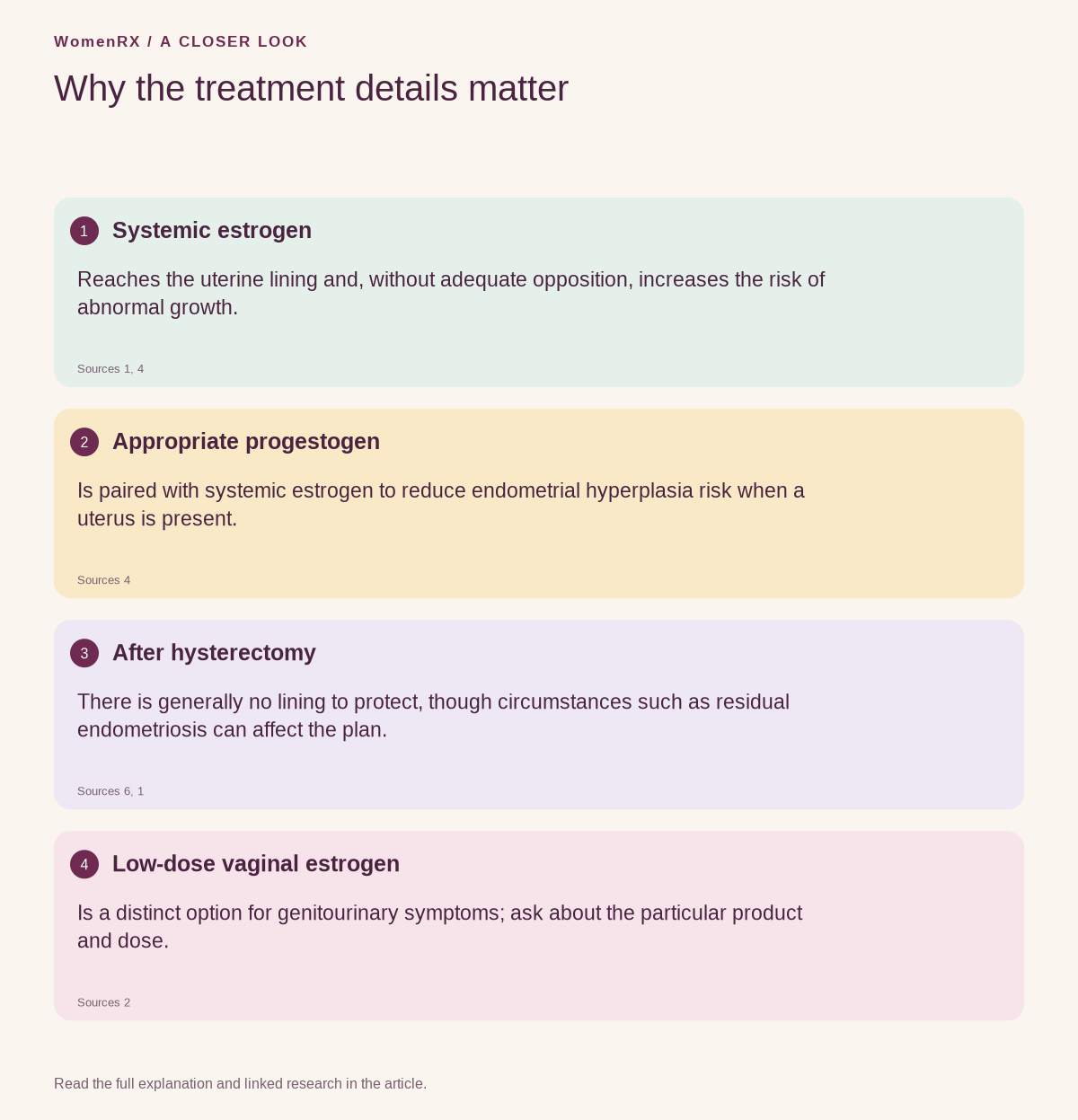
Why the treatment details matter
Systemic estrogen: Reaches the uterine lining and, without adequate opposition, increases the risk of abnormal growth.14
Appropriate progestogen: Is paired with systemic estrogen to reduce endometrial hyperplasia risk when a uterus is present.4
After hysterectomy: There is generally no lining to protect, though circumstances such as residual endometriosis can affect the plan.61
Low-dose vaginal estrogen: Is a distinct option for genitourinary symptoms; ask about the particular product and dose.2
Read the figure as text
The uterine-lining question changes with anatomy and the type of estrogen treatment.- Systemic estrogen: Reaches the uterine lining and, without adequate opposition, increases the risk of abnormal growth.14
- Appropriate progestogen: Is paired with systemic estrogen to reduce endometrial hyperplasia risk when a uterus is present.4
- After hysterectomy: There is generally no lining to protect, though circumstances such as residual endometriosis can affect the plan.61
- Low-dose vaginal estrogen: Is a distinct option for genitourinary symptoms; ask about the particular product and dose.2
Sources you can check
- PREMPHASE (CONJUGATED ESTROGENS AND MEDROXYPROGESTERONE ACETATE) KIT PREMPRO (CONJUGATED ESTROGENS AND MEDROXYPROGESTERONE ACETATE) TABLET, SUGAR COATED [WYETH PHARMACEUTICALS LLC, A SUBSIDIARY OF PFIZER INC.] | US prescribing information and patient instructionsAccessed 2026-09-25Return to first citation
- The 2022 hormone therapy position statement of The North American Menopause Society.“The 2022 Hormone Therapy Position Statement of The North American Menopause Society” Advisory Panel. · Menopause (New York, N.Y.) · 2022Return to first citation
- The 2023 nonhormone therapy position statement of The North American Menopause Society.Menopause (New York, N.Y.) · 2023Return to first citation
- Hormone therapy in postmenopausal women and risk of endometrial hyperplasia.Furness S, Roberts H, Marjoribanks J, Lethaby A. · The Cochrane database of systematic reviews · 2012Return to first citation
- Progestogens in Menopausal Hormone Therapy: A Double-Edged Sword.Ylikorkala O, Joensuu JM, Siitonen H, Mikkola TS. · Seminars in reproductive medicine · 2025Return to first citation
- Recommendations for hormone therapy in hysterectomized women: importance of new data in clinical management.Faubion SS, Kapoor E, Kuhle CL, Sood R, Thielen JM, Miller VM. · Expert review of endocrinology & metabolism · 2015Return to first citation