What to Do About Troublesome Progestogen Side Effects
The right next step depends on the exact medicine, why you take it, and whether your treatment also includes estrogen.
Check the exact product before deciding what to change: side-effect reports for estrogen-progestogen combinations don’t establish what progesterone alone will do. If you have a uterus and continue systemic estrogen, keep a plan for uterine-lining protection. Discuss troublesome symptoms with your prescriber, but seek urgent care for symptoms that could signal a clot, stroke, or severe allergic reaction. 1 2 3
Start with the exact product
“Progesterone side effects” can mean different things. Menopause hormone therapy may combine estrogen with a progestogen, while medroxyprogesterone acetate injection (Depo-Provera) is a contraceptive. The effects reported for one product and purpose shouldn’t be treated as a forecast for another. 1 2
In clinical trials of specific oral conjugated-estrogen and medroxyprogesterone products, reported treatment-related effects included breast pain, headache, abdominal pain, nausea, and depression. Across three regimens with 338 to 351 participants each, breast pain was reported by about 31-36% of participants, headache by 15-19%, abdominal pain by 10-17%, nausea by 6-8%, and depression by 4-8%. These were combination products, so the figures cannot tell you which ingredient caused an effect or predict your own experience with progesterone alone. 1
The pattern differs with the contraceptive injection. Its prescribing information reports menstrual bleeding changes, including spotting, irregular bleeding, prolonged bleeding, or no periods. In clinical studies, 57.3% of users reported menstrual bleeding irregularities at 12 months and 32.1% at 24 months; amenorrhea, or no periods, was reported by 55% at 12 months and 68% at 24 months. These are results for that product, not a comparison with menopause hormone therapy. 2
Match the symptom to the right next step
Write down the product name, whether it contains estrogen, and the reason you take it. Note when symptoms began and whether they follow a particular part of your treatment schedule. Include how much they affect sleep, mood, work, or daily activities. If you’re still having periods, note whether symptoms or bleeding seem to follow a cycle; if you’re postmenopausal, mention any bleeding. This information can help your prescriber consider the right question, even though it can’t identify the cause on its own.
If you’re postmenopausal and using estrogen-progestin therapy, unexplained persistent or recurring abnormal bleeding needs evaluation. With Depo-Provera, persistent or severe abnormal bleeding also calls for evaluation. Don’t dismiss bleeding as an expected side effect just because you take hormones. 1 2
Some symptoms shouldn’t wait for a routine treatment review. The oral estrogen-medroxyprogesterone products carry serious risks that include blood clots and stroke. 1 Depo-Provera’s patient information specifically warns about sharp chest pain or sudden breathlessness, severe calf pain or swelling, sudden problems with speech or vision or weakness in an arm or leg, and trouble breathing with swelling of the face or throat. Seek urgent care for symptoms like these, whether or not you know what caused them. These warnings don’t mean the two treatments have identical risks. 2
Ask what a change would solve, and what it might affect
If the medicine is part of menopause hormone therapy, the first decision is whether systemic treatment is still needed for the symptoms it treats. A menopause treatment review recommends the smallest effective dose for the shortest suitable duration; it also identifies nonhormonal medicines, including low-dose paroxetine, venlafaxine, and gabapentin, as alternatives for hot flashes. If vaginal symptoms are part of the picture, vaginal estrogen or nonhormonal vaginal moisturizers are options to discuss for those symptoms. These are ways to reconsider treatment for menopause symptoms, not proven fixes for side effects or substitutes for a progestogen while systemic estrogen continues. 3
The oral combination products described above include continuous and sequential regimens. If symptoms seem linked to a particular part of your schedule, ask whether that pattern changes the choice of regimen. You can also ask whether a different formulation or route fits the reason you’re taking the medicine. A change shouldn’t be presented as a reliable fix for breast pain, headache, or mood symptoms: the combination-product figures do not show that switching schedule, dose, timing, route, or formulation relieves them. 1
The reason for the progestogen matters. For someone with a uterus using systemic estrogen, a progestogen is used to reduce the risk of endometrial overgrowth from estrogen alone. Don’t stop it on your own while continuing estrogen; ask how to protect the uterine lining if the current approach isn’t tolerable. Whether that protection is needed depends on your treatment and uterus status, so make both part of the discussion. 1 3
If systemic estrogen treatment is still needed but a progestogen is difficult to tolerate, a menopause treatment review identifies combined estrogen-bazedoxifene as a possible alternative to an estrogen-progestogen combination for some people. Discuss whether that particular formulation fits your menopause symptoms and uterine-lining protection needs. It does not replace a progestogen used for contraception or another indication, and the review does not establish that it will resolve any particular side effect. 3
If you take a progestogen for another reason, such as contraception, don’t apply menopause-therapy options automatically. For example, bleeding changes are common in the Depo-Provera study information, and the injection has its own considerations. Tell your prescriber what is troublesome and ask what alternatives, if any, preserve the treatment’s purpose. 2
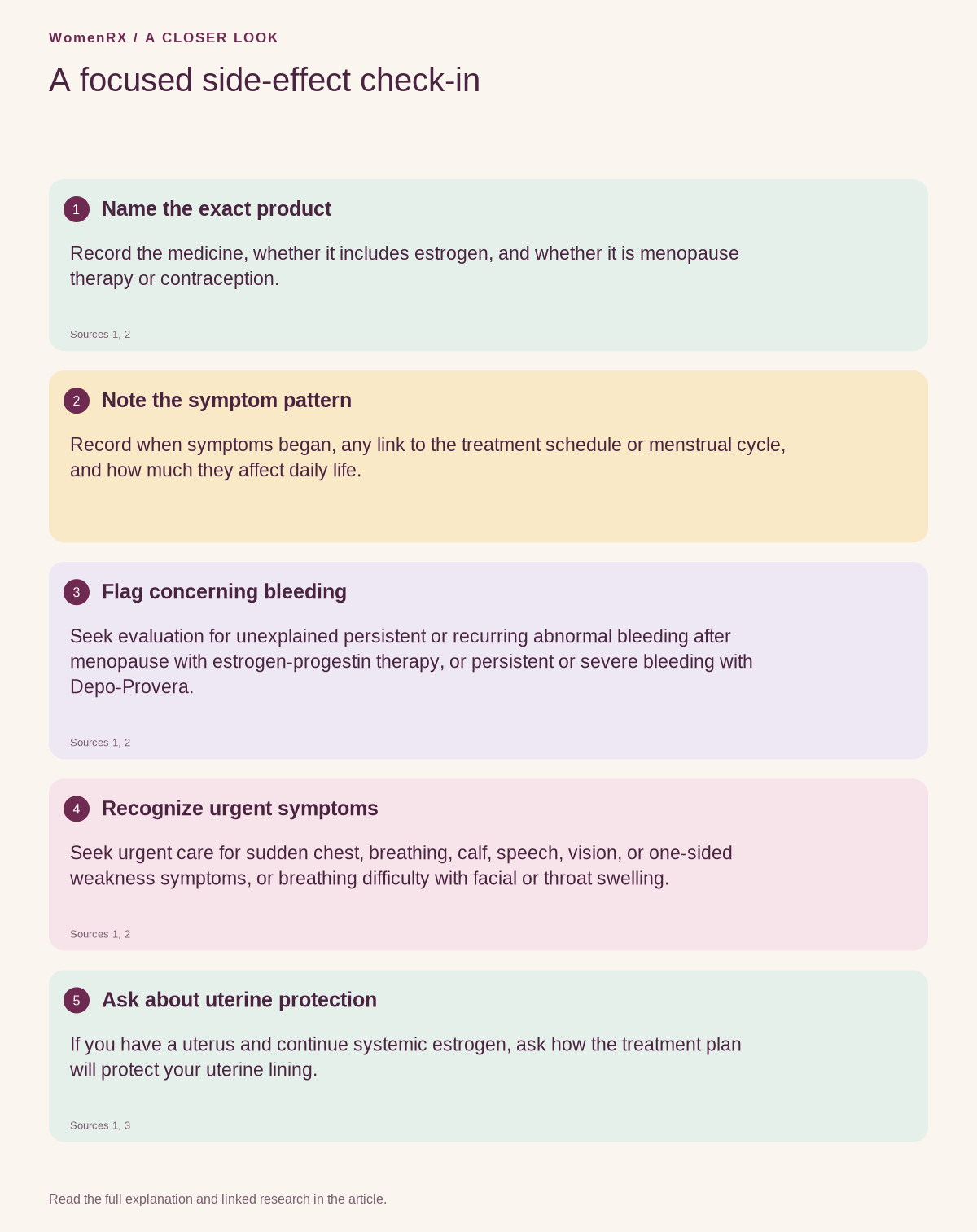
A focused side-effect check-in
Name the exact product: Record the medicine, whether it includes estrogen, and whether it is menopause therapy or contraception.12
Note the symptom pattern: Record when symptoms began, any link to the treatment schedule or menstrual cycle, and how much they affect daily life.
Flag concerning bleeding: Seek evaluation for unexplained persistent or recurring abnormal bleeding after menopause with estrogen-progestin therapy, or persistent or severe bleeding with Depo-Provera.12
Recognize urgent symptoms: Seek urgent care for sudden chest, breathing, calf, speech, vision, or one-sided weakness symptoms, or breathing difficulty with facial or throat swelling.12
Ask about uterine protection: If you have a uterus and continue systemic estrogen, ask how the treatment plan will protect your uterine lining.13
Read the figure as text
Use the product name, symptom pattern, and treatment purpose to frame the discussion, while recognizing symptoms that need faster attention.- Name the exact product: Record the medicine, whether it includes estrogen, and whether it is menopause therapy or contraception.12
- Note the symptom pattern: Record when symptoms began, any link to the treatment schedule or menstrual cycle, and how much they affect daily life.
- Flag concerning bleeding: Seek evaluation for unexplained persistent or recurring abnormal bleeding after menopause with estrogen-progestin therapy, or persistent or severe bleeding with Depo-Provera.12
- Recognize urgent symptoms: Seek urgent care for sudden chest, breathing, calf, speech, vision, or one-sided weakness symptoms, or breathing difficulty with facial or throat swelling.12
- Ask about uterine protection: If you have a uterus and continue systemic estrogen, ask how the treatment plan will protect your uterine lining.13
More questions, answered
Does a side effect mean the progestogen is the only cause?
Not necessarily. The menopause trial figures above come from products combining estrogen and medroxyprogesterone, so they don’t separate the effect of each ingredient. Bring the full product name and timing of symptoms to your prescriber. 1
Should I stop taking it if I feel unwell?
For troublesome symptoms, discuss treatment options with your prescriber. If you have a uterus and use systemic estrogen, don’t stop the progestogen without a plan for uterine-lining protection. Seek urgent care instead of waiting for that discussion if you have symptoms that could signal a clot, stroke, or severe allergic reaction. 1 2 3
Sources you can check
- PREMPHASE (CONJUGATED ESTROGENS AND MEDROXYPROGESTERONE ACETATE) KIT PREMPRO (CONJUGATED ESTROGENS AND MEDROXYPROGESTERONE ACETATE) TABLET, SUGAR COATED [WYETH PHARMACEUTICALS LLC, A SUBSIDIARY OF PFIZER INC.] | US prescribing information and patient instructionsAccessed 2026-09-25Return to first citation
- DEPO-PROVERA (MEDROXYPROGESTERONE ACETATE) INJECTION, SUSPENSION [PHARMACIA & UPJOHN COMPANY LLC] | US prescribing information and patient instructionsAccessed 2026-09-25Return to first citation
- Hormone Therapy and Other Treatments for Symptoms of Menopause.Hill DA, Crider M, Hill SR. · American family physician · 2016Return to first citation