How Progesterone Side Effects Differ Across Menopause Treatments
The hormone, the estrogen paired with it, and the way you take them all matter when comparing side effects.
Prometrium oral progesterone capsules can cause temporary dizziness or drowsiness. Other menopause products pair estrogen with a synthetic progestogen, and their reported side effects include breast tenderness, headache, and nausea. Those reports don’t show that one progestogen caused every symptom or that one formulation is safest. If you have a uterus and use systemic estrogen, the progestogen also helps protect the uterine lining, so a change needs to preserve that protection. 514
First, know what’s changing
“Progesterone” and “progestogen” aren’t interchangeable names for a single medicine. Micronized progesterone is one form used in menopause care. Prometrium is labeled as progesterone capsules; medroxyprogesterone acetate and levonorgestrel are different progestogens. Menopause treatments may provide a progestogen in a separate oral capsule, combine it with estrogen in an oral capsule or tablet, or include both hormones in a patch. Each arrangement raises a slightly different side-effect question. 25167
If you have a uterus and take systemic estrogen, a progestogen is generally included to reduce the risk of endometrial cancer. That’s why the question isn’t simply which progestogen feels better. It’s whether a different regimen addresses the symptom bothering you and maintains protection of the uterine lining. 4
What the everyday side-effect reports actually tell you
Separate oral progesterone (Prometrium): The US prescribing information for Prometrium warns that its capsules may cause temporary dizziness and drowsiness, including a concern about driving or operating machinery. This is a useful distinction if feeling groggy is your main problem. It doesn’t mean everyone taking progesterone will feel sleepy, or that another progestogen couldn’t affect how alert you feel. 5
A trial described in that prescribing information gives more context, but it isn’t a head-to-head comparison of progestogens. Among postmenopausal women taking cyclic oral progesterone with conjugated estrogens, 15% of 178 reported dizziness, compared with 9% of 174 receiving placebo over a three-year trial. Breast tenderness was reported by 27% versus 6%, respectively. Because the treatment group received both hormones, those figures cannot assign either effect to progesterone alone. 5
Oral estrogen plus medroxyprogesterone acetate: Prescribing information for combined conjugated-estrogen/medroxyprogesterone-acetate tablets identifies headache, breast pain or tenderness, nausea, and vomiting as possible common effects of the combined treatment. If you’re switching from this product to a separate estrogen and progesterone regimen, it would be misleading to call every symptom on that list an “MPA side effect.” The progestogen changes, and the estrogen may change; the hormones also move from a combined tablet to separate products. 1
Oral estradiol plus progesterone: The combined estradiol/progesterone capsule also lists breast tenderness, headache, nausea, vaginal bleeding, vaginal discharge, and pelvic pain among possible common effects. Sharing an ingredient with separate oral progesterone capsules does not make the two products’ side-effect reports directly comparable: their estrogen components and regimens differ. 65
A patch containing estradiol and levonorgestrel: This is a combined hormone patch, not simply an oral progestogen delivered through the skin. Its prescribing information describes headache, breast pain or tenderness, nausea, and vomiting as possible common effects of estrogen-plus-progestogen therapy. Choosing a patch does not, by itself, establish that levonorgestrel will cause fewer everyday side effects than oral progesterone or MPA. 751
The most useful comparison is therefore a narrow one: Which symptom are you trying to change, and which parts of your regimen would change with the proposed switch? For example, a switch from a combined oral estrogen/MPA tablet to an estradiol/levonorgestrel patch changes the estrogen, the progestogen, and the route. Feeling better or worse afterward would matter to you, but it wouldn’t isolate which of those changes made the difference. 17
Bleeding depends on the schedule, not just the hormone name
Bleeding can be particularly confusing when a regimen changes. With sequential combined hormone therapy, in which progestogen is taken for only part of the cycle, withdrawal bleeding at the end of that course is expected. With continuous combined therapy, irregular bleeding or spotting is common during the first four to six months. These patterns shouldn’t be compared as though they were side-effect rates for two different progestogens. 2
The NHS advises a care review if irregular bleeding continues for more than six months after starting hormone therapy. 2
What can’t be ranked from these comparisons
Long-term risks are a different question from whether a capsule makes you dizzy or a new regimen causes spotting. The Women’s Health Initiative estrogen-plus-progestin trial studied one specific combination: oral conjugated estrogens with MPA. Its findings cannot establish the same size of risk for micronized progesterone, other progestogens, or a combined patch. Equally, a lack of equivalent trial results cannot establish that those alternatives are risk-free. A review of progestogen safety reported that double-blind randomized trials directly comparing long-term breast and cardiovascular safety across progestogens were lacking. 53
If a side effect is prompting a change, name it precisely. “I feel dizzy after the progesterone capsule” points to a different discussion than “I have spotting since changing from sequential to continuous therapy.” Bringing the current product names and the proposed replacements into that conversation makes it possible to separate a change in progestogen from a change in estrogen, route, or bleeding schedule. 52
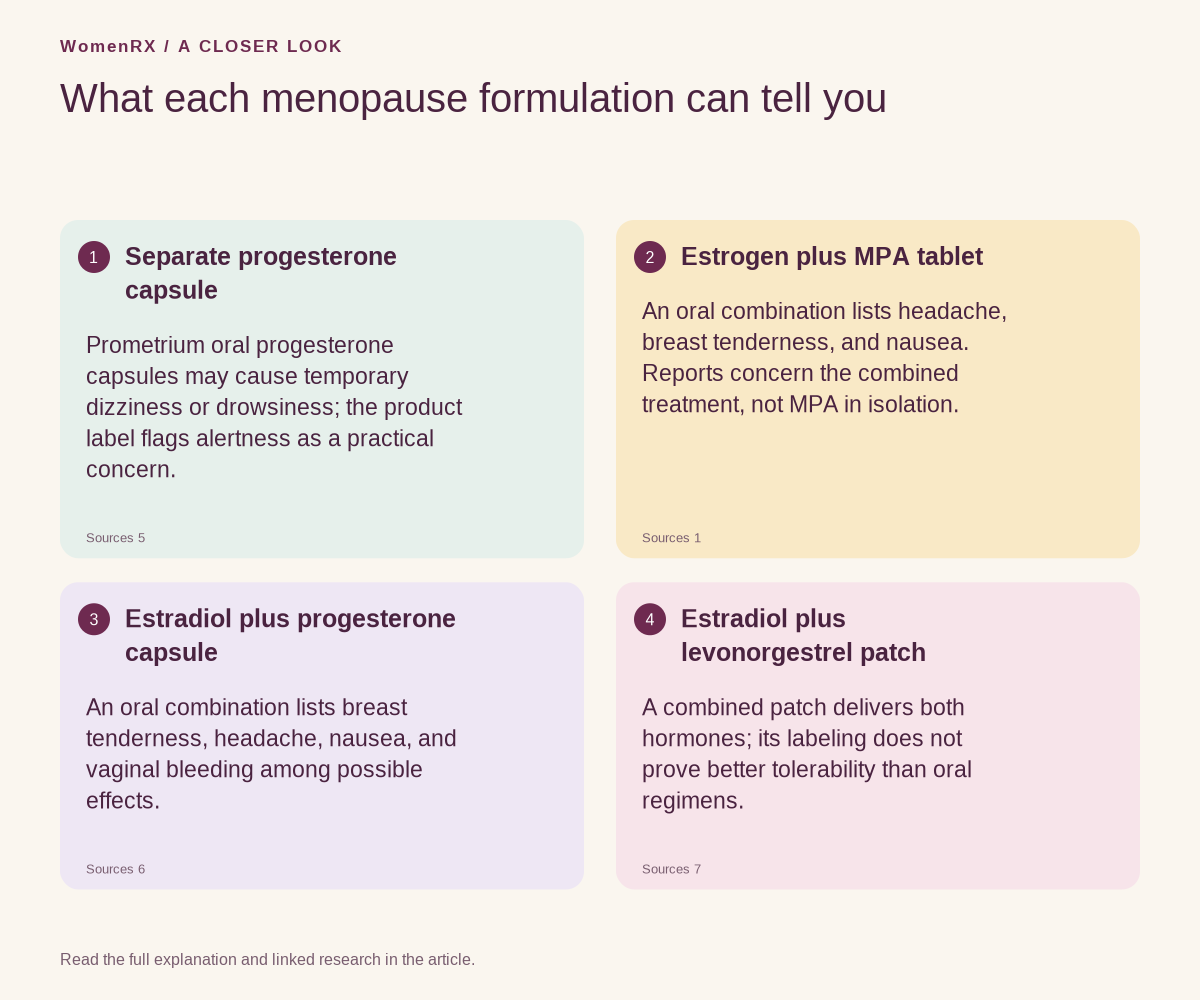
What each menopause formulation can tell you
Separate progesterone capsule: Prometrium oral progesterone capsules may cause temporary dizziness or drowsiness; the product label flags alertness as a practical concern.5
Estrogen plus MPA tablet: An oral combination lists headache, breast tenderness, and nausea. Reports concern the combined treatment, not MPA in isolation.1
Estradiol plus progesterone capsule: An oral combination lists breast tenderness, headache, nausea, and vaginal bleeding among possible effects.6
Estradiol plus levonorgestrel patch: A combined patch delivers both hormones; its labeling does not prove better tolerability than oral regimens.7
Read the figure as text
These are different products, not four arms of one side-by-side trial.- Separate progesterone capsule: Prometrium oral progesterone capsules may cause temporary dizziness or drowsiness; the product label flags alertness as a practical concern.5
- Estrogen plus MPA tablet: An oral combination lists headache, breast tenderness, and nausea. Reports concern the combined treatment, not MPA in isolation.1
- Estradiol plus progesterone capsule: An oral combination lists breast tenderness, headache, nausea, and vaginal bleeding among possible effects.6
- Estradiol plus levonorgestrel patch: A combined patch delivers both hormones; its labeling does not prove better tolerability than oral regimens.7
More questions, answered
Does switching to a patch eliminate progestogen side effects?
No. A combined estradiol/levonorgestrel patch still contains a progestogen, and its prescribing information describes possible effects of the combined therapy. It isn’t a direct side-effect comparison with oral progesterone capsules. 75
Sources you can check
- PREMPHASE (CONJUGATED ESTROGENS AND MEDROXYPROGESTERONE ACETATE) KIT PREMPRO (CONJUGATED ESTROGENS AND MEDROXYPROGESTERONE ACETATE) TABLET, SUGAR COATED [WYETH PHARMACEUTICALS LLC, A SUBSIDIARY OF PFIZER INC.] | US prescribing information and patient instructionsAccessed 2026-09-25Return to first citation
- Side effects of hormone replacement therapy (HRT) - NHSAccessed 2026-09-25Return to first citation
- Progestogen safety and tolerance in hormonal replacement therapy.Palacios S, Mejía A. · Expert opinion on drug safety · 2016Return to first citation
- Hormone Therapy and Other Treatments for Symptoms of Menopause.Hill DA, Crider M, Hill SR. · American family physician · 2016Return to first citation
- PROMETRIUM (PROGESTERONE) CAPSULE [ACERTIS PHARMACEUTICALS, LLC] | US prescribing information and patient instructionsAccessed 2026-09-25Return to first citation
- BIJUVA (ESTRADIOL AND PROGESTERONE) CAPSULE [MAYNE PHARMA] | US prescribing information and patient instructionsAccessed 2026-09-25Return to first citation
- CLIMARA PRO (ESTRADIOL AND LEVONORGESTREL) PATCH [BAYER HEALTHCARE PHARMACEUTICALS INC.] | US prescribing information and patient instructionsAccessed 2026-09-25Return to first citation