Why Progesterone Is Prescribed in Menopause and Fertility Care
Progesterone can serve very different purposes: protecting the uterine lining during estrogen therapy or supporting a specific stage of fertility treatment.
In menopause therapy, a progestogen is generally added to estrogen for someone with a uterus to protect the uterine lining. In fertility care, progesterone may be used as luteal support in particular treatment cycles, including some frozen embryo transfers. The reason, product, route, and duration depend on the treatment plan, so the medication name alone doesn’t tell the whole story. 4 5
Two treatment goals, not one universal use
Progesterone is a hormone, but a prescription that contains progesterone or a related progestogen can be intended for different reasons. In menopause care, the central question is often whether estrogen needs a partner to protect the uterus. In fertility treatment, progesterone may support a defined stage of a treatment cycle. Neither use means that every person needs progesterone, or that every product can be swapped for another.
It also helps to check the exact medication name. Micronized progesterone is not the same product as medroxyprogesterone acetate (MPA), a progesterone derivative used in specific medicines. The names may sound similar, but the indication and evidence for one product shouldn’t automatically be applied to another. 1 2 3
With estrogen during menopause therapy
For a postmenopausal person with an intact uterus who uses estrogen therapy, a progestogen is used to protect the endometrium, the lining of the uterus. That protective role is different from estrogen’s role in treating menopause symptoms. 4 6
The route matters. A systematic review concluded that transdermal micronized progesterone does not provide endometrial protection. So a progesterone product applied to the skin shouldn’t be assumed to do the same job as a prescribed oral or vaginal regimen. The review also described vaginal use as off-label, which is a reason to confirm the intended route and purpose rather than substituting products. 4
There isn’t one duration that fits every menopause treatment. The North American Menopause Society recommends individualizing hormone therapy and periodically reassessing its benefits and risks. If treatment continues, the reason for continuing it should be clear, such as persistent symptoms, and the decision should be revisited over time. 6
Risks also depend on the specific combination. For example, the Women’s Health Initiative reported increased risks of blood clots, stroke, and heart attack compared with placebo among postmenopausal women ages 50 to 79 taking one particular daily oral combination of conjugated estrogen and MPA for 5.6 years. Those findings describe that regimen and study population, not a personal risk estimate for every progesterone product or hormone therapy. 1 6
In fertility treatment
One specific fertility use is luteal support around a frozen embryo transfer in an artificially prepared cycle. A 2026 systematic review and network meta-analysis included 12 observational studies with more than 7,500 participants who had low progesterone around transfer. Additional progesterone was associated with improved reproductive outcomes, but the studies differed in their progesterone thresholds and treatment protocols; no route clearly proved superior. This is evidence about a particular treatment situation, not a reason to take progesterone simply because someone is trying to conceive. 5
In that setting, useful questions are: What part of the treatment cycle is progesterone meant to support? Which product and route are prescribed? What determines when it will be stopped? The fertility clinic’s protocol matters because the evidence describes treatment around embryo transfer, not a universal schedule for all fertility care. 5
Questions that clarify the prescription
When you’re given a progesterone or progestogen prescription, ask what specific goal it serves and how the product is expected to achieve it. If it’s paired with estrogen, ask whether the purpose is endometrial protection and whether the route matches that purpose. If it’s part of fertility treatment, ask which stage of the cycle it supports and what sets the planned duration.
For any use, ask which risks apply to the exact product and combination you’re taking. A finding about oral conjugated estrogen with MPA, for example, shouldn’t be treated as though it measured every progesterone formulation. The treatment name, route, reason for use, and planned review together provide a much clearer picture than the word “progesterone” alone. 1 6
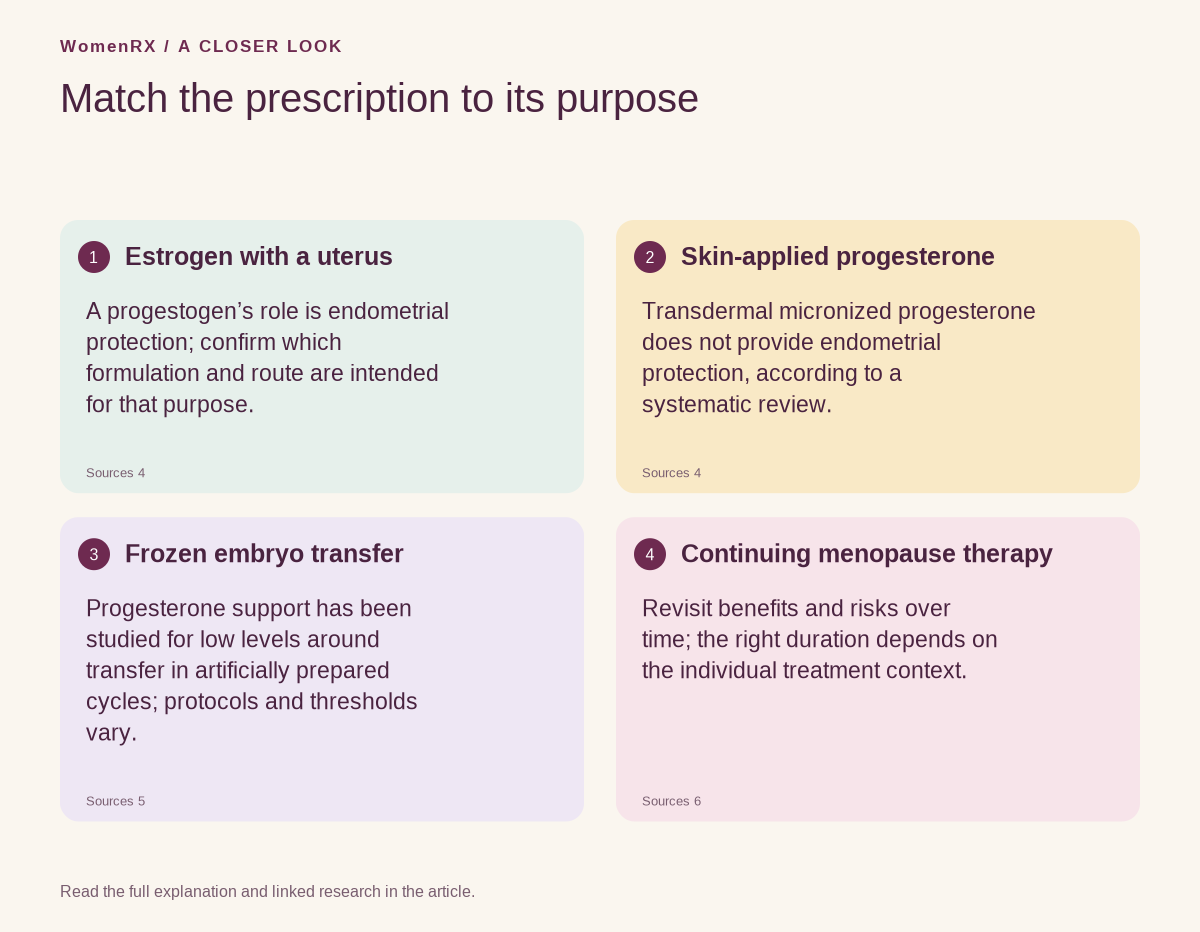
Match the prescription to its purpose
Estrogen with a uterus: A progestogen’s role is endometrial protection; confirm which formulation and route are intended for that purpose.4
Skin-applied progesterone: Transdermal micronized progesterone does not provide endometrial protection, according to a systematic review.4
Frozen embryo transfer: Progesterone support has been studied for low levels around transfer in artificially prepared cycles; protocols and thresholds vary.5
Continuing menopause therapy: Revisit benefits and risks over time; the right duration depends on the individual treatment context.6
Read the figure as text
The same broad medication family can serve different goals. Start with the treatment setting, then clarify route, duration, and the risks relevant to the specific product.- Estrogen with a uterus: A progestogen’s role is endometrial protection; confirm which formulation and route are intended for that purpose.4
- Skin-applied progesterone: Transdermal micronized progesterone does not provide endometrial protection, according to a systematic review.4
- Frozen embryo transfer: Progesterone support has been studied for low levels around transfer in artificially prepared cycles; protocols and thresholds vary.5
- Continuing menopause therapy: Revisit benefits and risks over time; the right duration depends on the individual treatment context.6
More questions, answered
Is progesterone the same as medroxyprogesterone acetate?
No. Micronized progesterone and medroxyprogesterone acetate are distinct products; MPA is a derivative of progesterone. Their uses and evidence aren’t automatically interchangeable, so check the exact medication name on the prescription. 1 2 3
Does progesterone protect the uterus no matter how it’s used?
No. A systematic review concluded that transdermal micronized progesterone does not provide endometrial protection. Route and formulation matter, so don’t assume a skin-applied product serves the same purpose as a prescribed oral or vaginal regimen. 4
Sources you can check
- PREMPHASE (CONJUGATED ESTROGENS AND MEDROXYPROGESTERONE ACETATE) KIT PREMPRO (CONJUGATED ESTROGENS AND MEDROXYPROGESTERONE ACETATE) TABLET, SUGAR COATED [WYETH PHARMACEUTICALS LLC, A SUBSIDIARY OF PFIZER INC.] | US prescribing information and patient instructionsAccessed 2026-09-25Return to first citation
- DEPO-PROVERA (MEDROXYPROGESTERONE ACETATE) INJECTION, SUSPENSION [PHARMACIA & UPJOHN COMPANY LLC] | US prescribing information and patient instructionsAccessed 2026-09-25Return to first citation
- Position paper of the expert panel of the Polish Society of Menopause and Andropause on the use of Oestrogel® in menopausal hormone therapy.Bińkowska M, Paszkowski T, Skrzypulec-Plinta V, Zgliczyński W. · Przeglad menopauzalny = Menopause review · 2025Return to first citation
- The impact of micronized progesterone on the endometrium: a systematic review.Stute P, Neulen J, Wildt L. · Climacteric : the journal of the International Menopause Society · 2016Return to first citation
- Reproductive outcomes after rescue luteal phase support for women with low serum progesterone in artificial cycles around frozen embryo transfer day: Systematic review and network meta-analysis of over 7500 patients.Etrusco A, Agrifoglio V, D'Amato A, Wyns C, Di Donna MC, Vitagliano A, Alviggi C, Conforti A, Laganà AS, Busnelli A, Levi Setti PE, Riemma G. · International journal of gynaecology and obstetrics: the official organ of the International Federation of Gynaecology and Obstetrics · 2026Return to first citation
- The 2022 hormone therapy position statement of The North American Menopause Society.“The 2022 Hormone Therapy Position Statement of The North American Menopause Society” Advisory Panel. · Menopause (New York, N.Y.) · 2022Return to first citation