Can progesterone cream protect your uterus during estrogen therapy?
A skin-applied progesterone cream shouldn’t be assumed to protect the uterine lining when you use systemic estrogen.
If you have a uterus and use systemic estrogen, a progesterone cream rubbed onto the skin is not an evidence-supported substitute for a progestogen regimen shown to protect the uterine lining. A systematic review concluded that transdermal micronized progesterone does not provide endometrial protection. Ask about the exact product and regimen, rather than relying on labels such as “natural” or “bioidentical.” 2
The key distinction is where the progesterone goes
A progesterone cream applied to your skin is a transdermal product. That route isn’t interchangeable with oral progesterone, vaginal progesterone, or a progestogen delivered inside the uterus. The name on the package may sound similar, but evidence for one route doesn’t establish that another route protects the uterine lining.
For people with a uterus using systemic estrogen, this distinction matters because unopposed estrogen can lead to endometrial overgrowth, called hyperplasia. A systematic review of micronized progesterone concluded that transdermal progesterone does not provide endometrial protection. So a skin cream shouldn’t be counted on to provide that protection just because it contains progesterone. 12
What has evidence, and what still needs checking
The same review found evidence for endometrial protection with oral micronized progesterone in a studied sequential regimen. It also described possible protection with certain vaginal regimens, but characterized vaginal use as off-label. Those findings don’t mean that every dose, schedule, product, or route works equally well. Your estrogen regimen and the specific progestogen plan need to be considered together. 2
A levonorgestrel intrauterine device is another distinct option, not a progesterone cream. A systematic review covering 11 studies in perimenopausal and postmenopausal women using estrogen therapy found that the device protected against endometrial hyperplasia in the studies reviewed. The review included both randomized and non-comparative studies, so its findings shouldn’t be taken to mean every device or estrogen regimen is interchangeable. 1
The evidence cited here doesn’t establish the US approval status of any particular cream. Before relying on one, ask your prescriber or pharmacist to identify the exact product and confirm whether that product is approved for endometrial protection with your treatment, and what evidence supports its specific route and regimen. “Bioidentical,” “natural,” and “compounded” aren’t answers to those product-specific questions.
Questions that get you a clearer answer
If you’re already using a skin cream or considering one, you can ask:
- Is this product applied to the skin, used vaginally, or taken by mouth?
- Is it intended to protect the uterine lining while I use systemic estrogen, or for another reason?
- What evidence supports this exact product and regimen for endometrial protection?
- If it isn’t the protection plan, what alternative is appropriate for my situation?
The useful takeaway is simple: don’t treat a skin-applied progesterone cream as the progestogen part of systemic estrogen therapy unless the exact product and regimen have evidence for that purpose. The route matters, and a similar ingredient name doesn’t prove equivalent protection.
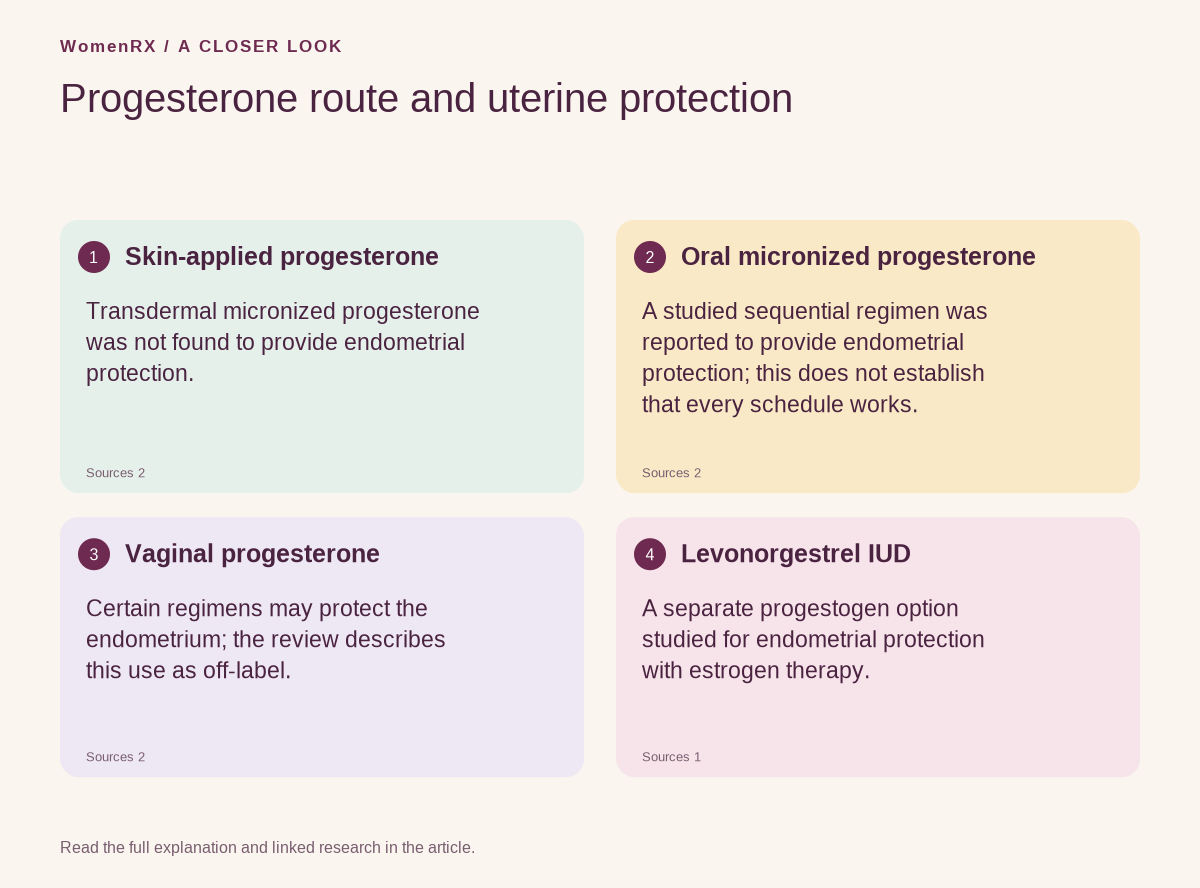
Progesterone route and uterine protection
Skin-applied progesterone: Transdermal micronized progesterone was not found to provide endometrial protection.2
Oral micronized progesterone: A studied sequential regimen was reported to provide endometrial protection; this does not establish that every schedule works.2
Vaginal progesterone: Certain regimens may protect the endometrium; the review describes this use as off-label.2
Levonorgestrel IUD: A separate progestogen option studied for endometrial protection with estrogen therapy.1
Read the figure as text
These routes aren’t interchangeable. The evidence cited here distinguishes skin-applied progesterone from other approaches studied for endometrial protection.- Skin-applied progesterone: Transdermal micronized progesterone was not found to provide endometrial protection.2
- Oral micronized progesterone: A studied sequential regimen was reported to provide endometrial protection; this does not establish that every schedule works.2
- Vaginal progesterone: Certain regimens may protect the endometrium; the review describes this use as off-label.2
- Levonorgestrel IUD: A separate progestogen option studied for endometrial protection with estrogen therapy.1
More questions, answered
Is vaginal progesterone the same as progesterone cream rubbed onto the skin?
No. They use different routes, and evidence for vaginal progesterone doesn’t establish that a skin-applied cream protects the uterine lining. The review described some vaginal regimens as potentially protective, but off-label. 2
Does feeling better on a progesterone cream show that it protects the uterine lining?
No. Symptom changes don’t establish endometrial protection. The relevant question is whether the exact product and regimen have evidence for protecting the uterine lining when used with systemic estrogen. 2
Sources you can check
- Benefits of Levonorgestrel Intrauterine Device Use vs. Oral or Transdermal Progesterone for Postmenopausal Women Using Estrogen Containing Hormone Therapy.Clark K, Westberg SM. · Innovations in pharmacy · 2019Return to first citation
- The impact of micronized progesterone on the endometrium: a systematic review.Stute P, Neulen J, Wildt L. · Climacteric : the journal of the International Menopause Society · 2016Return to first citation