Does Progesterone Cream Work for Menopause Symptoms or HRT Protection?
A progesterone cream’s possible symptom effects and its ability to protect the uterine lining are separate questions, and marketing terms don’t answer either one.
Evidence that progesterone cream relieves menopause symptoms is limited: one small randomized trial found no detectable improvement in hot flashes or mood over 12 weeks. That does not establish that every cream has no effect. But a cream shouldn’t be assumed to protect the uterine lining when you use estrogen; evidence and safety depend on the specific product and regimen. 6 3
Two different goals, two different kinds of evidence
A cream marketed as “natural progesterone” may be promoted for hot flashes, sleep, mood, or as a way to balance estrogen. Those symptom claims are not the same as showing that a progesterone product protects the uterine lining during estrogen therapy. A product would need relevant evidence for the goal you’re considering, in the formulation and regimen you’d actually use.
The word “natural” doesn’t establish that a cream works like another progesterone product. A review explains that hormones described as bioidentical may have the same chemical structure as hormones used in conventional therapy, while custom-compounded preparations can vary in purity, potency, and quality. That review also identifies topical progesterone’s effects on the endometrium as an area of uncertainty. 3
For hot flashes and other menopause symptoms
The direct clinical evidence for progesterone cream is limited. In one randomized, placebo-controlled trial, 80 postmenopausal women used progesterone cream or placebo for 12 weeks. The researchers found no detectable change in vasomotor symptoms, mood, or sexual feelings with the cream. One small trial can’t prove that all creams or all outcomes are ineffective, but it doesn’t support relying on cream for symptom relief. 6
An older North American Menopause Society position statement said that few data supported topical progesterone cream for hot flashes. That statement is from 2004, so it’s best read as historical context rather than a current treatment recommendation. 7
For bothersome hot flashes, current menopause guidance identifies hormone therapy as the most effective treatment, while stressing that benefits and risks vary by the person and the treatment. If hormone therapy isn’t a good fit or isn’t your preference, the 2023 position statement lists evidence-based nonhormonal options, including certain prescription medicines, cognitive behavioral therapy, and clinical hypnosis. These are alternatives to discuss based on your symptoms and circumstances, not evidence that progesterone cream works. 4 5
If you use estrogen and have a uterus
The question here is whether the specific estrogen and progestogen regimen provides appropriate protection for the uterine lining. Estrogen without a progestin can increase endometrial cancer risk in a woman with a uterus; adding a progestin has been shown to reduce endometrial hyperplasia, which can precede cancer. The applicable product and regimen matter, so don’t treat an over-the-counter or compounded cream as interchangeable with a prescribed product on the basis of the word “progesterone.” 2 3
There is a concrete example of why product-specific evidence matters: the prescribing information for an estradiol-and-micronized-progesterone capsule reports a one-year endometrial safety assessment in postmenopausal women using that product. That finding belongs to the tested capsule and regimen; it does not establish that progesterone cream offers the same protection. 1
Before combining estrogen with a cream, ask the prescriber or pharmacist: What exact estrogen product am I using? Does my uterus mean I need a progestogen with this regimen? What evidence supports this specific progesterone product and route for endometrial protection? If the answer rests on a cream’s marketing claims rather than evidence for the product and regimen, don’t assume it protects the lining.
A practical way to assess the claim
Check the label for the exact ingredients, route, and whether the product is a standardized prescription formulation or custom compounded. Then match the evidence to your goal: symptom improvement, endometrial protection, or both. Evidence for one doesn’t prove the other, and evidence from a capsule doesn’t establish an effect for a cream. 1 3 6
If you’re using estrogen and have persistent or recurring unusual genital bleeding after menopause, the estradiol vaginal cream prescribing information says this should be evaluated, with diagnostic testing when indicated. Don’t use a progesterone cream as a substitute for finding out what’s causing the bleeding. 2
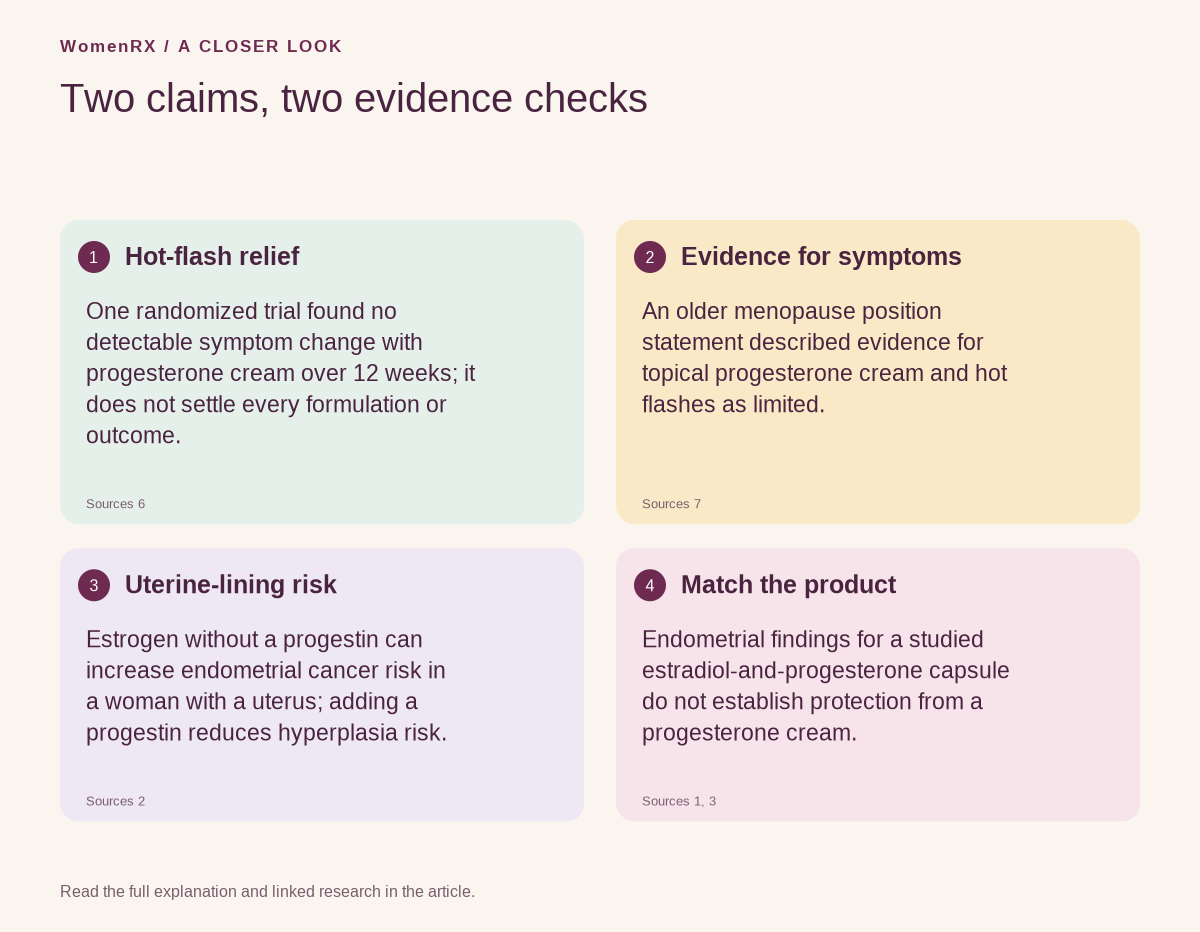
Two claims, two evidence checks
Hot-flash relief: One randomized trial found no detectable symptom change with progesterone cream over 12 weeks; it does not settle every formulation or outcome.6
Evidence for symptoms: An older menopause position statement described evidence for topical progesterone cream and hot flashes as limited.7
Uterine-lining risk: Estrogen without a progestin can increase endometrial cancer risk in a woman with a uterus; adding a progestin reduces hyperplasia risk.2
Match the product: Endometrial findings for a studied estradiol-and-progesterone capsule do not establish protection from a progesterone cream.13
Read the figure as text
Symptom relief and uterine-lining protection are distinct goals; evidence for one product or goal does not establish the other.- Hot-flash relief: One randomized trial found no detectable symptom change with progesterone cream over 12 weeks; it does not settle every formulation or outcome.6
- Evidence for symptoms: An older menopause position statement described evidence for topical progesterone cream and hot flashes as limited.7
- Uterine-lining risk: Estrogen without a progestin can increase endometrial cancer risk in a woman with a uterus; adding a progestin reduces hyperplasia risk.2
- Match the product: Endometrial findings for a studied estradiol-and-progesterone capsule do not establish protection from a progesterone cream.13
More questions, answered
Does “natural” mean progesterone cream is the same as prescribed progesterone?
No. “Natural” or “bioidentical” describes a marketing or hormone-identity claim, not proof that two products have the same formulation, quality, effects, or evidence. A review notes concerns about variability in custom-compounded preparations. 3
Can I use progesterone cream with estrogen if I still have my uterus?
Don’t assume the cream protects your uterine lining. Ask whether your specific estrogen regimen requires a progestogen and what evidence supports the exact product and route being proposed. Estrogen without a progestin can increase endometrial cancer risk, and adding a progestin has been shown to reduce endometrial hyperplasia. 2
Sources you can check
- BIJUVA (ESTRADIOL AND PROGESTERONE) CAPSULE [MAYNE PHARMA] | US prescribing information and patient instructionsAccessed 2026-09-25Return to first citation
- ESTRACE (ESTRADIOL) CREAM [ALLERGAN, INC.] | US prescribing information and patient instructionsAccessed 2026-09-25Return to first citation
- Bioidentical hormones.Stanczyk FZ, Matharu H, Winer SA. · Climacteric : the journal of the International Menopause Society · 2021Return to first citation
- The 2022 hormone therapy position statement of The North American Menopause Society.“The 2022 Hormone Therapy Position Statement of The North American Menopause Society” Advisory Panel. · Menopause (New York, N.Y.) · 2022Return to first citation
- The 2023 nonhormone therapy position statement of The North American Menopause Society.Menopause (New York, N.Y.) · 2023Return to first citation
- Transdermal progesterone and its effect on vasomotor symptoms, blood lipid levels, bone metabolic markers, moods, and quality of life for postmenopausal women.Wren BG, Champion SM, Willetts K, Manga RZ, Eden JA. · Menopause (New York, N.Y.) · 2003Return to first citation
- Treatment of menopause-associated vasomotor symptoms: position statement of The North American Menopause Society.North American Menopause Society. · Menopause (New York, N.Y.) · 2004Return to first citation