Does Progesterone Cream Relieve Menopause Symptoms, and How Is Benefit Measured?
Trials haven’t shown reliable relief from progesterone cream for hot flashes or mood, and they don’t establish a dependable sleep benefit or uterine protection.
Progesterone cream hasn’t been shown to reliably ease menopause symptoms. In one 12-week trial, postmenopausal women had no detectable improvement in hot flashes or mood with the tested cream; a review found mixed results across three cream trials. Those studies don’t establish a reliable time to benefit, a sleep benefit, or protection of the uterine lining. 4 6
What the studies found, symptom by symptom
The clearest trial findings concern hot flashes and mood. In a randomized, placebo-controlled study, 80 postmenopausal women used either progesterone cream or placebo for 12 weeks. Researchers found no detectable change in hot flashes, mood characteristics, or sexual feelings with the cream, although blood progesterone rose slightly. This result applies to the cream tested, not every product sold as progesterone cream. 4
A review of three randomized trials found mixed results for hot flashes. One trial using a cream compounded specifically for that study reported greater relief than placebo. Two trials of manufactured creams did not. The review concluded that the trial evidence did not support progesterone cream for menopause-related hot flashes. A single positive trial does not show that other compounded creams work, or that creams with similar labels deliver the same amount of hormone. 6
Sleep is less clear. The studies summarized don’t establish that progesterone cream improves sleep itself. If night sweats ease, sleep might improve as a result, but that possibility is different from evidence that the cream treats sleep problems. The 12-week trial did not detect a change in mood characteristics either. 4
The studies also don’t give a useful comparison by menopausal stage. The symptom trial involved postmenopausal women; a separate study included peri- and postmenopausal women but looked at skin outcomes, not relief of menopause symptoms. So those skin findings can’t tell you whether the cream helps symptoms during perimenopause. 3 4
A skin study doesn’t answer a symptom question
A randomized study of 40 peri- and postmenopausal women tested 2% progesterone cream for 16 weeks and measured skin elasticity, hydration, and other skin outcomes. It reported improvements in some measures of skin elasticity and firmness, with a minimal rise in mean blood progesterone. It wasn’t a trial of hot flashes, mood, or sleep, so it shouldn’t be used as proof that the cream treats those symptoms. 3
Wild yam cream is another product sometimes discussed alongside progesterone, but it isn’t the same thing. In a crossover trial of 23 menopausal women, wild yam cream did not produce a significant symptom difference compared with placebo. That result is about wild yam cream, not progesterone cream. 5
Symptom relief and uterine protection are separate questions
A cream’s effect on a symptom is not proof that it provides reliable hormone delivery or protects the uterine lining. The progesterone-cream symptom trials summarized in the review do not establish uterine protection. If you have a uterus and use estrogen, don’t assume that a progesterone cream is an adequate progestogen component. Ask the clinician managing your estrogen to clarify what protection is intended. 1 4 6
This distinction matters because evidence for hormone therapy as a treatment does not automatically apply to every product or route. The North American Menopause Society identifies hormone therapy as the most effective treatment for bothersome hot flashes and night sweats, and says its benefits and risks vary with factors including the type and route of treatment and whether a progestogen is used. That guidance does not make progesterone cream interchangeable with a studied hormone-therapy regimen. 1
Make a response measurable, not guessable
There’s no dependable cream-specific timeline to promise. The 12-week study found no detectable improvement with the tested cream; 12 weeks was the study period, not a proven waiting time for benefit. 4
If you’re assessing a product, start with one main symptom you want to change. For example, note how often hot flashes or night sweats happen, how disruptive they are, or how often sleep is interrupted. Revisit the same observation later rather than relying only on a general impression. This is a practical way to make a discussion more concrete, not a validated test of treatment response.
Keep the product name and formulation handy, and note whether you’re also using estrogen. Record unwanted effects as well as possible benefits. Vaginal bleeding and headaches were the most commonly reported adverse effects in the three cream trials summarized by the review; that finding doesn’t establish the safety of every formulation. 6
If hot flashes or night sweats are the main concern, options with stronger evidence are available. Menopause guidance identifies hormone therapy as the most effective treatment for vasomotor symptoms. For women who aren’t good candidates for hormone therapy or prefer not to use it, the North American Menopause Society’s nonhormone statement recommends several options, including cognitive behavioral therapy and certain prescription treatments. 1 2
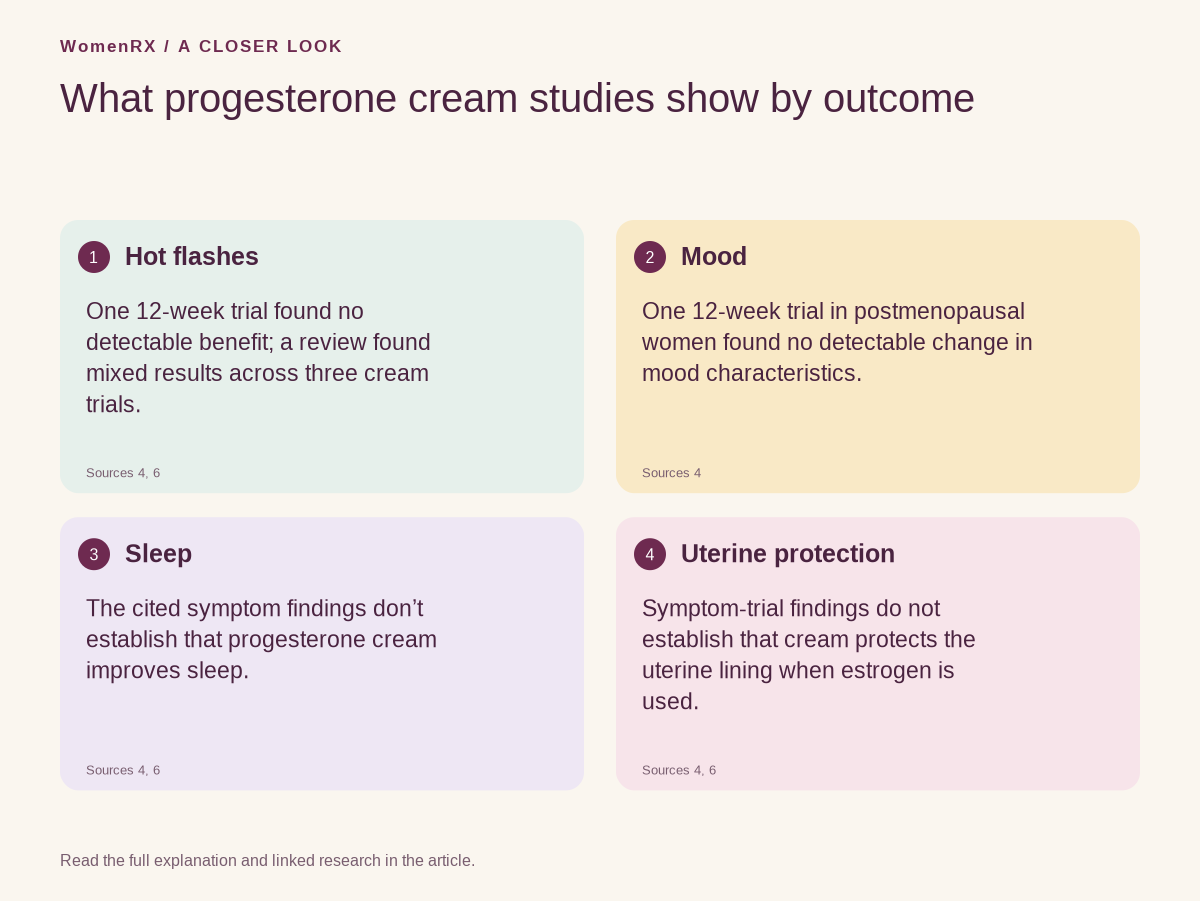
What progesterone cream studies show by outcome
Hot flashes: One 12-week trial found no detectable benefit; a review found mixed results across three cream trials.46
Mood: One 12-week trial in postmenopausal women found no detectable change in mood characteristics.4
Sleep: The cited symptom findings don’t establish that progesterone cream improves sleep.46
Uterine protection: Symptom-trial findings do not establish that cream protects the uterine lining when estrogen is used.46
Read the figure as text
The findings vary by symptom and formulation. Symptom relief, hormone delivery, and uterine protection are separate questions.- Hot flashes: One 12-week trial found no detectable benefit; a review found mixed results across three cream trials.46
- Mood: One 12-week trial in postmenopausal women found no detectable change in mood characteristics.4
- Sleep: The cited symptom findings don’t establish that progesterone cream improves sleep.46
- Uterine protection: Symptom-trial findings do not establish that cream protects the uterine lining when estrogen is used.46
More questions, answered
How quickly should progesterone cream work?
There isn’t a dependable onset time established for progesterone cream. One placebo-controlled study assessed a particular cream over 12 weeks and found no detectable improvement in hot flashes or mood. That study period isn’t a proven timeline for benefit. 4
Is wild yam cream the same as progesterone cream?
No. A small crossover trial of wild yam cream in 23 menopausal women found no significant symptom difference between the active cream and placebo. That finding doesn’t establish the effect of progesterone cream. 5
Sources you can check
- The 2022 hormone therapy position statement of The North American Menopause Society.“The 2022 Hormone Therapy Position Statement of The North American Menopause Society” Advisory Panel. · Menopause (New York, N.Y.) · 2022Return to first citation
- The 2023 nonhormone therapy position statement of The North American Menopause Society.Menopause (New York, N.Y.) · 2023Return to first citation
- Effects and side-effects of 2% progesterone cream on the skin of peri- and postmenopausal women: results from a double-blind, vehicle-controlled, randomized study.Holzer G, Riegler E, Hönigsmann H, Farokhnia S, Schmidt JB. · The British journal of dermatology · 2005Return to first citation
- Transdermal progesterone and its effect on vasomotor symptoms, blood lipid levels, bone metabolic markers, moods, and quality of life for postmenopausal women.Wren BG, Champion SM, Willetts K, Manga RZ, Eden JA. · Menopause (New York, N.Y.) · 2003Return to first citation
- Effects of wild yam extract on menopausal symptoms, lipids and sex hormones in healthy menopausal women.Komesaroff PA, Black CV, Cable V, Sudhir K. · Climacteric : the journal of the International Menopause Society · 2001Return to first citation
- Bioidentical progesterone cream for menopause-related vasomotor symptoms: is it effective?Whelan AM, Jurgens TM, Trinacty M. · The Annals of pharmacotherapy · 2013Return to first citation