Is progesterone lotion different from progesterone cream?
Lotion and cream are product forms, not proof of different absorption or uterine protection.
A progesterone lotion may differ from a cream in its ingredients or how it delivers progesterone, but the word “lotion” alone can’t tell you how much is absorbed. A small study in postmenopausal women found different blood levels with one skin-applied cream and gel; it didn’t test lotion or uterine protection. Compare the active ingredient, amount, and application route, not just the texture. 2
The name tells you less than the label
“Lotion” and “cream” describe a product’s form. They don’t establish how much progesterone it contains, how it’s absorbed, or what it can do. To compare two products, look at the active ingredient, the stated amount of progesterone, the other ingredients, and whether the directions say to apply it to skin or use it vaginally.
Those details matter more than whether one product feels lighter or spreads more easily. But even a complete label comparison can’t show whether a particular product delivers enough progesterone for a specific menopause-related purpose.
What a skin-applied product study found
A randomized crossover study tested one progesterone cream and one gel, both applied to the skin, in 10 postmenopausal women. Participants used each formulation for 14 days. On the final day, the researchers measured progesterone in blood and saliva over 24 hours. Blood serum exposure was higher with the cream than the gel in this study. 2
That finding shows why it’s not safe to assume that every formulation behaves identically. It does not show that all creams absorb more than all gels, or tell us how a lotion compares with a cream. The study tested neither a lotion nor a range of products, and it measured hormone levels rather than menopause symptom relief or uterine-lining protection. 2
Skin and vaginal products aren’t interchangeable
The application route is another key difference. A small randomized crossover study of vaginal progesterone gel involved 19 couples, with women aged 18 to 40. The researchers found lower serum progesterone levels in women after intercourse than when they used the gel and abstained. That study was about vaginal use in a reproductive-age population, not skin-applied products for menopause care. Its results can’t tell you how a lotion or skin cream behaves. 1
So if a product says “topical,” check its directions to see where it’s meant to be applied. Evidence about a vaginal product doesn’t automatically answer questions about a skin product, and vice versa.
If you’re considering it with estrogen
If you’re using estrogen and have a uterus, don’t assume that a progesterone lotion or cream protects the uterine lining based on its name, texture, or a claim that it absorbs. The skin-applied cream-and-gel study did not assess uterine protection. 2
For a product you’re considering, show the full label and route of use to the clinician managing your menopause care. Ask whether that exact product and formulation are intended for your situation. This is a different question from whether the product feels or spreads differently.
The practical takeaway: lotion and cream may be formulated differently, but the label alone can’t prove a difference in absorption or establish protection. The available skin study offers a limited comparison between one cream and one gel, not a product-by-product answer for lotions. 2
Compare the product, not just its texture
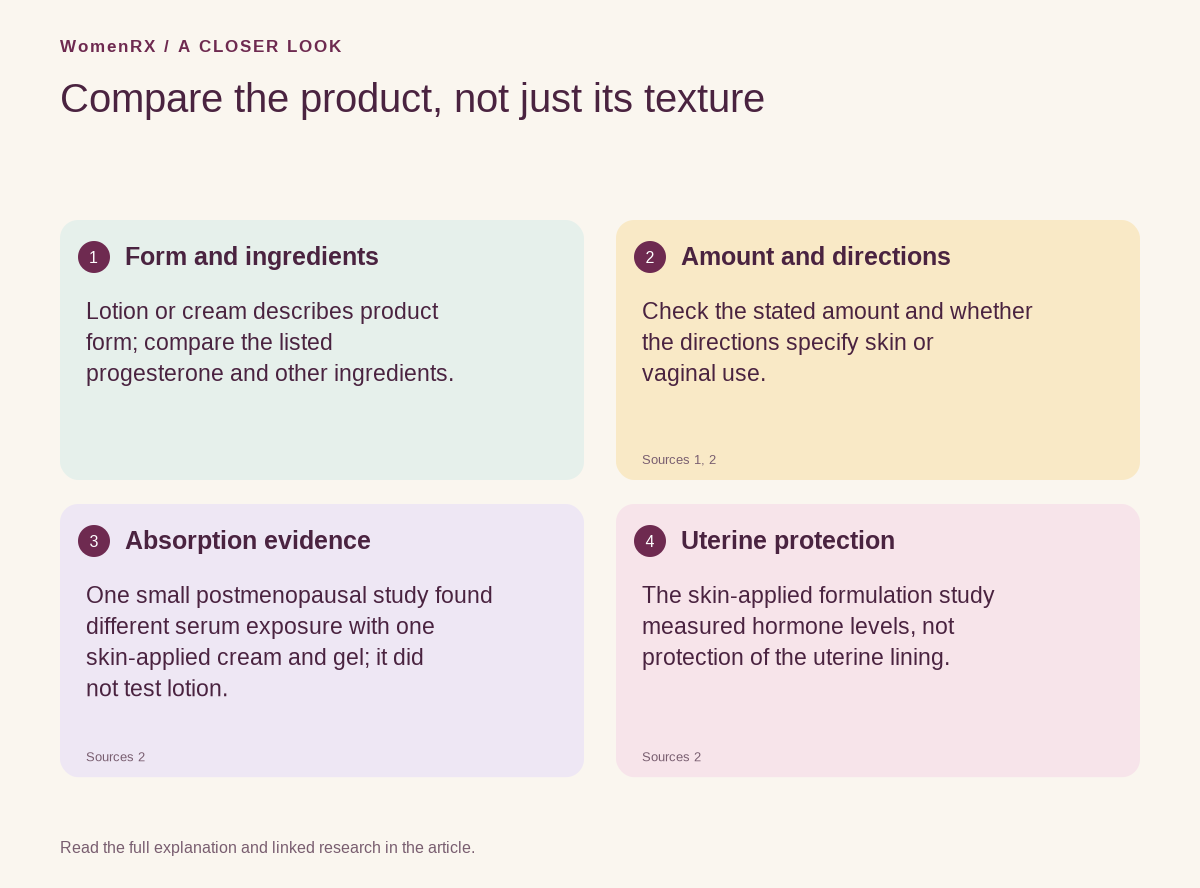
Form and ingredients: Lotion or cream describes product form; compare the listed progesterone and other ingredients.
Amount and directions: Check the stated amount and whether the directions specify skin or vaginal use.12
Absorption evidence: One small postmenopausal study found different serum exposure with one skin-applied cream and gel; it did not test lotion.2
Uterine protection: The skin-applied formulation study measured hormone levels, not protection of the uterine lining.2
Read the figure as text
These details help distinguish what you can read on a product label from what requires evidence about that exact formulation and use.- Form and ingredients: Lotion or cream describes product form; compare the listed progesterone and other ingredients.
- Amount and directions: Check the stated amount and whether the directions specify skin or vaginal use.12
- Absorption evidence: One small postmenopausal study found different serum exposure with one skin-applied cream and gel; it did not test lotion.2
- Uterine protection: The skin-applied formulation study measured hormone levels, not protection of the uterine lining.2
Sources you can check
- Sexual absorption of vaginal progesterone: a randomized control trial.Merriam KS, Leake KA, Elliot M, Matthews ML, Usadi RS, Hurst BS. · International journal of endocrinology · 2015Return to first citation
- Percutaneous progesterone delivery via cream or gel application in postmenopausal women: a randomized cross-over study of progesterone levels in serum, whole blood, saliva, and capillary blood.Du JY, Sanchez P, Kim L, Azen CG, Zava DT, Stanczyk FZ. · Menopause (New York, N.Y.) · 2013Return to first citation