Can Progesterone Cream Relieve Menopause Symptoms?
The evidence for progesterone cream is limited, and it shouldn’t be treated as interchangeable with other hormone therapy or assumed to protect the uterus.
Progesterone cream may be absorbed through the skin, but that doesn’t show it reliably relieves hot flashes, sleep problems, or other menopause symptoms. Research on cream for hot flashes is sparse, and a small study of cream used with estrogen is not enough to establish uterine protection. If you use systemic estrogen and have a uterus, confirm what provides that protection rather than assuming a cream does. 4 8 3 2

What the evidence says about symptom relief
If you’re considering progesterone cream for hot flashes or other menopause symptoms, the key distinction is between a hormone getting into the body and a treatment being shown to help. Small studies show that progesterone can be absorbed through the skin. They don’t establish that cream reliably relieves menopause symptoms. 4 5
For hot flashes specifically, a North American Menopause Society position statement said there were few data supporting topical progesterone cream. That statement is older, so it shouldn’t be read as a current review of every product. It does, however, capture the central limitation: evidence for cream is not the same as evidence for other hormone treatments. 8
By comparison, the Society’s 2022 statement describes hormone therapy as the most effective treatment for hot flashes and night sweats, with its benefit-risk balance depending on factors such as age, timing, formulation, and personal health. That broad evidence for hormone therapy does not establish that progesterone cream alone, or a particular cream, works for those symptoms. 6
Absorption doesn’t prove a useful effect
In a randomized crossover study, 10 postmenopausal women used progesterone cream and gel for short periods. Progesterone levels changed after application, but the study measured hormone levels, not whether symptoms improved. A separate study in 19 women found a small average rise in serum progesterone after six weeks of cream use, with wide variation between women; its authors said the clinical benefit remained unknown. 4 5
These studies also show why a hormone number can be misleading. In the crossover study, saliva and fingertip blood readings were much higher than serum readings. The authors warned that relying on serum levels to monitor topical doses could underestimate exposure. That finding does not provide a validated way to adjust a cream dose or predict symptom relief. 4
Creams are not all necessarily the same formulation. Findings from a particular product and study can’t automatically be applied to every over-the-counter or compounded cream. MedlinePlus notes that research on products marketed as “natural” hormone creams is mixed and long-term safety information is limited. 1
The separate question: protecting the uterus while using estrogen
If you have a uterus and use systemic estrogen, the estrogen can stimulate the uterine lining. A progestogen is added to counter that effect and reduce the risk of endometrial overgrowth. This is a different treatment goal from easing hot flashes, and evidence for one goal does not prove the other. 2
There is one small study that makes this question less simple, but doesn’t settle it. Twenty-six healthy menopausal women completed both six-month treatment periods: estrogen with transdermal progesterone cream and estrogen with oral medroxyprogesterone. Among 52 post-treatment biopsies, none showed endometrial hyperplasia. However, 12 showed proliferative endometrium, the study was small and short, and the result cannot establish long-term protection or prove that creams generally protect the uterine lining. 3
Other progesterone or progestogen approaches have their own evidence. For example, a review of studies in people using estrogen reported evidence that a levonorgestrel IUD prevented endometrial hyperplasia comparably to oral or vaginal progesterone in the included research. Those findings apply to those approaches, not automatically to a skin cream. 2
If you’re using systemic estrogen and have a uterus, ask the clinician who prescribed it to identify your specific endometrial-protection plan and the evidence for that formulation. Don’t assume that a cream provides protection because it contains progesterone or because a hormone test shows absorption. 2 3 4
A practical way to judge a cream claim
Start with the outcome you want: fewer hot flashes, better sleep, or protection of the uterine lining are different questions. For symptom relief, look for evidence measuring that symptom, not just hormone levels. For protection during estrogen therapy, look for evidence about endometrial outcomes with the exact type of treatment, not simply evidence that progesterone enters the bloodstream. The current evidence described here does not justify treating topical cream as a proven solution for either purpose. 3 4 8
If hot flashes are the main problem, established options include individualized hormone therapy for appropriate candidates and evidence-based nonhormone treatments for people who prefer or need them. The 2023 menopause position statement lists options such as cognitive behavioral therapy, clinical hypnosis, certain prescription medicines, and weight loss, with different evidence levels. A cream’s possible absorption is not a substitute for comparing treatments based on symptom benefit and personal circumstances. 6 7
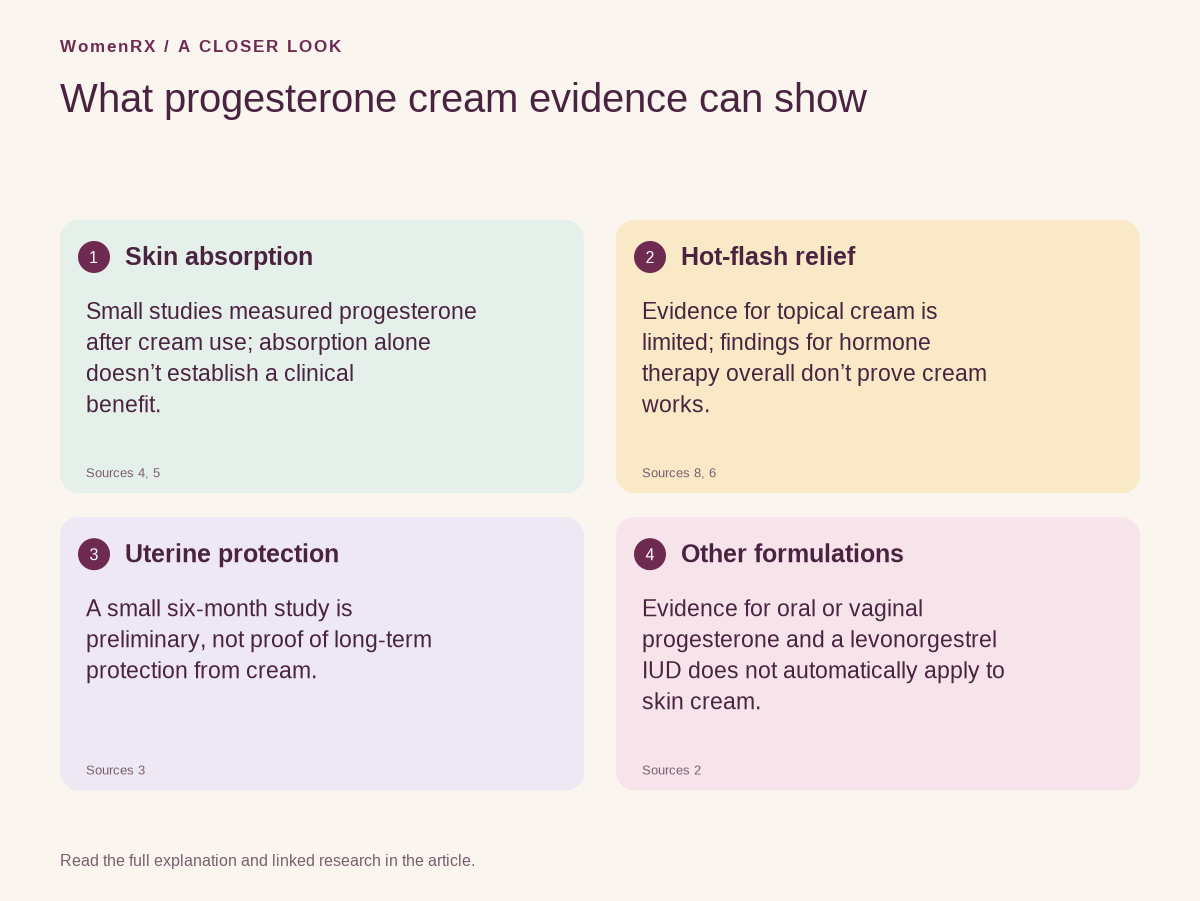
What progesterone cream evidence can show
Skin absorption: Small studies measured progesterone after cream use; absorption alone doesn’t establish a clinical benefit.45
Hot-flash relief: Evidence for topical cream is limited; findings for hormone therapy overall don’t prove cream works.86
Uterine protection: A small six-month study is preliminary, not proof of long-term protection from cream.3
Other formulations: Evidence for oral or vaginal progesterone and a levonorgestrel IUD does not automatically apply to skin cream.2
Read the figure as text
Separate evidence of absorption, symptom relief, and uterine protection before deciding what a cream claim means.- Skin absorption: Small studies measured progesterone after cream use; absorption alone doesn’t establish a clinical benefit.45
- Hot-flash relief: Evidence for topical cream is limited; findings for hormone therapy overall don’t prove cream works.86
- Uterine protection: A small six-month study is preliminary, not proof of long-term protection from cream.3
- Other formulations: Evidence for oral or vaginal progesterone and a levonorgestrel IUD does not automatically apply to skin cream.2
More questions, answered
Can progesterone cream replace the progestogen prescribed with estrogen?
Don’t assume it can. A small six-month study found no endometrial hyperplasia in the biopsies of 26 women who completed both study treatments, but it cannot establish long-term protection or prove that creams generally protect the uterine lining. Ask what specific treatment is intended to protect your uterus. 3 2
Can a progesterone blood test show whether cream is working?
A blood level doesn’t show whether the cream is relieving a symptom or protecting the uterine lining. In a small study, topical use produced very different progesterone readings across serum, saliva, and fingertip blood; the researchers cautioned that serum readings could underestimate exposure. 4
Sources you can check
- Menopause | Menopause Symptoms | MedlinePlusAccessed 2026-09-25Return to first citation
- Benefits of Levonorgestrel Intrauterine Device Use vs. Oral or Transdermal Progesterone for Postmenopausal Women Using Estrogen Containing Hormone Therapy.Clark K, Westberg SM. · Innovations in pharmacy · 2019Return to first citation
- Transdermal progesterone cream as an alternative progestin in hormone therapy.Leonetti HB, Landes J, Steinberg D, Anasti JN. · Alternative therapies in health and medicine · 2005Return to first citation
- Percutaneous progesterone delivery via cream or gel application in postmenopausal women: a randomized cross-over study of progesterone levels in serum, whole blood, saliva, and capillary blood.Du JY, Sanchez P, Kim L, Azen CG, Zava DT, Stanczyk FZ. · Menopause (New York, N.Y.) · 2013Return to first citation
- A study to evaluate serum and urinary hormone levels following short and long term administration of two regimens of progesterone cream in postmenopausal women.Carey BJ, Carey AH, Patel S, Carter G, Studd JW. · BJOG : an international journal of obstetrics and gynaecology · 2000Return to first citation
- The 2022 hormone therapy position statement of The North American Menopause Society.“The 2022 Hormone Therapy Position Statement of The North American Menopause Society” Advisory Panel. · Menopause (New York, N.Y.) · 2022Return to first citation
- The 2023 nonhormone therapy position statement of The North American Menopause Society.Menopause (New York, N.Y.) · 2023Return to first citation
- Treatment of menopause-associated vasomotor symptoms: position statement of The North American Menopause Society.North American Menopause Society. · Menopause (New York, N.Y.) · 2004Return to first citation