Can Menopause Hormone Therapy Relieve Joint Pain?
Joint aches can appear around menopause, but their timing alone doesn’t show what’s causing them or whether hormone therapy will help.
Possibly, but joint-pain relief is not as well established as hormone therapy’s benefits for hot flashes and other recognized menopause symptoms. A small observational study of women with jaw pain found less pain interference among hormone-therapy users, but no difference in pain intensity and no proof of a treatment effect. New aches deserve attention to their pattern, especially if joints are swollen or daily life is affected. 2 3 1
An ache can coincide with menopause without being caused by it
Perimenopause and menopause can come with aching joints. Joint and muscle pain also appeared in surveys of women ages 40 to 60 in Ethiopia and China. Those surveys recorded what women reported at one point in time; they couldn’t determine why a particular joint hurt or whether hormone therapy would ease it. 1 4 5
That distinction matters if you’ve developed a new ache just as your periods are changing or have stopped. Menopause may be part of the picture, but an injury or arthritis may need a different approach. The location of the pain, what brings it on, and whether there’s warmth or swelling can offer better clues than timing alone. 1
What does the hormone-therapy evidence show?
In a pilot study of 45 women with painful temporomandibular disorder, which affects the jaw muscles and joints, researchers compared women with regular menstrual cycles, postmenopausal women not using hormone therapy, and postmenopausal women using it. The hormone-therapy group had lower scores for how much pain interfered with daily life and for some measures of anxiety and depression. The groups did not differ significantly in pain intensity or jaw movement limitation. 3
This was a small cross-sectional comparison, not a trial that assigned hormone therapy and followed pain afterward. It can’t tell us whether therapy caused the differences, much less whether it would relieve pain in a knee, hip, or hand. 3
The North American Menopause Society’s 2022 position statement identifies hormone therapy as the most effective treatment for hot flashes and other vasomotor symptoms and for genitourinary symptoms of menopause; it also notes benefits for preventing bone loss and fracture. Those are different outcomes from relieving joint pain or treating arthritis. The statement calls for decisions that account for a woman’s symptoms and health history, because benefits and risks vary by factors including therapy type, route, and when treatment begins. 2
If you’re already considering hormone therapy for bothersome menopause symptoms, joint aches are worth mentioning as part of the whole picture. The limited joint-pain findings aren’t a sound reason to choose it solely to treat an aching joint or a diagnosed joint disease. 2 3
Which pain patterns suggest another explanation?
These are clues, not diagnoses. For example, pain with swelling or bruising after repetitive activity can fit a sprain or strain. Pain that worsens with walking and stiffness after activity can fit osteoarthritis. Stiffness and pain on both sides that are worse after you’ve been still, such as on waking, can occur with rheumatoid arthritis. Sudden, severe pain in a hot, swollen big toe can occur with gout. 1
Medication timing is another piece of context. Breast-cancer endocrine medicines are not menopausal hormone therapy. A study involving anastrozole, letrozole, exemestane, and tamoxifen describes joint pain as a concern during breast-cancer treatment, but its actual test was whether an S-equol supplement changed drug exposure. It did not test what caused the pain or whether the supplement relieved it. If an ache began after a medication change, tell the clinician managing that treatment rather than assuming menopause explains it. 6
Pain that disrupts sleep or normal activities, worsens, or keeps returning deserves an assessment. Seek prompt care for a hot, swollen joint, particularly if you feel feverish, shivery, or generally unwell. Severe pain after an injury, inability to bear weight, or numbness around an injured joint also needs urgent attention. 1
A useful starting point is to describe what the joint does: which joint hurts, whether movement or rest changes the pain, and whether you can see swelling or feel warmth. That account helps separate a broadly timed menopause symptom from a joint problem that needs its own evaluation. 1
What each finding can tell you
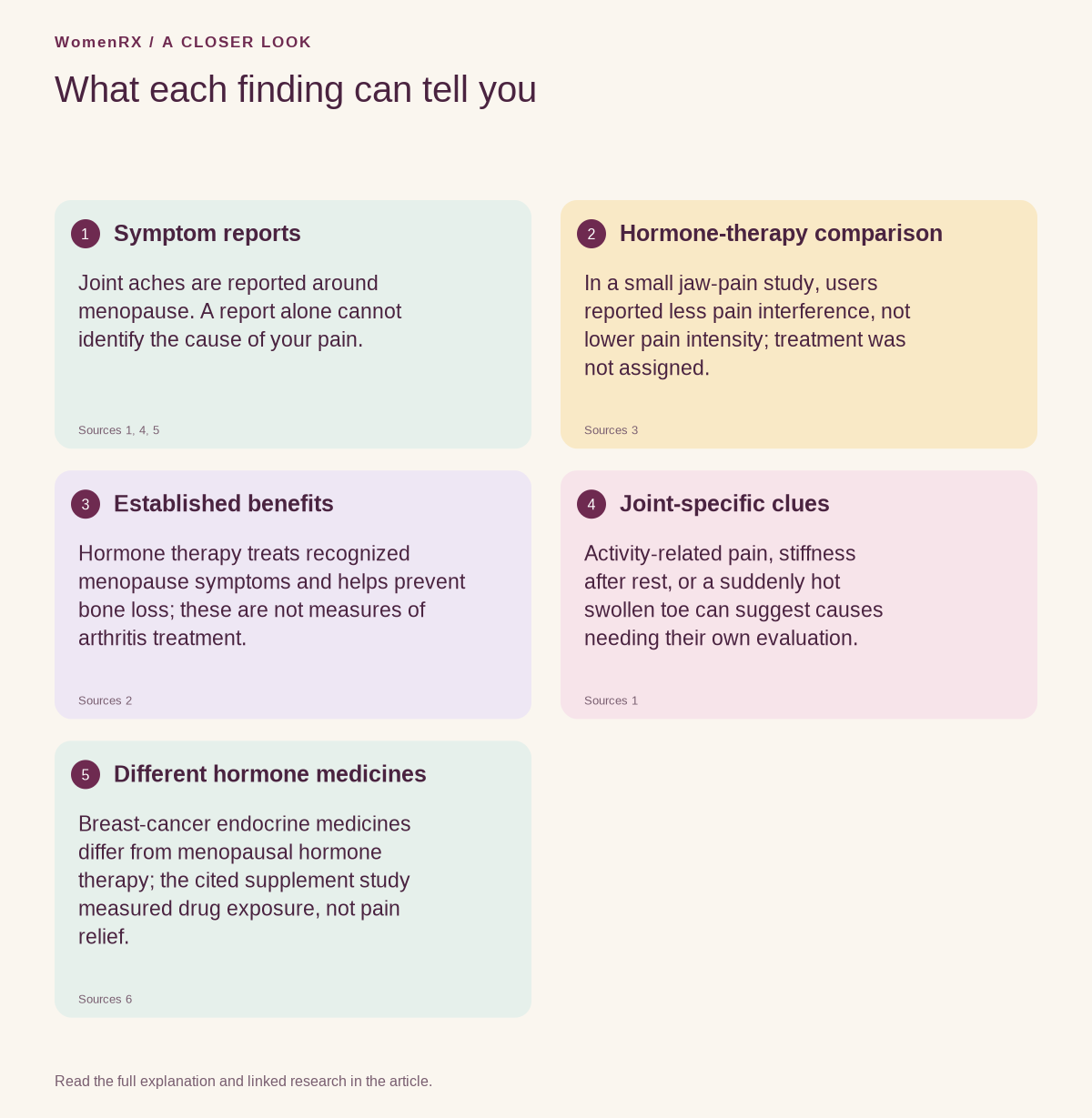
Symptom reports: Joint aches are reported around menopause. A report alone cannot identify the cause of your pain.145
Hormone-therapy comparison: In a small jaw-pain study, users reported less pain interference, not lower pain intensity; treatment was not assigned.3
Established benefits: Hormone therapy treats recognized menopause symptoms and helps prevent bone loss; these are not measures of arthritis treatment.2
Joint-specific clues: Activity-related pain, stiffness after rest, or a suddenly hot swollen toe can suggest causes needing their own evaluation.1
Different hormone medicines: Breast-cancer endocrine medicines differ from menopausal hormone therapy; the cited supplement study measured drug exposure, not pain relief.6
Read the figure as text
Reported aches, a hormone-therapy comparison, and signs of joint disease answer different questions.- Symptom reports: Joint aches are reported around menopause. A report alone cannot identify the cause of your pain.145
- Hormone-therapy comparison: In a small jaw-pain study, users reported less pain interference, not lower pain intensity; treatment was not assigned.3
- Established benefits: Hormone therapy treats recognized menopause symptoms and helps prevent bone loss; these are not measures of arthritis treatment.2
- Joint-specific clues: Activity-related pain, stiffness after rest, or a suddenly hot swollen toe can suggest causes needing their own evaluation.1
- Different hormone medicines: Breast-cancer endocrine medicines differ from menopausal hormone therapy; the cited supplement study measured drug exposure, not pain relief.6
Sources you can check
- Joint pain - NHSAccessed 2026-09-25Return to first citation
- The 2022 hormone therapy position statement of The North American Menopause Society.“The 2022 Hormone Therapy Position Statement of The North American Menopause Society” Advisory Panel. · Menopause (New York, N.Y.) · 2022Return to first citation
- Hormone therapy and psychosocial factors in menopausal women with painful TMD: a pilot cross-sectional study.Farias LNG, Costa Neto RED, Pinheiro MA, Cavalcanti YW. · Journal of applied oral science : revista FOB · 2026Return to first citation
- Menopausal symptoms and utilization of menopausal hormone therapy among women aged 40-60 years in Addis Ababa, Ethiopia: a cross-sectional study.Asfaw TG, Gebreyohannes RD, Tesfaye MT. · BMC women's health · 2024Return to first citation
- Prevalence of menopausal symptoms and attitudes towards menopausal hormone therapy in women aged 40-60 years: a cross-sectional study.Lu J, Li K, Zheng X, Liu R, Chen M, Xian J, Tu S, Xie L. · BMC women's health · 2023Return to first citation
- Lack of effects of S-equol-containing supplement on the pharmacokinetics of oral hormone therapy drugs for breast cancer.Sambe T, Imamura CK, Hida N, Yamazaki T, Mizukami T, Ryu K, Fukunaga K, Mushiroda T, Miyakawa H, Uchiyama S, Uchida N, Kobayashi S. · Cancer chemotherapy and pharmacology · 2025Return to first citation