Joint Pain Around Menopause: What Estrogen Evidence Shows
Joint aches can appear during the menopause transition, but their timing alone can’t tell you what’s causing them.
Estrogen may be part of the picture: joint aches can occur during perimenopause and menopause, and estrogen interacts with joint tissues. Neither fact proves that hormones caused your pain or that hormone therapy will relieve it. Injury and arthritis are other possibilities. The pattern of pain, especially swelling, stiffness, or trouble bearing weight, can help determine what needs attention. 1 4
Where estrogen fits into the picture
Aching joints can occur during perimenopause and menopause. Estrogen also interacts with cartilage and the synovium, tissue that lines a joint. That makes a connection between hormonal change and joint symptoms plausible, but it doesn’t establish why your particular joint hurts. Changes that come with aging, including loss of muscle volume, may be part of the picture too. 1 4
Timing matters, but it’s only one clue. If knee pain began around the same time your periods became irregular, tell your clinician both things. Also mention whether the knee swells or hurts mainly when you walk. Joint pain can follow an injury or come from a condition such as arthritis, even when it starts during the menopause transition. 1
Why a hormone link isn’t a treatment answer
Hormone therapy treats certain menopause concerns, but benefits for one symptom don’t automatically carry over to another. The published summary of the North American Menopause Society’s 2022 position statement names relief of hot flashes and genitourinary symptoms, along with prevention of bone loss and fracture. It doesn’t discuss joint-pain relief. That omission doesn’t settle whether hormone therapy might affect joint pain; it means those named benefits shouldn’t be presented as proof that it treats aching joints. 3
If you’re considering hormone therapy for bothersome hot flashes or another reason, joint pain is still worth discussing separately. The position statement says hormone therapy’s risks vary with the type, route, duration, and timing of treatment, among other factors. Whether it makes sense for your menopause symptoms is a different question from what’s causing a painful joint. 3
The pain pattern offers better clues than timing alone
Notice whether one joint hurts or several, whether there’s visible swelling, and whether movement or rest changes the pain. These patterns can point toward different possibilities, though none is a diagnosis on its own:
- Pain that worsens when walking, with stiffness after activity can occur with osteoarthritis.
- A warm, swollen joint that hurts when moved or pressed can occur with bursitis.
- Pain and stiffness on both sides of the body that are worse after rest, such as on waking, can occur with rheumatoid arthritis. 1
A useful way to describe the problem is: “It started about two months ago, affects both hands, and feels stiffest when I wake up,” or “It’s one knee, and walking makes it worse.” These are examples, not signs that menopause is or isn’t the cause. Where the pain is, when it began, how often it happens, and what changes it are details used in pain assessment. 2
When pain needs attention
Arrange an evaluation if joint pain is affecting your sleep or usual activities, getting worse, or repeatedly coming back. A joint that feels hot and is swollen needs prompt medical assessment, particularly if you also feel feverish or unwell. Don’t wait to see whether that pattern passes with a change in menopause symptoms. 1
Get emergency care for very bad joint pain after a fall or injury, an inability to walk or put weight on the joint, a joint that appears out of place, or tingling or loss of feeling around the joint after an injury. 1
Menopause belongs in the conversation about new joint aches. So do the location and behavior of the pain. Looking at both gives you a better basis for the next step than assuming estrogen explains it.
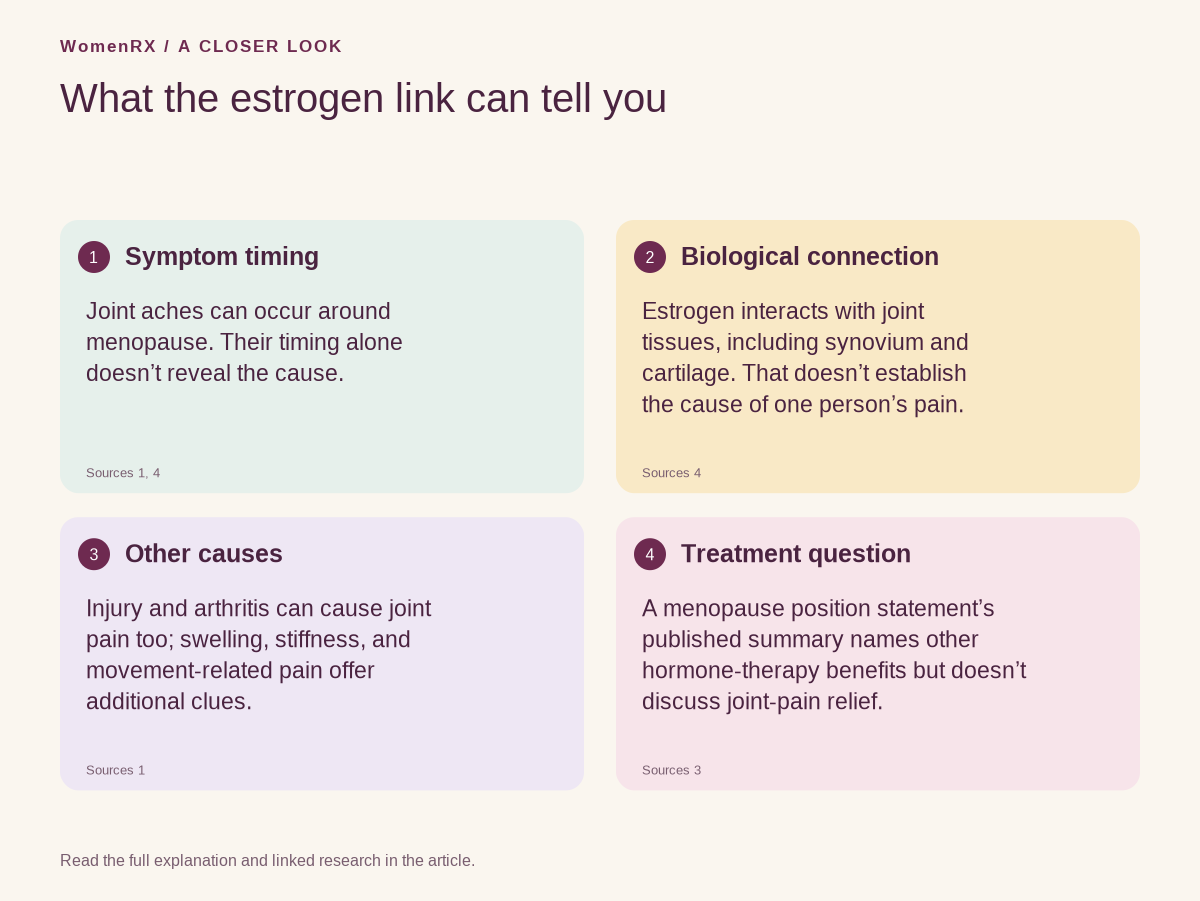
What the estrogen link can tell you
Symptom timing: Joint aches can occur around menopause. Their timing alone doesn’t reveal the cause.14
Biological connection: Estrogen interacts with joint tissues, including synovium and cartilage. That doesn’t establish the cause of one person’s pain.4
Other causes: Injury and arthritis can cause joint pain too; swelling, stiffness, and movement-related pain offer additional clues.1
Treatment question: A menopause position statement’s published summary names other hormone-therapy benefits but doesn’t discuss joint-pain relief.3
Read the figure as text
Four different kinds of information can sound like the same answer, but they support different conclusions.- Symptom timing: Joint aches can occur around menopause. Their timing alone doesn’t reveal the cause.14
- Biological connection: Estrogen interacts with joint tissues, including synovium and cartilage. That doesn’t establish the cause of one person’s pain.4
- Other causes: Injury and arthritis can cause joint pain too; swelling, stiffness, and movement-related pain offer additional clues.1
- Treatment question: A menopause position statement’s published summary names other hormone-therapy benefits but doesn’t discuss joint-pain relief.3
More questions, answered
Does joint pain mean my estrogen is low?
No. Joint pain can occur around menopause, but the symptom alone can’t establish your estrogen level or show that estrogen changes caused it. Injury and arthritis are among other possible explanations. 1 4
Sources you can check
- Joint pain - NHSAccessed 2026-09-25Return to first citation
- Pain | MedlinePlusAccessed 2026-09-25Return to first citation
- The 2022 hormone therapy position statement of The North American Menopause Society.“The 2022 Hormone Therapy Position Statement of The North American Menopause Society” Advisory Panel. · Menopause (New York, N.Y.) · 2022Return to first citation
- Arthralgia of menopause - A retrospective review.Blumer J. · Post reproductive health · 2023Return to first citation