Joint Pain Around Menopause: What the Evidence Says About Its Course
Joint aches can coincide with the menopause transition, but that timing alone can’t predict how long yours will last or what’s causing it.
Joint symptoms are reported around menopause, but prevalence findings don’t tell you how long an individual’s pain will last or whether it will ease after periods stop. Menopause may be one contributor, while activity-related pain, inflammatory conditions, and medication effects are other possibilities. The pattern of pain and any swelling or loss of function can help guide what to do next. 157
Joint aches can begin while your periods are changing, and it’s reasonable to wonder whether they’re connected. Joint symptoms are reported around menopause, and changing estrogen levels have been proposed as one contributor. Those observations describe symptoms around this life stage; they don’t provide a personal timeline or show that pain will disappear after menopause. 57
The difficulty is that menopause happens at a time when other causes of joint pain, including osteoarthritis, also become more common. A change in your cycle is part of the story, not a diagnosis for a painful joint. 15
What the pain pattern can tell you
Consider when a joint hurts as well as where. These patterns are clues, not firm distinctions:
- Worse with walking or after activity: This can fit osteoarthritis. Pain, swelling, or bruising after intense or repetitive exercise can instead point toward a sprain or strain. 1
- Stiff after resting: Pain and stiffness on both sides of the body that feel worse after you haven’t moved, such as when you wake up, can fit an inflammatory condition such as rheumatoid arthritis. It’s worth assessing rather than assuming it’s menopause. 1
- New after a medication change: A menopause review describes joint symptoms in women taking aromatase inhibitors and after sudden withdrawal of hormone therapy. In a meta-analysis of six randomized trials involving postmenopausal women, arthralgia was reported more often with the hot-flash medicine fezolinetant than with placebo. Neither finding identifies the cause of one person’s ache, but the timing is useful to discuss with the prescriber. 45
Menopause and inflammatory arthritis aren’t mutually exclusive. A prospective study followed 433 women whose joint symptoms were already considered clinically suspicious for inflammatory arthritis. Its findings cannot be applied to everyone with an ache during perimenopause. The practical point is simpler: a persistent inflammatory-looking pattern needs its own assessment, whatever is happening with your periods. 16
When the joint needs attention now
Seek urgent medical assessment for a hot, swollen joint, even if you don’t have a fever. Joint pain with fever or feeling generally unwell also needs urgent assessment. These can be signs of a problem that should not wait for a menopause-related explanation. 1
Seek immediate emergency care if you have very bad joint pain after a fall or injury, or you cannot walk or put weight on the joint. 1
If pain or swelling keeps returning or getting worse, or the pain disrupts sleep or ordinary activities, arrange a medical assessment. For a milder ache without those features, resting the affected joint when you can or using a cold pack wrapped in a towel may help while you work out what aggravates it. The right longer-term approach depends on the cause. 12
Menopause may be part of the explanation, but timing alone can’t tell you what’s causing the pain or when it will end. For example, a knee that mainly hurts when you walk suggests a different line of inquiry from stiffness in several joints every morning. Paying attention to that difference is more useful than trying to predict which month the pain should end. 15
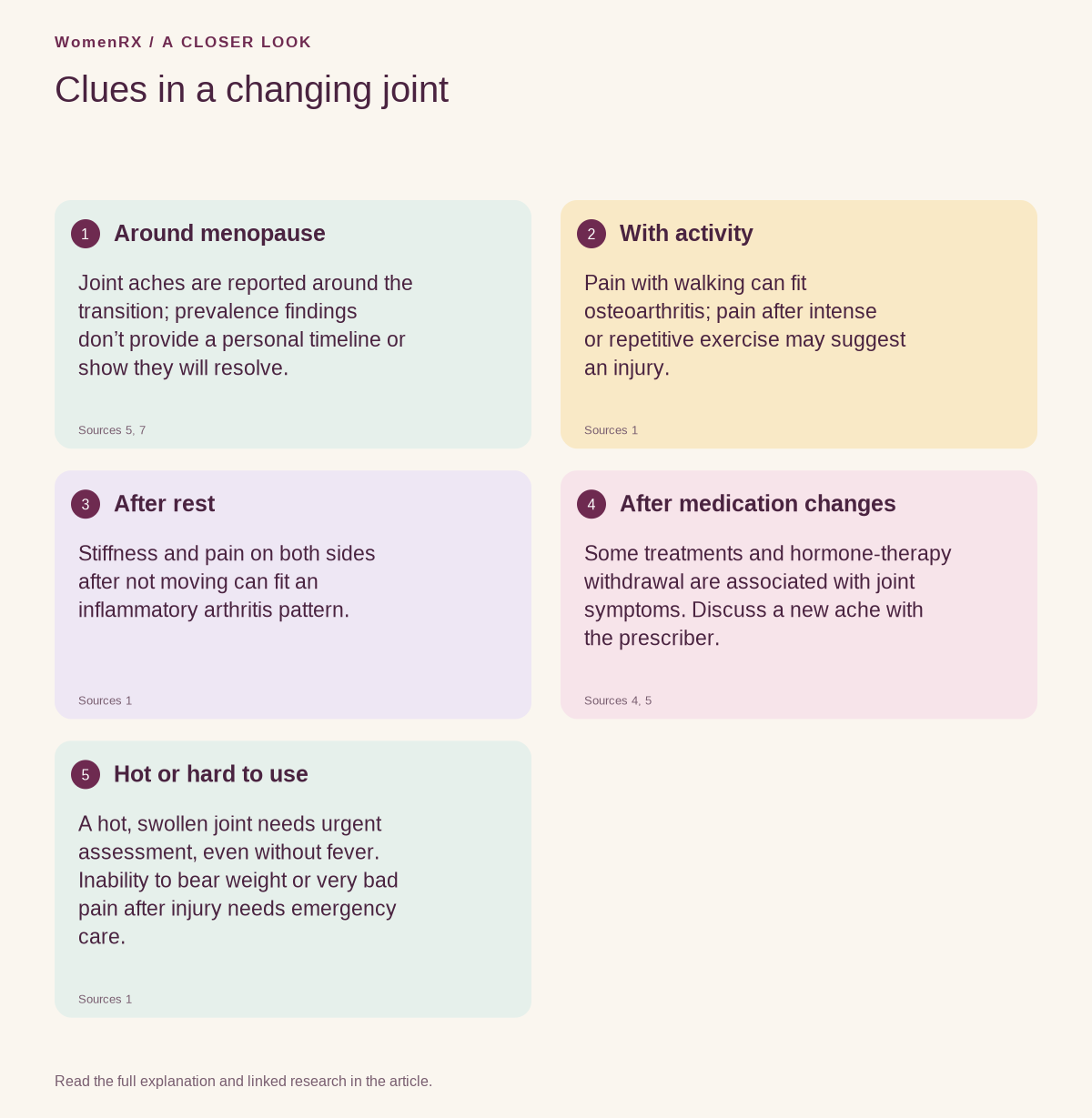
Clues in a changing joint
Around menopause: Joint aches are reported around the transition; prevalence findings don’t provide a personal timeline or show they will resolve.57
With activity: Pain with walking can fit osteoarthritis; pain after intense or repetitive exercise may suggest an injury.1
After rest: Stiffness and pain on both sides after not moving can fit an inflammatory arthritis pattern.1
After medication changes: Some treatments and hormone-therapy withdrawal are associated with joint symptoms. Discuss a new ache with the prescriber.45
Hot or hard to use: A hot, swollen joint needs urgent assessment, even without fever. Inability to bear weight or very bad pain after injury needs emergency care.1
Read the figure as text
Menopause timing is one piece of context. Pain patterns and changes in function can point toward other possible causes or a need for faster care.- Around menopause: Joint aches are reported around the transition; prevalence findings don’t provide a personal timeline or show they will resolve.57
- With activity: Pain with walking can fit osteoarthritis; pain after intense or repetitive exercise may suggest an injury.1
- After rest: Stiffness and pain on both sides after not moving can fit an inflammatory arthritis pattern.1
- After medication changes: Some treatments and hormone-therapy withdrawal are associated with joint symptoms. Discuss a new ache with the prescriber.45
- Hot or hard to use: A hot, swollen joint needs urgent assessment, even without fever. Inability to bear weight or very bad pain after injury needs emergency care.1
More questions, answered
Will hormone therapy make menopause-related joint pain go away?
Not reliably. A review describes some benefit for joint aches around the menopause transition, but the North American Menopause Society’s hormone therapy position statement identifies clearer treatment roles for hot flashes, night sweats, genitourinary symptoms, and prevention of bone loss. Joint pain still deserves assessment on its own merits, particularly if it is swollen, worsening, or limiting what you can do. 135
Sources you can check
- Joint pain - NHSAccessed 2026-09-25Return to first citation
- Pain | MedlinePlusAccessed 2026-09-25Return to first citation
- The 2022 hormone therapy position statement of The North American Menopause Society.“The 2022 Hormone Therapy Position Statement of The North American Menopause Society” Advisory Panel. · Menopause (New York, N.Y.) · 2022Return to first citation
- Effectiveness and safety of fezolinetant in alleviating vasomotor symptoms linked to Menopause.: A systematic review and Meta-Analysis.Elnaga AAA, Alsaied MA, Elettreby AM, Ramadan A. · European journal of obstetrics, gynecology, and reproductive biology · 2024Return to first citation
- Menopausal arthralgia: Fact or fiction.Magliano M. · Maturitas · 2010Return to first citation
- Shorter reproductive time span and early menopause increase the risk of ACPA-negative inflammatory arthritis in postmenopausal women with clinically suspect arthralgia.Heutz JW, Boeren AMP, Claassen S, van Mulligen E, de Jong PHP, van der Helm-van Mil AHM. · Rheumatology (Oxford, England) · 2025Return to first citation
- Arthralgia of menopause - A retrospective review.Blumer J. · Post reproductive health · 2023Return to first citation