Joint Pain Around Menopause: When to Get It Checked
Joint aches can become more common around the menopause transition, but swelling, worsening pain, or trouble with everyday activities deserves attention in its own right.
Joint pain can occur during perimenopause and after menopause, but that timing doesn’t establish the cause. Arrange medical assessment if pain is worsening, keeps returning, affects sleep or normal activities, or hasn’t improved after about two weeks. Get urgent assessment for a hot, swollen joint with fever or feeling unwell, or for a joint that looks out of place or has lost sensation after an injury. 1 3
Menopause may be part of the picture, not the whole answer
Aches and stiffness are common reports around the menopause transition. A 2026 review of 37 observational studies, including 93,021 women, found muscle or joint pain was reported by 40% of premenopausal women, 57% of perimenopausal women, and 59% of postmenopausal women. These pooled comparisons show an association, not proof that falling estrogen caused an individual woman’s pain. The studies also varied considerably, and often didn’t identify a specific joint condition behind the symptoms. 3
Age and other factors can matter too. In one community study of 743 Chinese women aged 35 to 64, musculoskeletal symptoms varied with both menopausal stage and age; higher BMI was also associated with more knee pain, stiffness, and hand swelling. That study can’t establish why any one person has symptoms, but it’s a reminder not to assume menopause is the only explanation. 5
The pattern can help point to what needs checking
Pain after strenuous or repetitive activity, especially with bruising or swelling, may follow a strain or sprain. Pain that’s worse with walking and stiffness after activity can fit osteoarthritis. A warm, swollen joint that hurts when moved or pressed can have other causes, including bursitis. These patterns are clues, not a way to diagnose yourself. 1
Pay particular attention to pain and stiffness on both sides of the body that’s worse after resting, such as when you wake up. This is one pattern associated with rheumatoid arthritis and is worth discussing with a clinician, especially if it continues or affects function. 1
A suddenly very painful, hot, swollen joint is different from a familiar, gradual ache. A hot, swollen joint alongside a high temperature, feeling feverish, or chills needs urgent assessment because a joint infection is one possible cause. 1
When to arrange an assessment
Make an appointment if joint pain is stopping you from doing normal activities or disrupting sleep, is getting worse or repeatedly returning, or hasn’t improved after about two weeks of home care. Don’t wait for a particular duration if you’re worried or your ability to use the joint is changing. 1
Seek urgent assessment if the skin around a painful joint is swollen and hot, especially if you also feel unwell or feverish. After an injury, get urgent help if the joint looks out of place or the area has tingling or no feeling. 1
Bring a short, useful symptom timeline
You don’t need a detailed diary. Before an appointment, jot down when the pain started; which joints are affected and whether both sides are involved; whether there’s visible swelling or warmth; and when stiffness is worst. Add what makes it better or worse, whether it followed an injury or a change in activity, and one or two examples of what’s harder now, such as walking, opening a jar, or sleeping. These details help describe the pattern without assuming its cause. Pain can be constant or come and go, and its impact on daily life is useful information when working out what may be behind it. 1 2
Menopause is a reasonable part of that conversation, but it shouldn’t replace an assessment of persistent or concerning symptoms. Research reviews describe a possible relationship between sex hormones and musculoskeletal pain, while noting that whether hormone therapy prevents or treats joint pain is much less established. 4
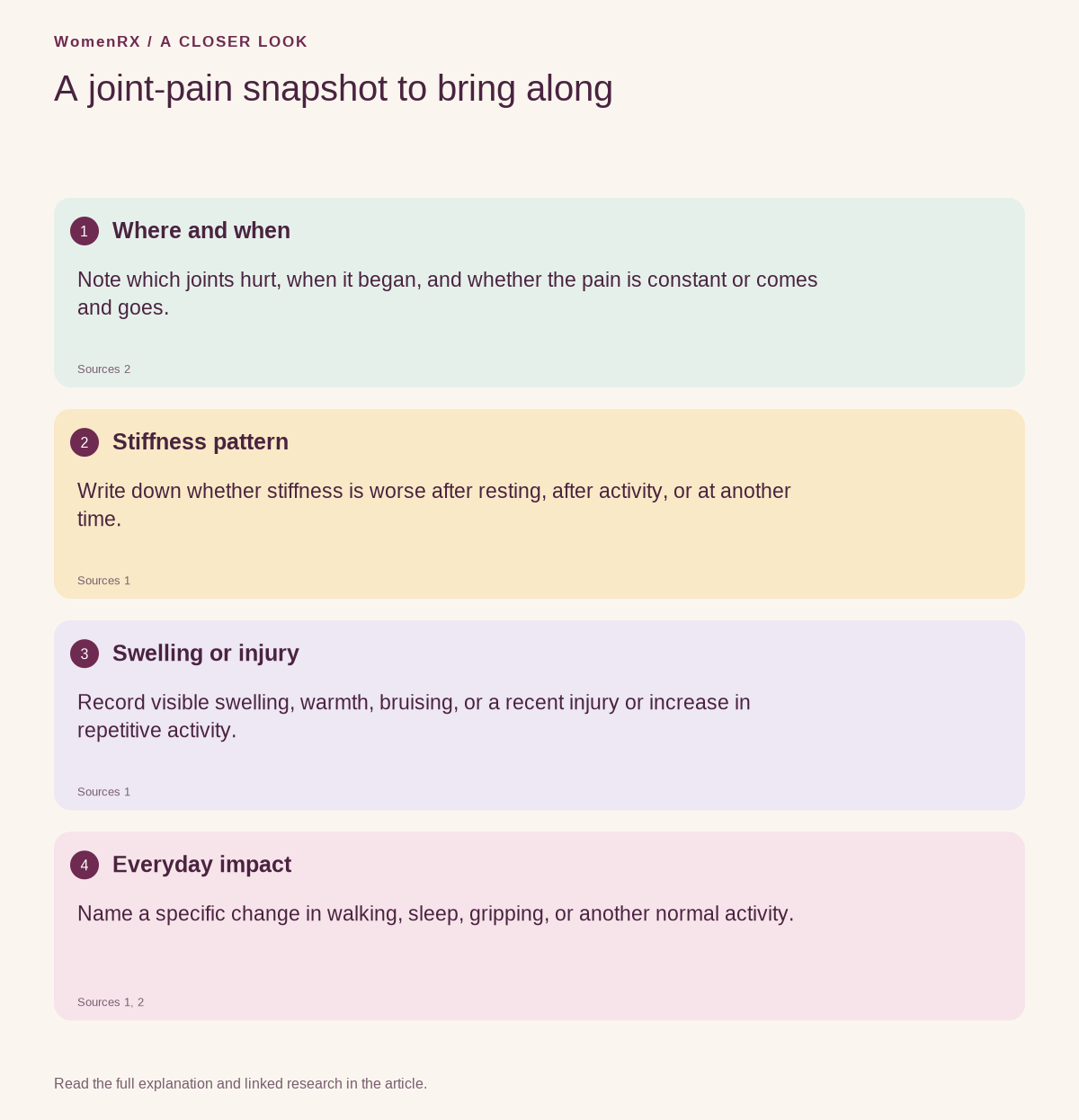
A joint-pain snapshot to bring along
Where and when: Note which joints hurt, when it began, and whether the pain is constant or comes and goes.2
Stiffness pattern: Write down whether stiffness is worse after resting, after activity, or at another time.1
Swelling or injury: Record visible swelling, warmth, bruising, or a recent injury or increase in repetitive activity.1
Everyday impact: Name a specific change in walking, sleep, gripping, or another normal activity.12
Read the figure as text
Record a few practical details so you can describe the pattern and its effect on daily life without trying to diagnose the cause.- Where and when: Note which joints hurt, when it began, and whether the pain is constant or comes and goes.2
- Stiffness pattern: Write down whether stiffness is worse after resting, after activity, or at another time.1
- Swelling or injury: Record visible swelling, warmth, bruising, or a recent injury or increase in repetitive activity.1
- Everyday impact: Name a specific change in walking, sleep, gripping, or another normal activity.12
More questions, answered
Does joint pain mean I’m in menopause?
No. Joint or muscle pain is reported more often in studies of perimenopausal and postmenopausal women, but those observational findings don’t show that menopause caused a particular person’s pain. Injury, arthritis, and other joint problems can also cause symptoms. 1 3
Is hormone therapy a proven treatment for menopause-related joint pain?
The relationship between sex hormones and musculoskeletal pain is an area of research, but whether hormone therapy can treat joint pain once it develops is much less established. The menopause-related aches should not be used on their own to assume hormone therapy will help. 4
Sources you can check
- Joint pain - NHSAccessed 2026-09-25Return to first citation
- Pain | MedlinePlusAccessed 2026-09-25Return to first citation
- Musculoskeletal Manifestations of Perimenopause: A Systematic Review and Meta-Analysis of 93,021 Women.Kruse C, McKechnie T, Dworsky-Fried J, Sardar A, Hacker G, Rattansi S, Fang E, Sprague S, Shea AK, Bhandari M. · JB & JS open access · 2026Return to first citation
- The influence of sex hormones on musculoskeletal pain and osteoarthritis.Gulati M, Dursun E, Vincent K, Watt FE. · The Lancet. Rheumatology · 2023Return to first citation
- The effect of age and menopausal status on musculoskeletal symptoms in Chinese women aged 35-64 years.Gao HL, Lin SQ, Wei Y, Chen Y, Wu ZL. · Climacteric : the journal of the International Menopause Society · 2013Return to first citation