Gum Changes Around Menopause: When to Get Them Checked
Menopause may be one factor in gum health, but new or ongoing bleeding or tenderness is a reason to book a dental check.
Menopause-related changes may affect periodontal health, but they can’t tell you why your gums are bleeding or tender, or how long symptoms will last in perimenopause. 2 If the change is new or ongoing, book a dental check rather than waiting for the transition to end. Keep brushing twice daily with fluoride toothpaste and cleaning between your teeth daily while you arrange it. 15
Menopause is context, not a gum diagnosis
If your gums have started bleeding when you clean between your teeth, it’s understandable to wonder whether perimenopause is behind it. The research gives you a reason to mention menopause at a dental visit, but not a reason to assume bleeding will pass when the transition is over.
A 2026 systematic review of nine observational studies compared periodontal findings in premenopausal and postmenopausal women who weren’t using hormone therapy. Overall, the postmenopausal groups tended to have deeper periodontal pockets, more attachment loss and more signs of inflammation. Results for the severity of periodontitis conflicted across studies, however, and several studies didn’t adequately account for other factors. These group comparisons can’t establish that menopause caused an individual woman’s gum problem. 2
They also don’t answer a practical perimenopause question: how long might bleeding or tenderness last? The review compared premenopausal with postmenopausal women; it did not establish a symptom timeline through the transition. 2 Rather than counting down to the end of perimenopause, pay attention to what’s happening in your mouth now.
Bleeding, dryness and burning point to different questions
Bleeding or tenderness around a tooth raises a different question from a mouth that feels dry or burns. A dentist can examine the gums and teeth and assess periodontal findings, including pocket depth and attachment loss, instead of trying to identify a cause from the symptom alone. Those are the kinds of measures used in menopause-periodontal research. 2 In a US survey of adults aged 30 and older, people’s answers about their oral health did not always agree with dentists’ assessments of the care they needed. 5
Plaque belongs in that assessment too. The menopause studies measured plaque alongside gum findings, and results for plaque varied between studies. Menopause is therefore not a reason to skip the everyday cleaning that helps care for teeth and gums, or to assume that cleaning alone explains a new symptom. 12
Dryness may be worth mentioning at the same visit, along with any medicines you take. If the main problem is a persistent burning sensation, especially without a visible gum change, don’t assume it’s periodontitis. A review of burning mouth syndrome found associations with menopause and older age, but also with chronic medication use and other oral-health and health factors; it did not identify one definitive cause. 4 A dental assessment can look for oral problems. If burning persists without an explanation, or you’re concerned that a medicine or another health condition may be involved, raise that concern with a medical clinician as well. 4
What to do while you work out the cause
Start with the oral-care basics that apply whether or not you’re in perimenopause: brush twice a day with fluoride toothpaste, clean between your teeth daily, avoid tobacco and see a dentist regularly. 1 If your gums are sore and you’ve changed how you clean them, tell the dental team what changed. These habits support oral health, but they can’t identify the cause of bleeding.
For example, you might notice blood in one area when you clean between your teeth, or tenderness that wasn’t there before. If a change is new or keeps happening, book a dental check rather than waiting for your next routine visit or for perimenopause to end. An examination can assess findings that symptoms alone can’t establish; the menopause research doesn’t provide a rule for how long to wait. 25
Other context matters too. In a small two-year study of 59 postmenopausal women who already had periodontitis and were receiving periodontal maintenance, smokers lost alveolar bone height and density more often than nonsmokers. Because everyone studied already had periodontitis, the study can’t show how prior disease changes the meaning of a new symptom. If you use tobacco, mention it at your dental visit. 3 Age and other health conditions may also complicate comparisons between premenopausal and postmenopausal groups. 2
The useful question isn’t simply, “Is this menopause?” It’s, “What does an examination show about my gums, and could dryness or another factor be part of what I’m feeling?” Menopause can remain part of the conversation without becoming the only explanation. 245
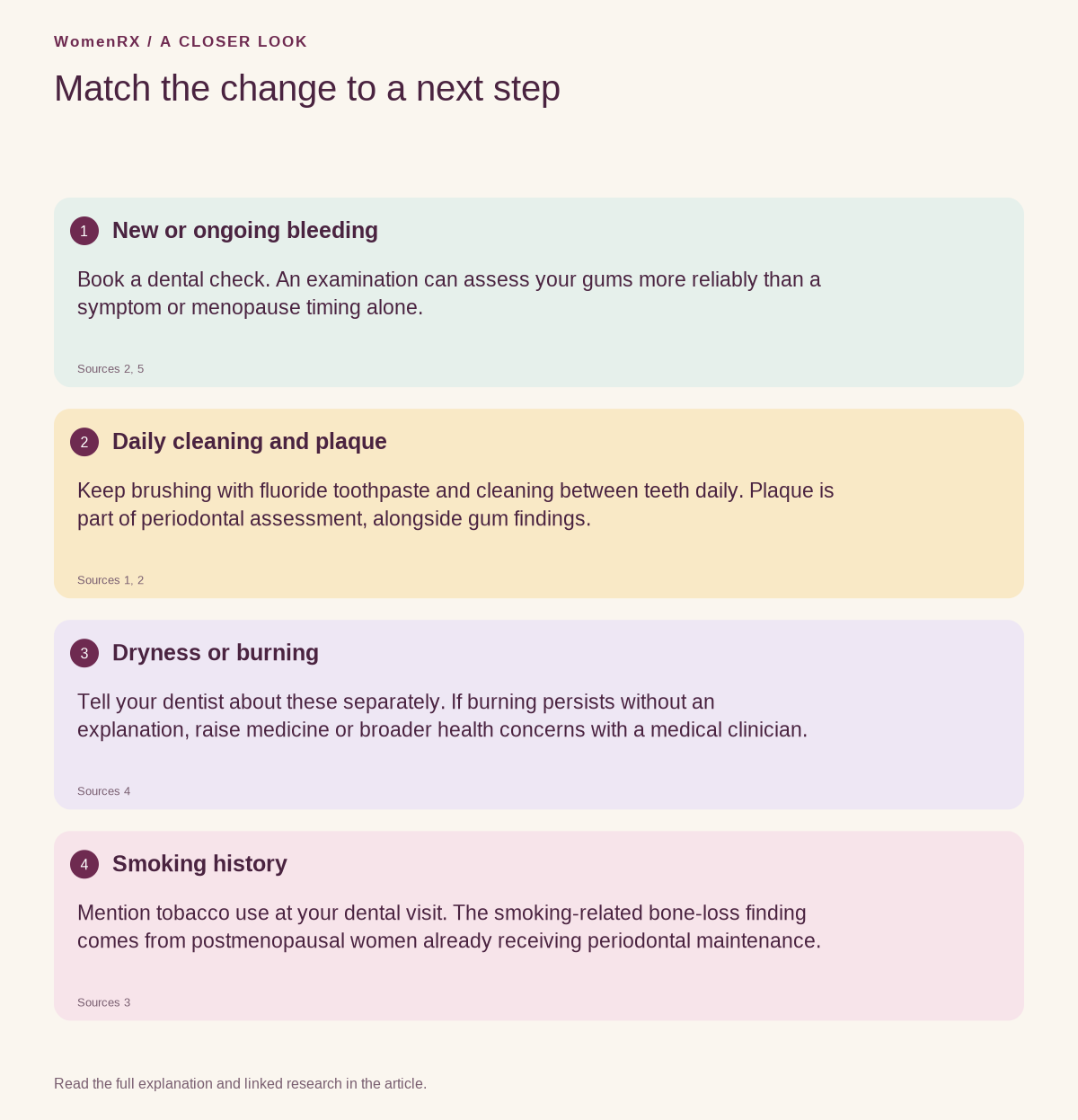
Match the change to a next step
New or ongoing bleeding: Book a dental check. An examination can assess your gums more reliably than a symptom or menopause timing alone.25
Daily cleaning and plaque: Keep brushing with fluoride toothpaste and cleaning between teeth daily. Plaque is part of periodontal assessment, alongside gum findings.12
Dryness or burning: Tell your dentist about these separately. If burning persists without an explanation, raise medicine or broader health concerns with a medical clinician.4
Smoking history: Mention tobacco use at your dental visit. The smoking-related bone-loss finding comes from postmenopausal women already receiving periodontal maintenance.3
Read the figure as text
These distinctions help you decide what to do, not diagnose a gum condition or set an exact waiting period.- New or ongoing bleeding: Book a dental check. An examination can assess your gums more reliably than a symptom or menopause timing alone.25
- Daily cleaning and plaque: Keep brushing with fluoride toothpaste and cleaning between teeth daily. Plaque is part of periodontal assessment, alongside gum findings.12
- Dryness or burning: Tell your dentist about these separately. If burning persists without an explanation, raise medicine or broader health concerns with a medical clinician.4
- Smoking history: Mention tobacco use at your dental visit. The smoking-related bone-loss finding comes from postmenopausal women already receiving periodontal maintenance.3
More questions, answered
Will gum bleeding stop when perimenopause ends?
The menopause-periodontal review can’t give you a timetable: it compared premenopausal and postmenopausal groups rather than following bleeding symptoms through perimenopause. If bleeding is new or ongoing, book a dental check instead of assuming it will stop when the transition ends. 25
Sources you can check
- Dental Health: MedlinePlusAccessed 2026-09-25Return to first citation
- Impact of menopause on clinical periodontal outcomes: a systematic review.Martín FC, Rus MJ, de la Cruz Gándara Alvarez A, Simon-Soro A, Cantiga-Silva C. · Clinical oral investigations · 2026Return to first citation
- The association of cigarette smoking with alveolar bone loss in postmenopausal females.Payne JB, Reinhardt RA, Nummikoski PV, Dunning DG, Patil KD. · Journal of clinical periodontology · 2000Return to first citation
- Exploring the association between menopause and burning mouth syndrome: an updated review.Qaderi K, Eghdampour F, Mallah MA, Kalhor M, Ghasemi H, Fallahnia N, Sohrabi Z. · BMC oral health · 2026Return to first citation
- Clinical Oral Health Recommended Care and Oral Health Self-Report, NHANES, 2013-2014.Wiener RC, Dwibedi N, Shen C, Findley PA, Sambamoorthi U. · Advances in public health · 2018Return to first citation