Gum Changes Around Menopause: What Needs a Dental Check?
Hormonal changes may affect mouth tissues, but bleeding gums or a loose tooth need attention on their own terms.
If your gums bleed, swell, or feel sore during perimenopause, arrange a dental check rather than assuming hormones are the cause. Mention discharge or a tooth that feels loose directly. Menopause may affect oral tissues and their response to plaque, but a gum symptom can’t tell you which factor is involved. Dry mouth is worth describing separately. 2 3 4
Why hormones and plaque aren’t competing explanations
If you notice blood when you brush, it’s understandable to wonder whether perimenopause has something to do with it. Hormonal changes may affect mouth tissues. A review of menopause and oral health describes associations between falling estrogen and changes to the gums and other tissues lining the mouth. That’s a reason to mention your menopausal stage to your dentist, not a way to identify the cause of bleeding. 4
Plaque and calculus remain part of the picture. Researchers have proposed that hormonal changes can alter how sensitive gum tissue is to these local irritants. Think of these as two different questions: Is there plaque or calculus affecting the gums? And might the tissue be responding differently than it used to? A possible change in tissue response doesn’t make plaque irrelevant, and finding plaque wouldn’t rule out every other influence. The proposed interaction doesn’t establish what caused one person’s symptoms. 2
One small study shows why it’s worth resisting an easy menopause explanation. Among 112 women attending a university dental clinic, self-reported gum bleeding, tooth sensitivity, and calculus did not differ significantly between the researchers’ participant clusters. Oral dryness was reported more often in a cluster of older women whose periods had stopped and who also had systemic diseases. Because the study took a snapshot of self-reported symptoms, it can’t separate the effects of menopause from age, health conditions, or other differences between participants. 2
What the change might mean for your next step
Bleeding, swelling, or soreness: These are reasons to have your gums examined, whether you still have periods or are postmenopausal. Bleeding alone doesn’t show whether plaque, a change in tissue response, or something else is involved. Tell your dentist where you notice it and whether it keeps happening. Gum bleeding and swelling have been included among periodontal symptoms assessed in studies of women, but a symptom report isn’t a diagnosis. 2 3
Discharge or a tooth that feels loose: Bring either change to a dentist’s attention rather than treating it as an expected part of menopause. Both have been assessed as periodontal symptoms in research involving postmenopausal women. That research doesn’t establish a timetable for care, but it gives no basis for explaining these changes away as hormonal. 3
Dry mouth: Describe this separately from what’s happening at the gumline. Dry mouth appears in research on oral symptoms around menopause, including the dental-clinic study, but that study didn’t establish menopause as its cause. Let your dentist know about health conditions and medicines as part of your history without assuming either explains the dryness. 2 4
A dental visit can bring these threads together. Explain what feels different, and ask whether your dentist sees plaque or calculus that needs attention and whether your usual cleaning routine is working for your gums. If you’re in perimenopause or postmenopause, include that as context. Regular visits with a dentist or oral health professional are part of caring for your teeth and gums. 1 2
The takeaway isn’t that hormones have no role. It’s that menopause context can’t replace a look at the gums and teeth. Research on menopause-related oral changes also hasn’t established hormone therapy as a treatment for gum symptoms; a review calls for further study of treatments for oral symptoms. 4
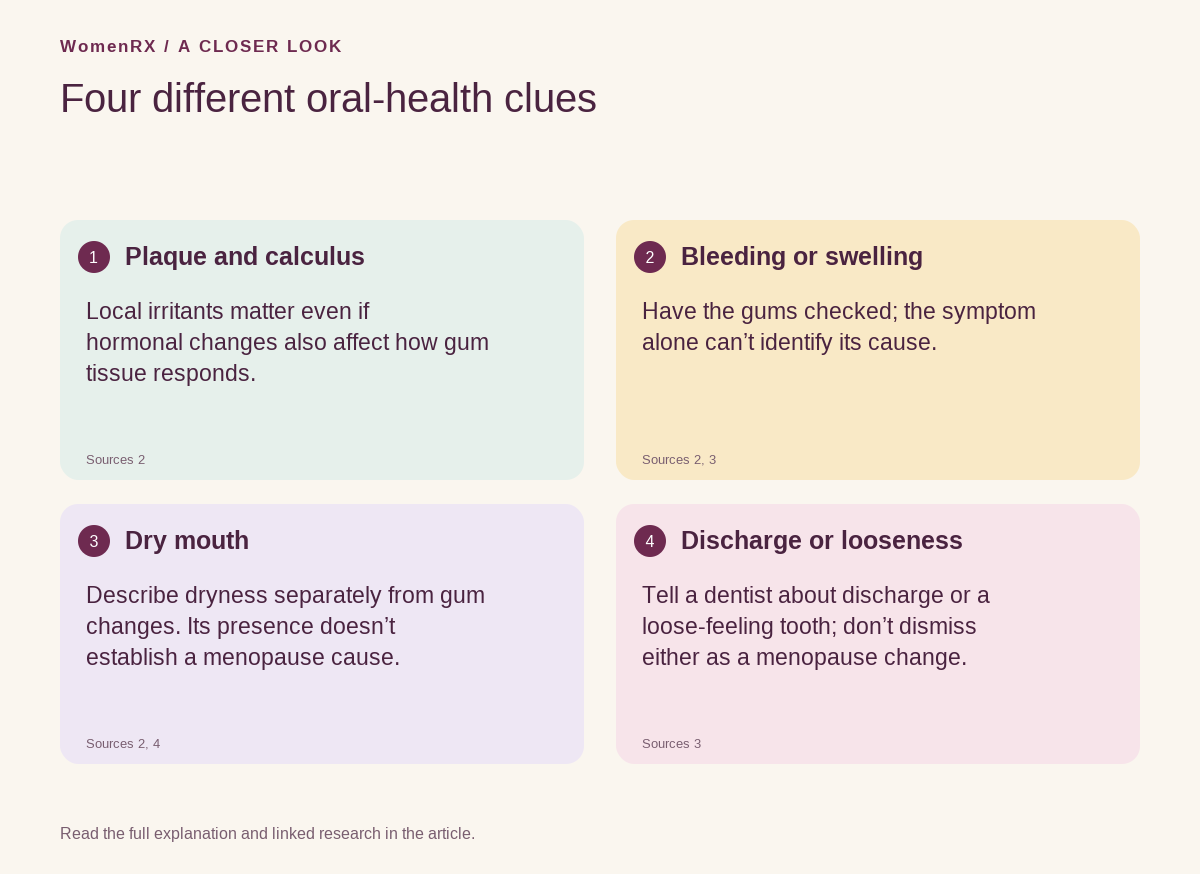
Four different oral-health clues
Plaque and calculus: Local irritants matter even if hormonal changes also affect how gum tissue responds.2
Bleeding or swelling: Have the gums checked; the symptom alone can’t identify its cause.23
Dry mouth: Describe dryness separately from gum changes. Its presence doesn’t establish a menopause cause.24
Discharge or looseness: Tell a dentist about discharge or a loose-feeling tooth; don’t dismiss either as a menopause change.3
Read the figure as text
These changes can overlap, but they don’t all point to the same explanation.- Plaque and calculus: Local irritants matter even if hormonal changes also affect how gum tissue responds.2
- Bleeding or swelling: Have the gums checked; the symptom alone can’t identify its cause.23
- Dry mouth: Describe dryness separately from gum changes. Its presence doesn’t establish a menopause cause.24
- Discharge or looseness: Tell a dentist about discharge or a loose-feeling tooth; don’t dismiss either as a menopause change.3
Sources you can check
- Dental Health: MedlinePlusAccessed 2026-09-25Return to first citation
- Clusters explaining the relation between menopause and self-reported periodontal disease: a cross-sectional study.Fadel HT, Qarah LA, Alharbi MO, Al-Sharif A, Al-Harkan DS, Kassim S, Abu-Hammad O, Dar-Odeh N. · PeerJ · 2025Return to first citation
- Relationship between self-reported periodontal status and skeletal bone mineral density in Japanese postmenopausal women.Taguchi A, Suei Y, Ohtsuka M, Nakamoto T, Lee K, Sanada M, Tsuda M, Ohama K, Tanimoto K, Bollen AM. · Menopause (New York, N.Y.) · 2005Return to first citation
- Menopause, skin and common dermatoses. Part 4: oral disorders.Ashraf M, Kamp E, Musbahi E, DeGiovanni C. · Clinical and experimental dermatology · 2022Return to first citation