Menopause and Health: What Changes, and What Needs Care?
Menopause can bring real symptoms and lasting health changes, but it isn’t a disease or an explanation for every new symptom.
Menopause is reached after 12 months without a period, and the transition can bring changes such as sleep trouble, vaginal dryness, and mood shifts. Lower estrogen can also contribute to bone loss and changes in cholesterol and cardiovascular risk. These are reasons to consider your own health history, not proof that every later health problem is caused by menopause. Bleeding after menopause deserves evaluation. 1 2
Menopause is a transition, not a diagnosis for everything
Menopause is the point when you’ve gone 12 months without a period. The years leading up to it can include irregular periods, sleep problems, vaginal dryness, mood changes, and bladder symptoms. Some people also have vasomotor symptoms, such as hot flashes. These experiences can affect daily life, but they don’t mean menopause itself is an illness. 1 5
A useful distinction is between a symptom that may be related to changing hormones and a health problem that needs its own explanation. For example, sleep trouble can occur during the transition, but it shouldn’t automatically be blamed on menopause if it persists or is affecting your life. The same goes for mood or bladder changes: their presence doesn’t establish their cause. 1
Bone and heart health are longer-term considerations
Lower estrogen can contribute to bone-density loss. Over time, that can raise the chance of osteoporosis and fractures. MedlinePlus also describes possible rises in cholesterol and increased risk of heart disease and stroke after menopause. These are changes in risk, not a prediction that you’ll develop any of those conditions. Your age and personal health history matter when considering what they mean for you. 1
Menopause hormone therapy is one example of why individual context matters. It can prevent bone loss and fracture, but its risks vary with factors including the type of therapy, route, duration, timing, and whether a progestogen is used. The Menopause Society says the benefit-risk balance is generally more favorable for certain younger or recently menopausal women with bothersome symptoms and no contraindications, and less favorable when therapy is started later. This is not a reason to assume that everyone needs hormone therapy for long-term prevention. 5
For bothersome hot flashes, hormone therapy is the most effective treatment, and evidence-supported nonhormonal options also exist. If vaginal symptoms are the concern, treatment choices differ. The useful next step is to name the symptom and what you want help with, rather than treating “menopause” as one problem with one solution. 5 6
One change that shouldn’t be written off
Bleeding after menopause merits medical evaluation. It can have more than one cause, including uterine polyps, and it isn’t something to dismiss as a routine return of periods. 2 4
That’s different from an ultrasound finding of a thicker uterine lining in someone who has no bleeding. A Canadian guideline addresses that situation separately and aims to avoid unnecessary invasive tests while investigating selectively based on risk. The finding and the symptom aren’t interchangeable. 3
Make prevention personal
Menopause is a useful moment to bring bone and cardiovascular health into the conversation, but menopause status alone can’t tell you your individual risk. Consider your age, personal and family history, existing health conditions, and any symptoms you’re experiencing. If something has changed, explain what changed and when; that helps separate a possible menopause symptom from a new or unrelated condition. For hormone therapy, benefits and risks should be individualized and periodically reassessed. 1 5
The practical takeaway: recognize common transition symptoms, keep longer-term bone and heart health on the radar, and don’t assume a new or concerning change is “just menopause.”
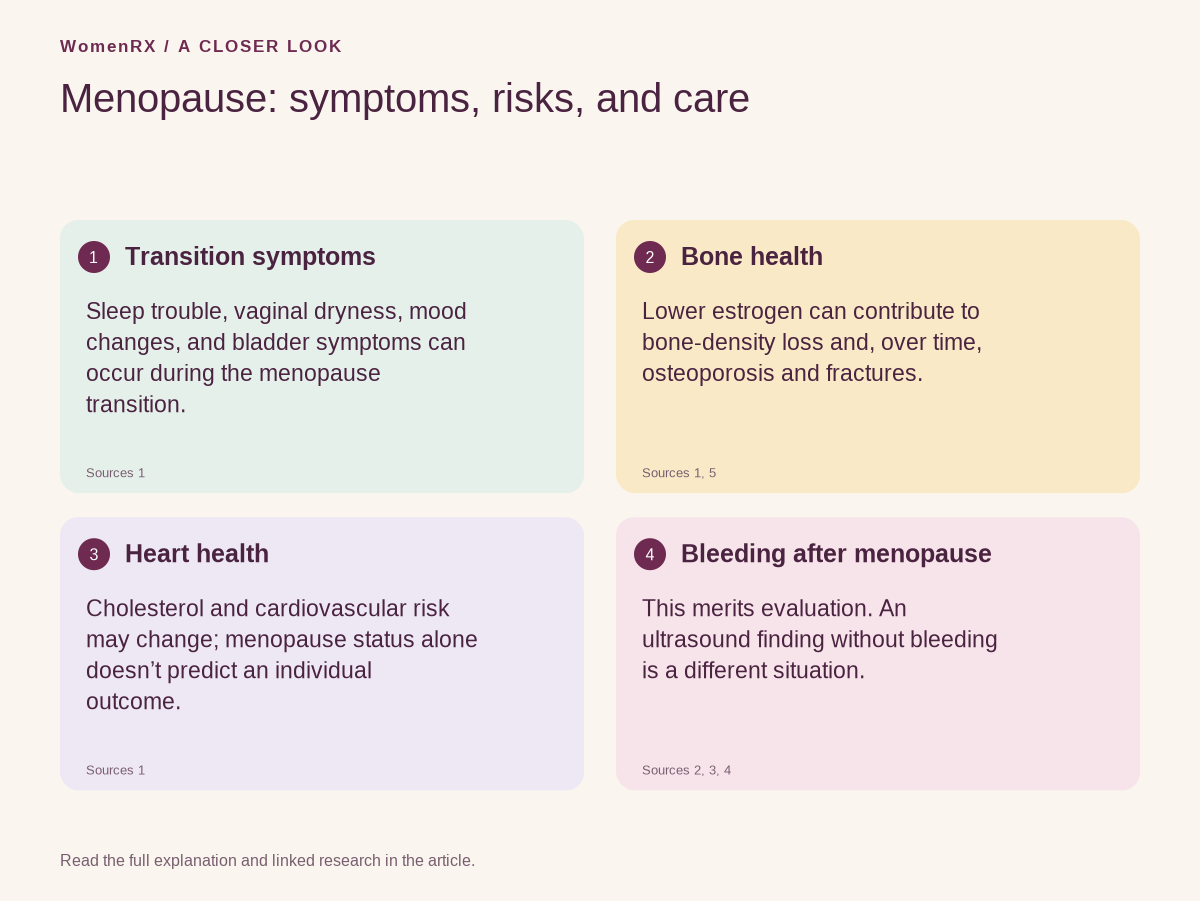
Menopause: symptoms, risks, and care
Transition symptoms: Sleep trouble, vaginal dryness, mood changes, and bladder symptoms can occur during the menopause transition.1
Bone health: Lower estrogen can contribute to bone-density loss and, over time, osteoporosis and fractures.15
Heart health: Cholesterol and cardiovascular risk may change; menopause status alone doesn’t predict an individual outcome.1
Bleeding after menopause: This merits evaluation. An ultrasound finding without bleeding is a different situation.234
Read the figure as text
Separate common transition experiences from longer-term health considerations and a change that deserves evaluation.- Transition symptoms: Sleep trouble, vaginal dryness, mood changes, and bladder symptoms can occur during the menopause transition.1
- Bone health: Lower estrogen can contribute to bone-density loss and, over time, osteoporosis and fractures.15
- Heart health: Cholesterol and cardiovascular risk may change; menopause status alone doesn’t predict an individual outcome.1
- Bleeding after menopause: This merits evaluation. An ultrasound finding without bleeding is a different situation.234
More questions, answered
Does menopause mean I’ll develop osteoporosis or heart disease?
No. Menopause-related estrogen changes can contribute to bone loss and may affect cholesterol and cardiovascular risk, but they don’t determine what will happen to you. Your age and personal health history also matter. 1
Is bleeding after menopause a normal menopause symptom?
Bleeding after menopause should be evaluated rather than assumed to be a routine menopause symptom. It can have different causes, including uterine polyps. 2 4
Sources you can check
- Menopause | Menopause Symptoms | MedlinePlusAccessed 2026-09-25Return to first citation
- A perspective on the revised American College of Obstetricians and Gynecologists' guidance for transvaginal ultrasound in the evaluation of postmenopausal bleeding.Goldstein SR. · Menopause (New York, N.Y.) · 2026Return to first citation
- Guideline No. 451: Asymptomatic Endometrial Thickening in Postmenopausal Women.Wolfman W, Bougie O, Chen I, Tang Y, Goldstein S, Bouteaud J. · Journal of obstetrics and gynaecology Canada : JOGC = Journal d'obstetrique et gynecologie du Canada : JOGC · 2024Return to first citation
- Guideline No. 447: Diagnosis and Management of Endometrial Polyps.Bougie O, Randle E, Thurston J, Magee B, Warshafsky C, Rittenberg D. · Journal of obstetrics and gynaecology Canada : JOGC = Journal d'obstetrique et gynecologie du Canada : JOGC · 2024Return to first citation
- The 2022 hormone therapy position statement of The North American Menopause Society.“The 2022 Hormone Therapy Position Statement of The North American Menopause Society” Advisory Panel. · Menopause (New York, N.Y.) · 2022Return to first citation
- The 2023 nonhormone therapy position statement of The North American Menopause Society.Menopause (New York, N.Y.) · 2023Return to first citation