Menopause in Your 40s or 50s: When Timing Changes Care
Menopause before 45 is a reason to discuss assessment and hormone health, while age alone can’t confirm what’s behind a change in your periods.
Natural menopause usually happens between ages 45 and 55; a US national survey estimated the median age at 50. Menopause before 45 is considered early, and before 40, premature. If periods change or stop before 45, ask whether assessment is appropriate. If menopause occurs before 45, the conversation may also include replacing missing hormones because of higher bone and heart health risks. 1 4
Age gives context, not a diagnosis
Natural menopause usually occurs between ages 45 and 55. In a US analysis of 15,322 women, the estimated median age at natural menopause was 50. These are population patterns, not a deadline: being in your 40s or 50s doesn’t, by itself, explain a change in your periods or predict how menopause will feel. 1 4
The age categories are useful because they can change what to discuss. Menopause before 45 is called early menopause; before 40, it’s called premature menopause. Premature ovarian insufficiency, or POI, is also a consideration in assessment before 40. An age cutoff alone does not establish that you have menopause or POI. 1 3
If periods change before 45
If you’re under 45 and having menopause-like symptoms or irregular or stopped periods, raise the change with a healthcare professional rather than assuming it’s simply typical menopause. Assessment may include blood tests, though testing isn’t described as necessary in every case. Before 40, you can ask whether premature menopause or POI should be considered. 1
There’s a specific reason earlier timing can change the care discussion: early or premature menopause is associated with higher chances of osteoporosis and cardiovascular disease. That’s a population-level risk, not a prediction that you’ll develop either condition. It’s a reason to discuss bone and heart health as part of your care. 1
If menopause has started before 45, guidance also emphasizes replacing missing hormones because of those higher bone and heart risks. That is a different conversation from the general question of whether hormone therapy is right for bothersome symptoms at the usual age of menopause. The right approach depends on your circumstances; age alone isn’t a treatment plan. 1 2
In your 40s or 50s, treatment still depends on more than age
Menopause between 45 and 55 falls within the usual range described in clinical guidance. The timing doesn’t mean symptoms will follow a predictable pattern. If you’re considering hormone therapy, the North American Menopause Society (NAMS) says the decision should be individualized, with benefits and risks reviewed periodically. 1 2
NAMS describes the benefit-risk balance as generally favorable for women under 60 or within 10 years of menopause onset, without contraindications, who are considering hormone therapy for bothersome hot flashes or to prevent bone loss. The statement says the balance appears less favorable when therapy is started more than 10 years after menopause or after age 60, in part because certain absolute health risks are greater. These are broad guidelines, not a personal verdict based on your decade of life. 2
A useful first question is: “My periods have changed, and I’m __. Is assessment appropriate, and what might it involve?” If menopause occurred before 45, you can also ask how that timing affects discussion of hormone replacement and bone and heart health. If you’re considering hormone therapy at any age, ask how your symptoms, health history, age, and time since menopause shape the benefits and risks. 1 2
The key distinction isn’t that women in their 40s and 50s have different, predictable symptoms. It’s that menopause before 45 may prompt assessment and an earlier discussion about replacing missing hormones, while treatment choices at any age remain individualized.
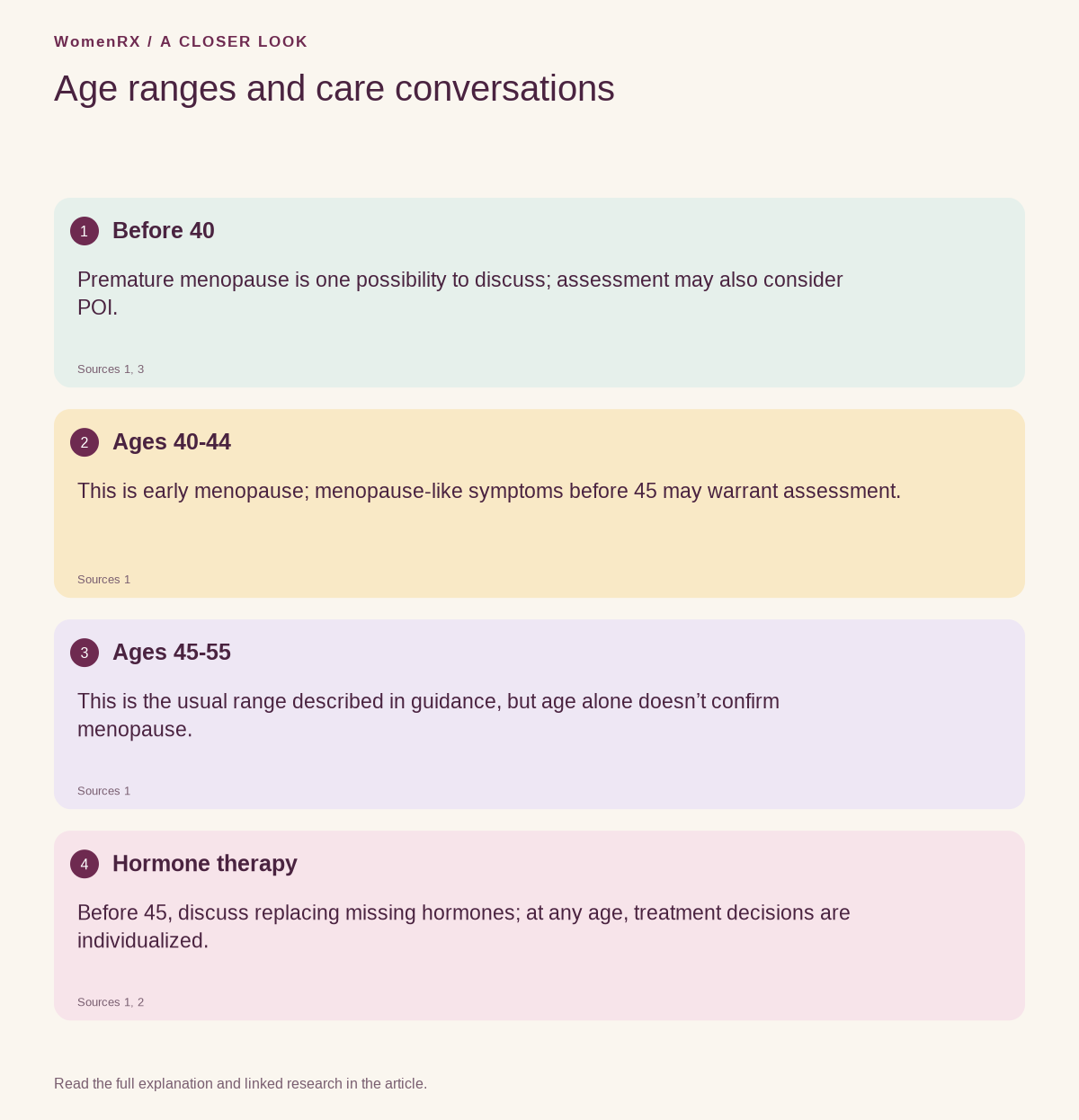
Age ranges and care conversations
Before 40: Premature menopause is one possibility to discuss; assessment may also consider POI.13
Ages 40-44: This is early menopause; menopause-like symptoms before 45 may warrant assessment.1
Ages 45-55: This is the usual range described in guidance, but age alone doesn’t confirm menopause.1
Hormone therapy: Before 45, discuss replacing missing hormones; at any age, treatment decisions are individualized.12
Read the figure as text
These ranges describe menopause timing categories and when assessment or follow-up discussions may differ. They are not a way to diagnose yourself.- Before 40: Premature menopause is one possibility to discuss; assessment may also consider POI.13
- Ages 40-44: This is early menopause; menopause-like symptoms before 45 may warrant assessment.1
- Ages 45-55: This is the usual range described in guidance, but age alone doesn’t confirm menopause.1
- Hormone therapy: Before 45, discuss replacing missing hormones; at any age, treatment decisions are individualized.12
More questions, answered
Does reaching 45 mean I’m in menopause?
No. The age categories describe timing; age alone doesn’t confirm the cause of a change in your periods. If you’re under 45 and having menopause-like symptoms, ask whether assessment is appropriate. 1
Does menopause timing determine whether hormone therapy is right for me?
No. Age and time since menopause help frame the benefits and risks, but NAMS recommends individualizing treatment and periodically reviewing it. Your symptoms and health history matter too. 2
Sources you can check
- Early or premature menopause - NHSAccessed 2026-09-25Return to first citation
- The 2022 hormone therapy position statement of The North American Menopause Society.“The 2022 Hormone Therapy Position Statement of The North American Menopause Society” Advisory Panel. · Menopause (New York, N.Y.) · 2022Return to first citation
- Long-term systemic outcomes of postmenopausal hormone replacement therapy by age at menopause: a real-world cohort study.Lu TF, Lu CH, Shih YH, Chen YF, Fan CT, Wang SJ, Hsu ST, Liu CK, Sun L, Hwang SF, Lee TH. · Human reproduction open · 2026Return to first citation
- Age at natural and surgical menopause and related factors: NHANES 2013-2023.Schulz RN, Shvartsman K, Borgia L, Witkop CT, Mancuso JD, Koehlmoos TP, Ahmed AE. · Menopause (New York, N.Y.) · 2026Return to first citation