When Menopause Usually Happens and What Counts as Early
Most women reach menopause between 45 and 55, but your period history and medical history matter as much as your age.
Menopause most commonly happens between ages 45 and 55. It’s identified after 12 months without a period when you’re not using hormonal contraception; the irregular periods leading up to it are perimenopause. Menopause before 45 is called early, while changes before 40 may call for evaluation for premature ovarian insufficiency, which isn’t quite the same thing. 45
The usual range is a guide, not a deadline
The most common age for reaching menopause is 45 to 55. Perimenopause, the transition leading up to it, usually begins in your 40s but can start earlier and last several years. During that time, periods may become irregular before they stop. An irregular month at 47 may fit that pattern, but it doesn’t tell you exactly when your final period will be. 45
For natural menopause, the useful milestone is 12 months without a period. That means you can only identify your final period in hindsight. The usual period-based definition doesn’t apply in the same straightforward way if you’re using hormonal contraception. There’s no routine test for perimenopause or menopause; age, symptoms and circumstances help make sense of what’s happening. 45
Before 45 and before 40 mean different things
If periods become irregular or stop before 45, clinicians may use the term early menopause. If menopause happens before 40, it’s called premature menopause. These age labels describe timing, but they don’t, by themselves, explain why your periods changed. 15
Before 40, another term matters: premature ovarian insufficiency, or POI. It means the ovaries aren’t working normally at that age. Unlike the idea that menopause always means periods have ended for good, someone with POI may still have occasional periods and may still become pregnant. A missed period or two isn’t enough to identify it. A clinical description of POI includes at least four months of infrequent or absent periods together with an elevated follicle-stimulating hormone (FSH) level; evaluation depends on the person’s circumstances. 25
That distinction changes the next move. For example, if you’re 38 and your previously regular periods have become infrequent, you don’t have to wait a full year without bleeding before asking a clinician to assess the change. If you’re 43 and having irregular periods and hot flashes, it’s also worth discussing rather than assuming your age settles the question. Blood tests may sometimes be used when menopause symptoms occur before 45. 12
Medical history can change how you read the timeline
Menopause can happen earlier after removal of the ovaries or as a result of treatments such as chemotherapy, radiation therapy or some hormone medicines. Removal of the uterus alone stops periods, but doesn’t cause menopause unless the ovaries are removed too. If you’ve had a hysterectomy, you therefore can’t use 12 months without bleeding to date menopause in the usual way. 15
Tell the clinician assessing a change in periods about any ovary or uterus surgery and cancer treatment. That history can change what a missing period means. It also matters when discussing care: early menopause and POI involve a longer time with low ovarian hormone levels than menopause at the usual age, so the conversation may include bone and heart health as well as symptoms. Hormone treatment is one possible part of that discussion, but treatment choices depend on medical history, including certain cancers. 13
Age is a useful clue, not a prediction. If you’re under 45 and your periods have become irregular or stopped, especially if you also have hot flashes, night sweats or vaginal dryness, asking for an assessment is a reasonable next step. The question isn’t just ‘Am I menopausal?’ It’s also whether your age and medical history call for a closer look at the cause. 15
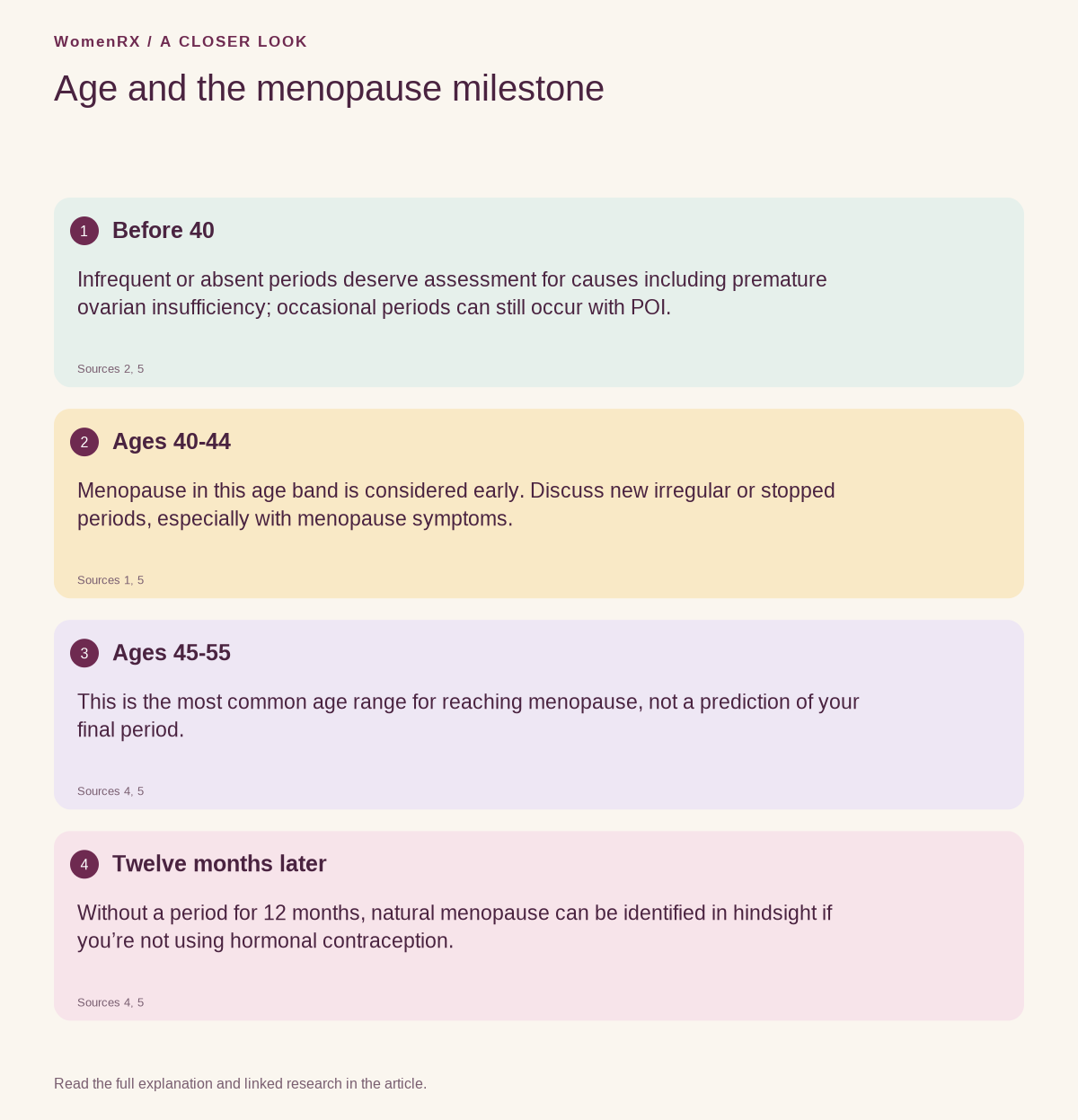
Age and the menopause milestone
Before 40: Infrequent or absent periods deserve assessment for causes including premature ovarian insufficiency; occasional periods can still occur with POI.25
Ages 40-44: Menopause in this age band is considered early. Discuss new irregular or stopped periods, especially with menopause symptoms.15
Ages 45-55: This is the most common age range for reaching menopause, not a prediction of your final period.45
Twelve months later: Without a period for 12 months, natural menopause can be identified in hindsight if you’re not using hormonal contraception.45
Read the figure as text
The age bands name when changes happen. The final milestone applies at any age when periods can be used to identify natural menopause.- Before 40: Infrequent or absent periods deserve assessment for causes including premature ovarian insufficiency; occasional periods can still occur with POI.25
- Ages 40-44: Menopause in this age band is considered early. Discuss new irregular or stopped periods, especially with menopause symptoms.15
- Ages 45-55: This is the most common age range for reaching menopause, not a prediction of your final period.45
- Twelve months later: Without a period for 12 months, natural menopause can be identified in hindsight if you’re not using hormonal contraception.45
Sources you can check
- Early or premature menopause - NHSAccessed 2026-09-25Return to first citation
- Expert opinion by the Italian Society of Gynecology of the Third Age (SIGiTE) and the Italian Society of Menopause (SIM) on diagnosis and treatment of premature ovarian insufficiency.Capozzi A, Ambroggio S, Cagnacci A, Gambacciani M, Lello S, DI Carlo C, Executive Committee of the Italian Society of Gynecology of the Third Age (SIGiTE) and the Italian Society o... · Minerva endocrinology · 2026Return to first citation
- Hormone therapy (HT) in women with premature ovarian insufficiency or early menopause: Time to think of a new paradigm for healthy aging. A joint FIGO and IMS position paper.Benedetto C, Khadilkar SS, Nappi RE, Genazzani AR, Frezet F, Cucinella L, Divakar H, Anagnostis P, Panay N. · Climacteric : the journal of the International Menopause Society · 2026Return to first citation
- What are menopause and perimenopause? - NHSAccessed 2026-09-25Return to first citation
- Menopause | Menopause Symptoms | MedlinePlusAccessed 2026-09-25Return to first citation