Early Menopause and Hormone Therapy: Is There a Stop Age?
Treatment through the usual age of menopause may help address years of earlier hormone loss, but the date to review it isn’t a deadline to stop.
If menopause happens early, hormone therapy may be discussed through approximately the usual age of menopause, particularly for premature ovarian insufficiency (POI). The rationale includes replacing hormones lost earlier than expected and protecting bone. “Until 51” is a useful way to start that discussion, not an automatic stop date. Your reason for treatment, health history, and current regimen all affect the decision. 5 2
Why the usual menopause age comes up
If you’ve heard that hormone therapy should continue “until 51” after early menopause, you may wonder what changes on that birthday. Nothing automatically does. The age is a way to frame the years between early ovarian hormone loss and the time menopause usually occurs, not a universal instruction to stop treatment.
That rationale is particularly clear for premature ovarian insufficiency (POI). An expert opinion on POI recommends hormone replacement to narrow the gap between early hormone loss and the average age of menopause, even when hot flashes or similar symptoms aren’t present. Bone health is one reason to take that gap seriously: the North American Menopause Society says hormone therapy has been shown to prevent bone loss and fractures. 5 2
There’s an important distinction, though. POI is a specific condition identified before age 40, with diagnostic criteria that include a change in periods and a blood test result. Not everyone whose menopause happens earlier than usual has POI. The POI recommendation explains why clinicians may raise an age-based treatment discussion; it doesn’t establish the same treatment duration for every person with early menopause. 5
What happens when you reach that age?
The question shifts from Why replace hormones lost early? to What is treatment doing for you now? For example, one person may still have bothersome hot flashes, while another may have started treatment primarily because of POI and be reassessing a bone-health plan. Those are different conversations, not different answers to a birthday rule.
Menopause Society guidance calls for periodic review of hormone therapy’s benefits and risks. It says longer use should have a documented reason, such as persistent bothersome hot flashes or night sweats. The balance depends in part on the type of therapy, dose, route, duration, timing of initiation, and whether a progestogen is used. Reaching the usual menopause age makes review worthwhile, but doesn’t settle whether to continue, change, or stop. 2
That review also shouldn’t confuse symptom relief with prevention of every later health problem. Hormone therapy treats menopausal symptoms and helps prevent bone loss, but it isn’t recommended solely to prevent cardiovascular disease. If hot flashes remain the main concern and hormone therapy isn’t a good fit or isn’t wanted, evidence-supported nonhormone treatments exist. Treating hot flashes another way, however, leaves bone health as its own question. 2 4 3
The treatment plan can change without the goal changing
Your personal history and the formulation matter as much as the age on the calendar. One concrete example is whether you have a uterus: estrogen used without a progestogen raises endometrial cancer risk in someone with a uterus, while adding a progestogen reduces the risk of endometrial hyperplasia. That affects how systemic treatment is planned, not just how long it continues. 1
A useful discussion at the usual menopause age has three parts: Why did I start? What benefit am I getting now? What has changed in my health or preferences? If treatment began for POI, ask how the original rationale changes as you reach the usual menopause age. If symptoms remain disruptive, ask how their benefit weighs against your current risks. If bone protection is the main concern, ask what the plan for bone health would be if hormone therapy changed. The point is to make a decision about your situation, rather than let an approximate age make it for you. 5 2
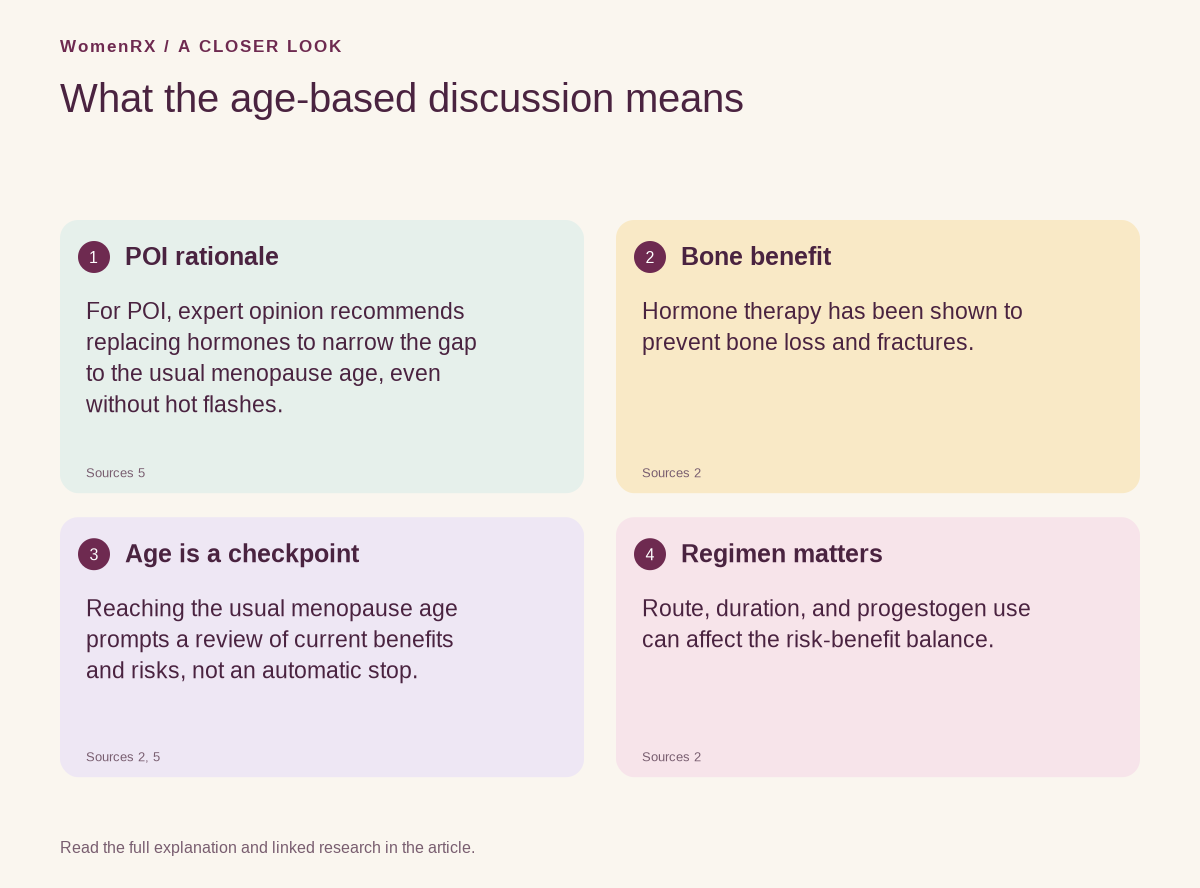
What the age-based discussion means
POI rationale: For POI, expert opinion recommends replacing hormones to narrow the gap to the usual menopause age, even without hot flashes.5
Bone benefit: Hormone therapy has been shown to prevent bone loss and fractures.2
Age is a checkpoint: Reaching the usual menopause age prompts a review of current benefits and risks, not an automatic stop.25
Regimen matters: Route, duration, and progestogen use can affect the risk-benefit balance.2
Read the figure as text
The reason to consider treatment after early hormone loss is distinct from the decision about treatment later.- POI rationale: For POI, expert opinion recommends replacing hormones to narrow the gap to the usual menopause age, even without hot flashes.5
- Bone benefit: Hormone therapy has been shown to prevent bone loss and fractures.2
- Age is a checkpoint: Reaching the usual menopause age prompts a review of current benefits and risks, not an automatic stop.25
- Regimen matters: Route, duration, and progestogen use can affect the risk-benefit balance.2
More questions, answered
Is the POI recommendation the same as advice for all early menopause?
No. POI is a specific condition identified before age 40. The recommendation to replace hormones to narrow the gap to the usual menopause age is specifically about POI; treatment after other forms of early menopause still needs an individual assessment. 5 2
Sources you can check
- CLIMARA (ESTRADIOL) PATCH [BAYER HEALTHCARE PHARMACEUTICALS INC.] | US prescribing information and patient instructionsAccessed 2026-09-25Return to first citation
- The 2022 hormone therapy position statement of The North American Menopause Society.“The 2022 Hormone Therapy Position Statement of The North American Menopause Society” Advisory Panel. · Menopause (New York, N.Y.) · 2022Return to first citation
- The 2023 nonhormone therapy position statement of The North American Menopause Society.Menopause (New York, N.Y.) · 2023Return to first citation
- Menopause cardiovascular health and the role of hormone therapy.Burns T, Crump J, Watts M. · Australian journal of general practice · 2026Return to first citation
- Expert opinion by the Italian Society of Gynecology of the Third Age (SIGiTE) and the Italian Society of Menopause (SIM) on diagnosis and treatment of premature ovarian insufficiency.Capozzi A, Ambroggio S, Cagnacci A, Gambacciani M, Lello S, DI Carlo C, Executive Committee of the Italian Society of Gynecology of the Third Age (SIGiTE) and the Italian Society o... · Minerva endocrinology · 2026Return to first citation