POI, Early Menopause, and Ovary-Removal Surgery
Age and what happened to ovarian function help distinguish these terms, and POI doesn’t always mean ovarian activity has stopped for good.
Premature ovarian insufficiency (POI) means loss of ovarian activity before age 40, but that activity can sometimes be intermittent. The international guideline calls ovarian function ending at ages 40-44 early menopause; NHS guidance uses early menopause for periods stopping before 45 and premature menopause for before 40. Surgery to remove ovaries can cause early or premature menopause. 1 3
The age cutoff matters, but so does the cause
These terms are related, not interchangeable. POI describes loss of ovarian activity before age 40. The international guideline uses early menopause for ovarian function ending from age 40 through 44. NHS guidance uses early menopause more broadly for periods stopping before 45, and premature menopause for that happening before 40. So you may see different terms used for changes before age 40. 1 3
| Term or circumstance | What it describes | A useful distinction |
|---|---|---|
| Premature ovarian insufficiency (POI) | Loss of ovarian activity before age 40, typically assessed through menstrual changes and hormone testing | Ovarian function may be intermittent; POI isn’t always the same as permanent menopause. |
| Early menopause | Menopause before 45; the POI guideline uses this term specifically for ages 40-44 | It describes timing, not necessarily why menopause happened. |
| Ovary-removal surgery | A possible cause of early or premature menopause | The operation is part of the explanation; ask whether ovaries will be removed and what that means for you. |
The distinctions in the table follow the international POI guideline and NHS overview. 1 3
POI can include periods of ovarian activity
With POI, periods may be absent or irregular and hormone testing can show ovarian insufficiency. But “insufficiency” matters: the condition does not always mean ovarian activity has ended permanently. The international guideline specifically recognizes that some women with POI have intermittent ovarian function. 3
That difference can matter if pregnancy is something you want to pursue. Intermittent function means natural pregnancy may remain possible for some women, but hormone therapy does not act as contraception. If pregnancy is a goal, ask what the diagnosis means for fertility and family-planning options in your circumstances. 3
POI is assessed using both menstrual history and biochemical testing. The 2024 guideline says one elevated FSH result above 25 IU can be enough for diagnosis; if the picture is uncertain, further testing may be considered. A symptom or a missed period alone doesn’t establish which of these conditions applies. 2 3
When surgery is part of the explanation
If you’ve heard the phrase “surgical menopause,” the useful detail to pin down is whether surgery removes the ovaries. Ovary-removal surgery can cause early or premature menopause. The operation is part of the explanation, though loss of ovarian activity before 40 following medical or surgical treatment can also be POI. 1 3
If surgery is being discussed, clarify whether the plan includes removing ovaries, and ask what the expected effect on ovarian function would be. The POI guideline recommends discussing the risk of POI before a medical or surgical intervention that may cause it. 3
Why the label can change the next conversation
The age and cause can shape what follow-up is relevant. POI can affect fertility and bone, cardiovascular, sexual, psychological, and neurological health, so its care is broader than managing hot flashes alone. The guideline recommends hormone therapy for women with POI until the usual age of menopause, including when they don’t have estrogen-deficiency symptoms; this is specific guidance for POI, not a one-size-fits-all instruction for every kind of menopause. 3
For menopause before 45, NHS guidance also notes higher chances of bone and heart problems. If your changes began before 45, it’s reasonable to ask what the likely cause is, whether testing is needed, and what health follow-up or treatment options fit your age and medical history. 1
A useful next step is to describe the timeline plainly: your age, how your periods changed, and whether you’ve had treatment or surgery that could affect ovarian function. If surgery is planned, ask directly whether ovaries are being removed and what that means for ovarian function. These details help separate a timing label from a diagnosis and its implications.
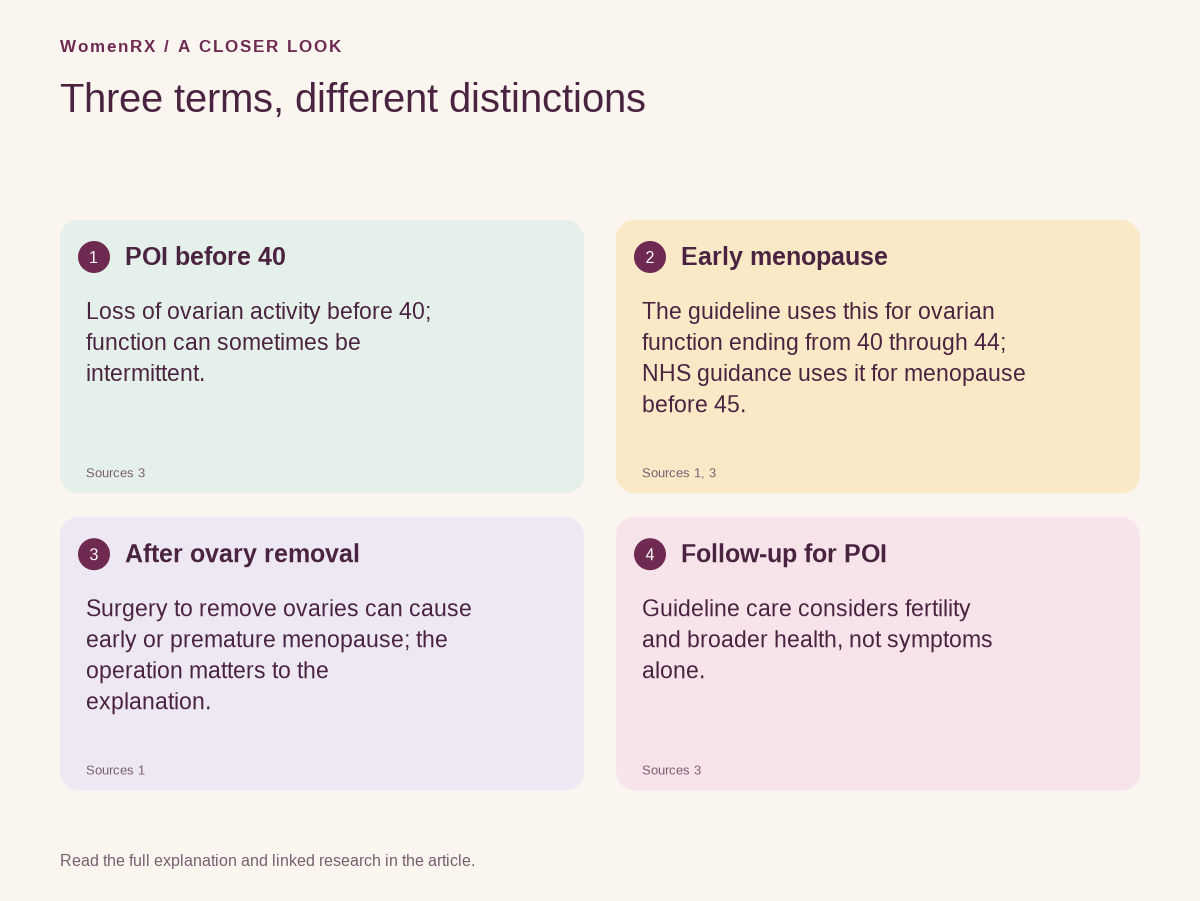
Three terms, different distinctions
POI before 40: Loss of ovarian activity before 40; function can sometimes be intermittent.3
Early menopause: The guideline uses this for ovarian function ending from 40 through 44; NHS guidance uses it for menopause before 45.13
After ovary removal: Surgery to remove ovaries can cause early or premature menopause; the operation matters to the explanation.1
Follow-up for POI: Guideline care considers fertility and broader health, not symptoms alone.3
Read the figure as text
Compare the age definition, cause, and ovarian-function distinction without treating the terms as interchangeable.- POI before 40: Loss of ovarian activity before 40; function can sometimes be intermittent.3
- Early menopause: The guideline uses this for ovarian function ending from 40 through 44; NHS guidance uses it for menopause before 45.13
- After ovary removal: Surgery to remove ovaries can cause early or premature menopause; the operation matters to the explanation.1
- Follow-up for POI: Guideline care considers fertility and broader health, not symptoms alone.3
More questions, answered
Does POI mean pregnancy is impossible?
Not necessarily. Ovarian function can be intermittent in POI, so natural pregnancy may still be possible for some women. Hormone therapy does not provide contraception, so discuss pregnancy intentions and contraception separately. 3
Is early menopause the same as POI?
No. POI refers to loss of ovarian activity before 40. The international guideline calls ovarian function ending between ages 40 and 44 early menopause, although NHS guidance uses early menopause for menopause before 45. 1 3
Sources you can check
- Early or premature menopause - NHSAccessed 2026-09-25Return to first citation
- Evidence-based guideline: premature ovarian insufficiency†‡.ESHRE, ASRM, CREWHIRL and IMS Guideline Group on POI, Panay N, Anderson RA, Bennie A, Cedars M, Davies M, Ee C, Gravholt CH, Kalantaridou S, Kallen A, Kim KQ, Misrahi M, Mousa A, N... · Climacteric : the journal of the International Menopause Society · 2024Return to first citation
- Evidence-based guideline: premature ovarian insufficiency.Panay N, Anderson RA, Bennie A, Cedars M, Davies M, Ee C, Gravholt CH, Kalantaridou S, Kallen A, Kim KQ, Misrahi M, Mousa A, Nappi RE, Rocca WA, Ruan X, Teede H, Vermeulen N, Vogt ... · Human reproduction open · 2024Return to first citation