Primary Ovarian Insufficiency: Causes and Diagnosis
Periods that become irregular or stop before 40 deserve an evaluation, but POI is diagnosed through hormone testing, not missed periods alone.
Primary ovarian insufficiency (POI) is considered when periods have been absent or unusually infrequent for more than four months before age 40. A 2021 position statement uses elevated follicle-stimulating hormone (FSH) on two tests more than four weeks apart. Possible causes include genetic or autoimmune conditions and effects of surgery, chemotherapy, or radiation, though often no cause is found. Ovarian function can fluctuate. 3 1
What the diagnosis is based on
A change in your periods is a reason to look for an explanation, not a diagnosis by itself. POI is assessed in someone under 40 whose periods have stopped or become very infrequent for more than four months. The 2021 position statement defines the hormone evidence as FSH above 25 IU/L on two tests taken more than four weeks apart. It also describes low estradiol as part of the typical pattern. 3
The position statement calls for two FSH test results as part of the hormone evidence, rather than relying on a single result. A pelvic ultrasound may also be used to look at the ovaries, but it is one part of an evaluation, not a substitute for the clinical and hormone criteria. 3 1
POI is not the same as menopause
POI describes reduced or irregular ovarian function before age 40, not necessarily a complete, permanent stop. Some people with POI still have occasional periods, and ovarian function may fluctuate. Spontaneous pregnancy can still occur, although fertility may be affected. With premature menopause, periods stop before 40 and pregnancy is no longer possible. 1 3
The distinction matters if you have questions about fertility or future health. A POI diagnosis does not, by itself, answer whether pregnancy is possible or what reproductive choices are right for you. Lower estrogen is also relevant to bone health: MedlinePlus notes that people with POI have increased risk of osteoporosis because estrogen helps keep bones strong. 1
How clinicians look for a cause
Sometimes testing identifies a likely cause; often it does not. Possible explanations include chromosome or gene differences, autoimmune conditions, and effects of surgery, chemotherapy, or radiation. A review of genetic research also describes genetic causes involving chromosomes and individual genes, but the range of possible genetic findings is broad. 3 4
The 2021 position statement describes an initial cause-focused evaluation that can include chromosome testing (karyotype), screening for an FMR1 gene premutation, and assessment for autoimmune causes. Those tests look for different explanations; a normal result does not rule out POI. Even after testing, a cause often remains unidentified. An unexplained result does not mean the symptoms are not real. 3 1
Other reasons periods may change
Irregular or missing periods can have explanations other than POI. For example, thyroid problems and polycystic ovary syndrome can affect menstrual patterns; periods can also be irregular around puberty and as menopause approaches. Too much exercise is another possible cause of irregular periods. These examples are why a clinician considers your age, menstrual history, symptoms, and test results together rather than assuming that irregular periods mean ovarian insufficiency. 2
If your periods have changed before age 40, the useful next step is to describe when the change began and how often you bleed, then ask whether the pattern and hormone results meet criteria for POI or point to another cause. If POI is confirmed, you can ask which cause-focused tests are relevant and what the result means for your own fertility, bone-health, and cardiovascular-health questions. The evaluation can identify a cause, but it may also leave the cause unexplained. 3 1
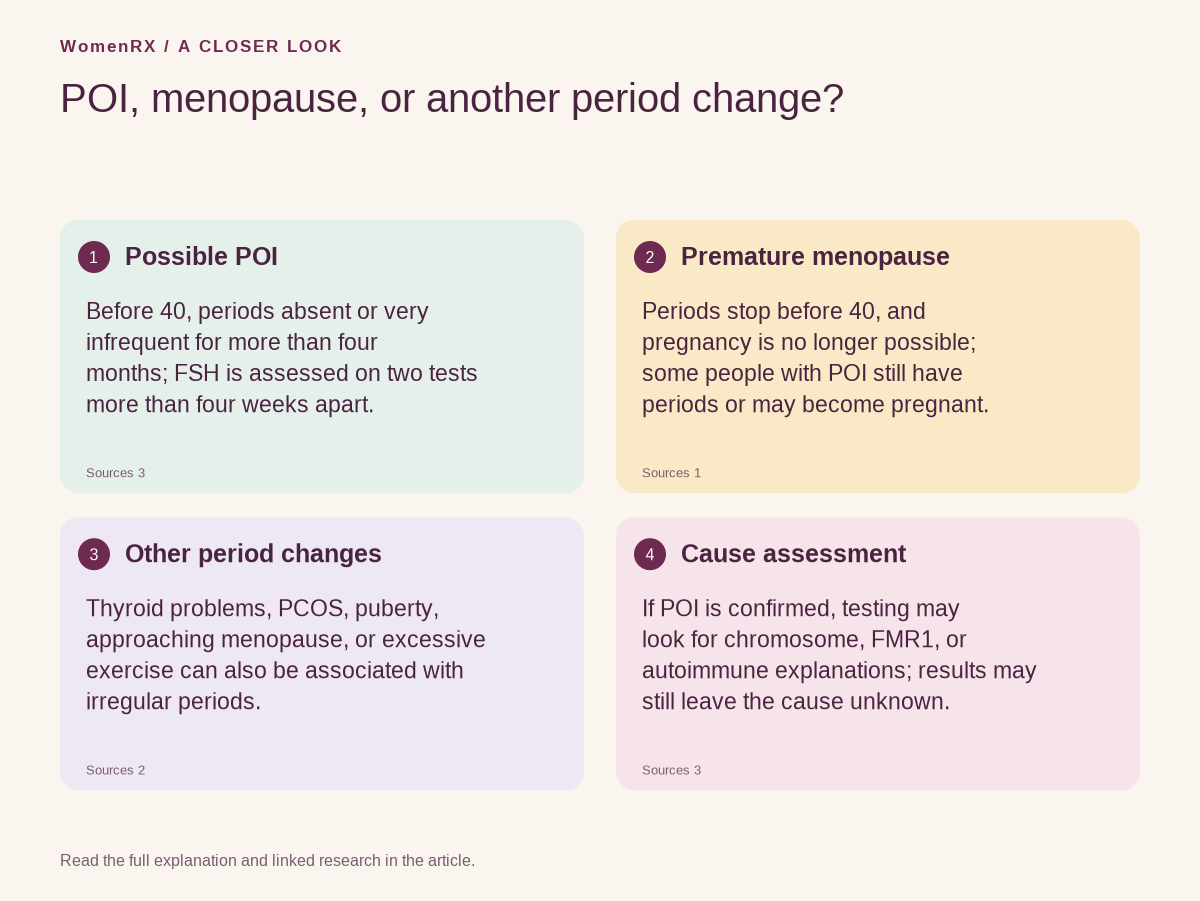
POI, menopause, or another period change?
Possible POI: Before 40, periods absent or very infrequent for more than four months; FSH is assessed on two tests more than four weeks apart.3
Premature menopause: Periods stop before 40, and pregnancy is no longer possible; some people with POI still have periods or may become pregnant.1
Other period changes: Thyroid problems, PCOS, puberty, approaching menopause, or excessive exercise can also be associated with irregular periods.2
Cause assessment: If POI is confirmed, testing may look for chromosome, FMR1, or autoimmune explanations; results may still leave the cause unknown.3
Read the figure as text
The menstrual pattern raises the question; age and hormone evaluation help distinguish POI from premature menopause or other causes.- Possible POI: Before 40, periods absent or very infrequent for more than four months; FSH is assessed on two tests more than four weeks apart.3
- Premature menopause: Periods stop before 40, and pregnancy is no longer possible; some people with POI still have periods or may become pregnant.1
- Other period changes: Thyroid problems, PCOS, puberty, approaching menopause, or excessive exercise can also be associated with irregular periods.2
- Cause assessment: If POI is confirmed, testing may look for chromosome, FMR1, or autoimmune explanations; results may still leave the cause unknown.3
More questions, answered
Does POI mean pregnancy is impossible?
No. Ovarian function can fluctuate in POI, and spontaneous pregnancy is possible, though POI can affect fertility. A diagnosis cannot predict an individual person's chance of pregnancy. 1 3
Does an unknown cause mean the diagnosis is uncertain?
Not necessarily. The diagnosis is based on the menstrual pattern and hormone findings. Cause-focused tests may not identify why it happened, and an unexplained cause is common. 3 1
Sources you can check
- Primary Ovarian Insufficiency | POI | MedlinePlusAccessed 2026-09-25Return to first citation
- Irregular periods - NHSAccessed 2026-09-25Return to first citation
- Position statement on the diagnosis and management of premature/primary ovarian insufficiency (except Turner Syndrome).Christin-Maitre S, Givony M, Albarel F, Bachelot A, Bidet M, Blanc JV, Bouvattier C, Brac de la Perrière A, Catteau-Jonard S, Chevalier N, Carel JC, Coutant R, Donadille B, Durante... · Annales d'endocrinologie · 2021Return to first citation
- Genetics of Primary Ovarian Insufficiency in the Next-Generation Sequencing Era.França MM, Mendonca BB. · Journal of the Endocrine Society · 2020Return to first citation