The Average Age of Menopause, and When Timing Is Early
In a large U.S. study, natural menopause occurred at a median age of 50, but an average is a population measure, not a deadline for your body.
A U.S. population study estimated the average age of natural menopause at 49.5 years and the median at 50. Menopause commonly occurs between 45 and 55. Before 45, it is considered early; before 40, premature. Those cutoffs help identify when to raise the question with a clinician, but they don’t predict your timing or explain the cause. 1 3
An average is a reference point, not a forecast
A recent U.S. study estimated the average age of natural menopause at 49.5 years; the median was 50. The mean and median are two ways to summarize a group, not estimates of when any one person will stop having periods. The study used a nationally representative sample, but even a strong population estimate can’t set a personal deadline. 3
Across studies, estimates can differ with the population being studied and how menopause is measured. For example, a meta-analysis of studies from several Asian countries reported pooled mean estimates ranging from 46.36 years in Pakistan to 52 years in Indonesia. Those are estimates from different country studies, not a single universal range for individuals. 2
There’s also some fuzziness in the exact age people report. In a long-running Dutch cohort, age at natural menopause could be determined for 57% of women who reached menopause during follow-up. Among women with natural menopause, 17% gave reports that differed by four or more years across repeated reports; agreement within one year was lower over longer recall periods. That makes a reported average useful context, but not a precision tool. 4
The age cutoffs that change the conversation
Menopause usually occurs between ages 45 and 55. Menopause before 45 is called early menopause, and before 40 is called premature menopause. It can happen naturally or follow treatment for another condition, including surgery to remove the ovaries. 1
If you’re under 45 and your periods are becoming irregular or have stopped, it’s reasonable to bring that up with a clinician, especially if you’re also noticing symptoms you associate with menopause. NHS guidance notes that blood tests may sometimes be considered for people under 45 with menopause symptoms. 1
These age labels flag timing; they don’t tell you why it’s happening. If premature ovarian insufficiency (POI) comes up, ask what the term means in your situation and how the clinician is distinguishing it from other causes. The age cutoffs alone can’t make that distinction.
Why earlier timing deserves attention
Menopause before 45 is more than being on the early side of an average. NHS guidance notes a higher chance of bone and heart problems when menopause starts before 45, which is why it’s worth discussing rather than treating the age label as trivia. 1
Timing alone still doesn’t tell you what will happen to your health. The useful next step is to explain your menstrual changes, when they began, and any treatment or surgery that could be relevant. The purpose isn’t to prove that your timing is unusual; it’s to understand what may be behind it and whether anything needs attention.
Why averages can’t tell you when yours will happen
Menopause timing is associated with factors such as family history, but those associations can’t predict an individual’s exact age. A meta-analysis of Asian studies also found differences in reported timing across populations and study settings. These findings describe group patterns; they don’t establish a reliable way to make menopause happen later or to calculate your personal timeline. 1 2
So if you’re 43, the average of 49.5 doesn’t mean you should wait six years to ask about changes. And if you’re 51, you haven’t missed a deadline. Use the average as context, and use the before-45 and before-40 cutoffs to recognize when timing itself merits a conversation.
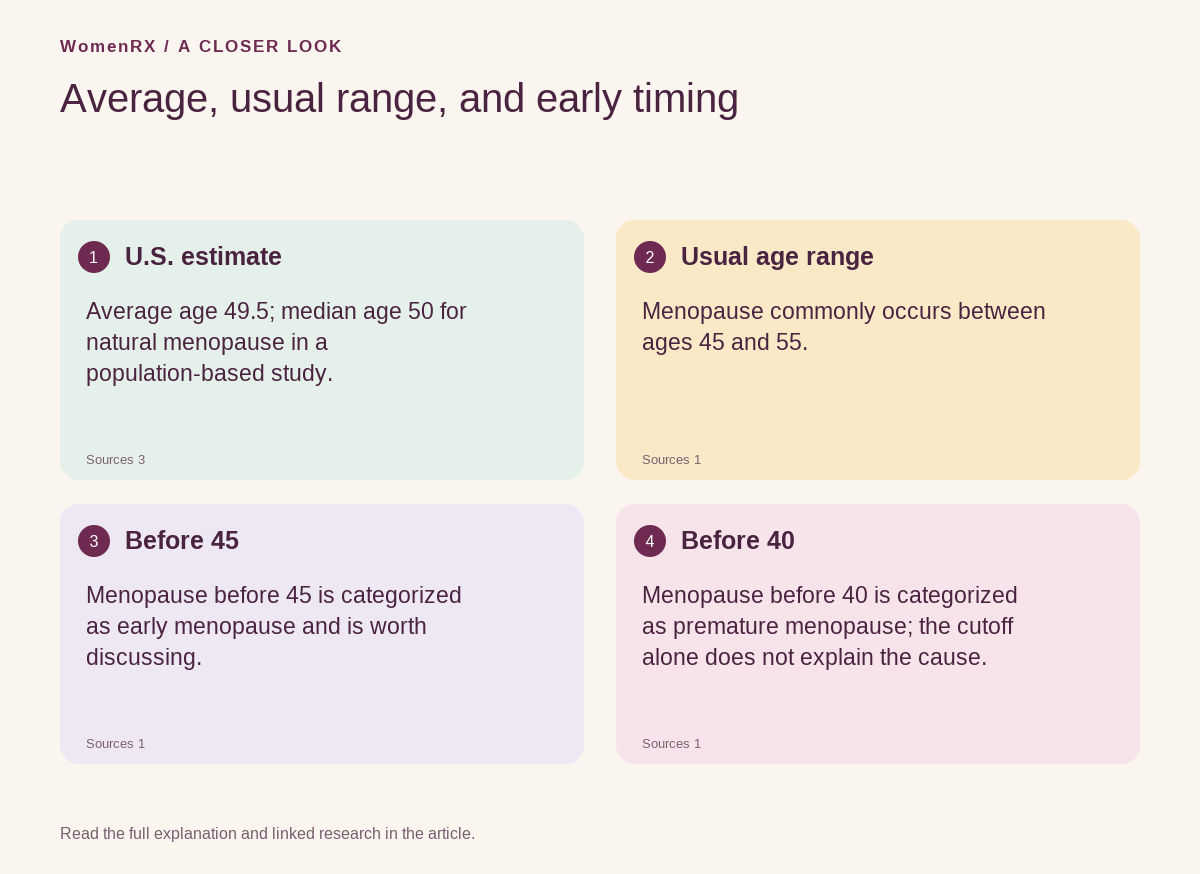
Average, usual range, and early timing
U.S. estimate: Average age 49.5; median age 50 for natural menopause in a population-based study.3
Usual age range: Menopause commonly occurs between ages 45 and 55.1
Before 45: Menopause before 45 is categorized as early menopause and is worth discussing.1
Before 40: Menopause before 40 is categorized as premature menopause; the cutoff alone does not explain the cause.1
Read the figure as text
These figures describe different things: a population estimate, a commonly reported age range, and age thresholds used to flag earlier menopause.- U.S. estimate: Average age 49.5; median age 50 for natural menopause in a population-based study.3
- Usual age range: Menopause commonly occurs between ages 45 and 55.1
- Before 45: Menopause before 45 is categorized as early menopause and is worth discussing.1
- Before 40: Menopause before 40 is categorized as premature menopause; the cutoff alone does not explain the cause.1
Sources you can check
- Early or premature menopause - NHSAccessed 2026-09-25Return to first citation
- Menopause Across Asia: A Comprehensive Meta-analysis of Age and Influencing Factors.Agrawal PK, Varshney A, Dev S, Garg R, Gautam A, Pursnani N, Panda SK, Agastya N. · Journal of mid-life health · 2025Return to first citation
- Age at natural and surgical menopause and related factors: NHANES 2013-2023.Schulz RN, Shvartsman K, Borgia L, Witkop CT, Mancuso JD, Koehlmoos TP, Ahmed AE. · Menopause (New York, N.Y.) · 2026Return to first citation
- Assessing age at natural menopause from self-reported data in a long-running population-based cohort study.Pieterse IJ, Picavet HSJ, MenoPause Consortium, Verschuren WMM, Broekman BFP. · Maturitas · 2026Return to first citation