Premature Ovarian Insufficiency: Assessment and Next Steps
Irregular or absent periods before 40 deserve a clear assessment, and a POI diagnosis doesn’t by itself settle every fertility question.
POI is assessed by looking at menstrual changes and blood tests together: the guideline uses at least four months of absent or irregular periods and an elevated FSH above 25 IU/L. Pregnancy and medication effects also matter when interpreting results. If POI is confirmed, care has separate parts: treating symptoms, addressing fertility goals, and following longer-term health. 3 2
Start with the pattern, not one missed period
Premature ovarian insufficiency (POI) means loss of ovarian activity before age 40. It can involve periods that become irregular or stop, along with blood-test findings consistent with reduced ovarian function. A change in periods can have other causes too, so one late period or one test result isn’t enough to explain what’s happening. 3
The international POI guideline recommends diagnosing POI when spontaneous absent or irregular periods have lasted at least four months and follicle-stimulating hormone (FSH) is elevated above 25 IU/L. FSH doesn’t have to be measured on a particular cycle day. If results or symptoms leave uncertainty, the guideline recommends repeating FSH after four to six weeks. 3
Pregnancy should be ruled out when periods stop. Hormonal medications, including some contraceptives, can change bleeding patterns and may lower FSH, making the picture harder to interpret. Tell the clinician assessing you what hormonal contraception or therapy you use; some may need to be stopped before the diagnosis can be confirmed. Don’t stop a medication on your own. 3
Estradiol is not recommended as the test that establishes POI by itself. A low result can add support when FSH is elevated, but it should be interpreted as part of the wider assessment. 3
Treat symptoms and plan for longer-term health
POI can affect more than periods. The guideline identifies possible effects on fertility, bone and cardiovascular health, sexual function, and emotional well-being, as well as symptoms related to low estrogen. That’s why management isn’t one decision about one blood test. 3
For symptoms, hormone therapy is a treatment to consider, not an automatic choice. The POI guideline says it can mitigate some effects of the condition. Broader menopause guidance identifies hormone therapy as the most effective treatment for hot flashes and night sweats and says it can prevent bone loss. It also says risks vary with the treatment used and the person receiving it. Those broader findings help explain the conversation, but they don’t replace an individual assessment for someone with POI. 2 5
If hot flashes or night sweats are troublesome and hormone therapy isn’t suitable or isn’t what you want, there are other symptom-treatment discussions to have. Menopause guidance supports options including cognitive behavioral therapy and certain prescription medicines, such as some antidepressants and gabapentin. That guidance addresses menopausal symptoms generally; it doesn’t establish that every option has been studied specifically in people with POI. 6
Bone health is a separate reason not to let the conversation end when symptoms improve. The POI guideline includes bone and cardiovascular health among its longer-term concerns and addresses monitoring where relevant. Ask how those concerns will be followed in your circumstances. Treatment for hot flashes, a plan for bone health, and cardiovascular follow-up aren’t interchangeable parts of care. 3
Give fertility its own conversation
If pregnancy is a goal, say so early in the assessment. Managing low-estrogen symptoms and assessing the possibility of pregnancy answer different questions. A fertility evaluation can consider your history and, when relevant, tests for factors beyond ovarian function, including a partner’s semen analysis. Which steps make sense depends on your situation. 1 3
Ovarian activity may return intermittently after a POI diagnosis. A prospective study followed 60 women with POI in China for four years and assessed intermittent recovery of ovarian function and clinical pregnancy. That study doesn’t establish a reliable way to forecast what will happen for an individual. The practical distinction is that POI shouldn’t be treated as proof of certain permanent infertility, but neither should intermittent activity be mistaken for a predictable route to pregnancy. 4
If you hope to conceive, ask for fertility-focused guidance rather than waiting for periods to become regular. If pregnancy isn’t a goal, you still deserve a plan for symptoms and longer-term health. 2 3
Leave the assessment with a plan
A useful discussion connects four points: whether your bleeding pattern and FSH results meet the diagnostic criteria; whether pregnancy or hormonal medication affects interpretation; what help you want with symptoms; and whether fertility assessment is a priority. It should also establish how longer-term concerns, particularly bone and cardiovascular health, will be followed. 3
The aim isn’t to reduce POI to a lab result. It’s to establish whether the pattern fits and make the next decisions fit your health and your goals.
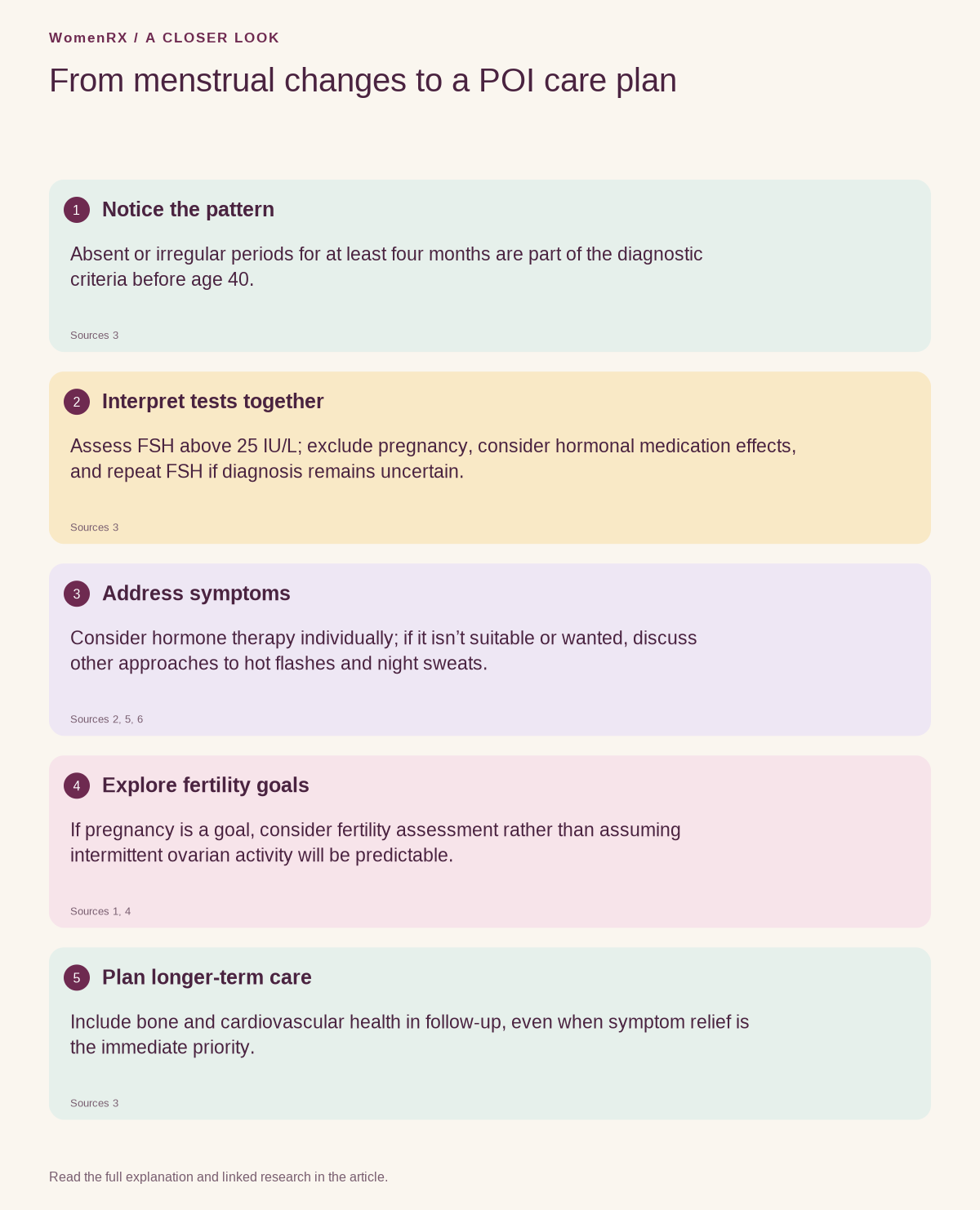
From menstrual changes to a POI care plan
Notice the pattern: Absent or irregular periods for at least four months are part of the diagnostic criteria before age 40.3
Interpret tests together: Assess FSH above 25 IU/L; exclude pregnancy, consider hormonal medication effects, and repeat FSH if diagnosis remains uncertain.3
Address symptoms: Consider hormone therapy individually; if it isn’t suitable or wanted, discuss other approaches to hot flashes and night sweats.256
Explore fertility goals: If pregnancy is a goal, consider fertility assessment rather than assuming intermittent ovarian activity will be predictable.14
Plan longer-term care: Include bone and cardiovascular health in follow-up, even when symptom relief is the immediate priority.3
Read the figure as text
Assessment establishes whether POI fits; the next paths address different needs rather than treating one result as the whole plan.- Notice the pattern: Absent or irregular periods for at least four months are part of the diagnostic criteria before age 40.3
- Interpret tests together: Assess FSH above 25 IU/L; exclude pregnancy, consider hormonal medication effects, and repeat FSH if diagnosis remains uncertain.3
- Address symptoms: Consider hormone therapy individually; if it isn’t suitable or wanted, discuss other approaches to hot flashes and night sweats.256
- Explore fertility goals: If pregnancy is a goal, consider fertility assessment rather than assuming intermittent ovarian activity will be predictable.14
- Plan longer-term care: Include bone and cardiovascular health in follow-up, even when symptom relief is the immediate priority.3
More questions, answered
Does one elevated FSH result confirm POI?
The guideline’s criteria pair an elevated FSH above 25 IU/L with at least four months of absent or irregular periods. A repeat FSH after four to six weeks is recommended when there’s diagnostic uncertainty, not automatically in every case. 3
Does POI mean pregnancy is impossible?
No. Intermittent ovarian recovery and clinical pregnancy were assessed in a prospective POI study, but its findings can’t tell you what will happen in your case. Possibility isn’t the same as a predictable chance of pregnancy. 4
Sources you can check
- Infertility | Infertility Treatments | MedlinePlusAccessed 2026-09-25Return to first citation
- Evidence-based guideline: premature ovarian insufficiency†‡.ESHRE, ASRM, CREWHIRL and IMS Guideline Group on POI, Panay N, Anderson RA, Bennie A, Cedars M, Davies M, Ee C, Gravholt CH, Kalantaridou S, Kallen A, Kim KQ, Misrahi M, Mousa A, N... · Climacteric : the journal of the International Menopause Society · 2024Return to first citation
- Evidence-based guideline: premature ovarian insufficiency.Panay N, Anderson RA, Bennie A, Cedars M, Davies M, Ee C, Gravholt CH, Kalantaridou S, Kallen A, Kim KQ, Misrahi M, Mousa A, Nappi RE, Rocca WA, Ruan X, Teede H, Vermeulen N, Vogt ... · Human reproduction open · 2024Return to first citation
- ERAP2 as a Potential Marker for Ovarian Ageing and Spontaneous Ovulation Recovery in Women With Premature Ovarian Insufficiency.Meng T, Jo Y, Wei S, Zhu H, Wang C, Meng S, Lee HJ, Joo J, Zhang J, Wei D, Chen ZJ, Ryu D, Qin Y, Jiao X. · BJOG : an international journal of obstetrics and gynaecology · 2025Return to first citation
- The 2022 hormone therapy position statement of The North American Menopause Society.“The 2022 Hormone Therapy Position Statement of The North American Menopause Society” Advisory Panel. · Menopause (New York, N.Y.) · 2022Return to first citation
- The 2023 nonhormone therapy position statement of The North American Menopause Society.Menopause (New York, N.Y.) · 2023Return to first citation