Low Estrogen in Your 30s: What Could Be Going On?
Missed periods and hot flashes deserve a closer look, but the pattern of your cycles and hormone results matters more than either symptom alone.
In your 30s, low estrogen can occur when the ovaries aren’t working as expected or when signals from the brain to the ovaries are suppressed. Missed or irregular periods can also have other causes, including pregnancy. A clinician can use your menstrual history, medication history, and targeted tests to distinguish possibilities. Premature ovarian insufficiency is one to assess when cycle changes persist, but symptoms or a single estradiol result don’t establish it.14
If your periods have changed and you’re having hot flashes, it’s reasonable to wonder about estrogen. The useful question isn’t just “Is my estrogen low?” It’s “Why have my cycles changed, and what does the pattern of testing show?” Those answers can point to different kinds of care.14
Start with the change in your periods
Think about what was usual for you and what’s different now. For example, have previously predictable periods become irregular, or have they stopped? The distinction matters because a clinician assessing premature ovarian insufficiency (POI) looks for at least four months of absent or irregular spontaneous cycles, alongside a follicle-stimulating hormone (FSH) result above the guideline’s diagnostic threshold. POI means loss of ovarian activity before age 40. Hot flashes may raise the question, but they aren’t a diagnostic test.4
Pregnancy is an early possibility to rule out when periods stop. Hormonal contraception also changes the picture: it can cause or conceal absent or irregular bleeding and may lower FSH, making POI harder to confirm while you’re using it. That’s why the dates of your last periods and the type of contraception or other hormone therapy you use are more helpful than trying to interpret a hormone number on its own.4
Two different ways ovarian estrogen production can change
The ovaries may be receiving a signal but not responding as expected. In POI, ovarian activity is impaired before 40. A history of removal of both ovaries before 40 establishes the diagnosis without further diagnostic hormone testing. When POI wasn’t caused by a medical or surgical intervention, an exact cause may never be identified. The guideline recommends discussing genetic testing and, when the cause is unknown, screening for a particular adrenal autoantibody; it also recommends checking thyroid function at diagnosis.4
The signal to the ovaries may be suppressed. In functional hypothalamic amenorrhea (FHA), changes in signaling from the brain reduce stimulation of the ovaries and can lead to low estrogen and missed periods. Stress, inadequate energy intake, weight loss, and heavy exercise may contribute, sometimes together. FHA can occur at a normal body weight, so appearance or weight alone can’t rule it in or out. It’s diagnosed after other causes are excluded.12
These aren’t interchangeable explanations. POI typically involves elevated FSH along with disrupted cycles; FHA involves reduced signaling from the brain, so FSH may be low rather than elevated. A clinician considers those results in the context of your history instead of treating every missed period as early menopause.14
Other conditions can disrupt periods without being POI or FHA. Pregnancy, elevated prolactin, thyroid dysfunction, and conditions associated with excess androgens were among the alternatives excluded in a study of women diagnosed with FHA. Which possibilities need testing depends on your symptoms and history.1
What testing can, and can’t, settle
For suspected POI, the guideline uses at least four months of disordered cycles and FSH above 25 IU/L for diagnosis. FSH does not have to be drawn on a particular cycle day. One elevated FSH result can meet the guideline’s testing criterion when the menstrual history fits, but the guideline recommends repeating it after four to six weeks if the diagnosis is uncertain. Estradiol can add evidence of low estrogen when FSH is elevated; estradiol alone should not be used to diagnose POI.4
This is why an isolated result from a home test or a lab report can be hard to interpret. It doesn’t tell the whole story of your cycles, pregnancy possibility, or hormone use. If POI is confirmed and wasn’t caused by an intervention, evaluation may then turn to possible causes, including genetic testing, adrenal autoantibody screening when the cause is unknown, and thyroid testing. Finding a cause isn’t always possible.4
Why the distinction changes the next move
If the pattern points toward FHA, the conversation is about what may be suppressing hormone signaling, such as changes in eating, exercise, weight, or stress, while checking for other causes of missed periods. If it points toward POI, the conversation also includes longer-term health and fertility implications. The POI guideline recommends hormone therapy to help maintain bone density and prevent osteoporosis, but treatment decisions follow an assessment of the individual situation. Hormone therapy is not a way to restore ovarian function or fertility.1234
You don’t need to decide which diagnosis fits before making an appointment. If periods have stopped or become persistently irregular in your 30s, bring the pattern itself into the conversation, along with any hot flashes, hormone use, major changes in exercise or eating, and relevant surgery or medical treatment. Those details help make the tests meaningful.14
When periods change in your 30s
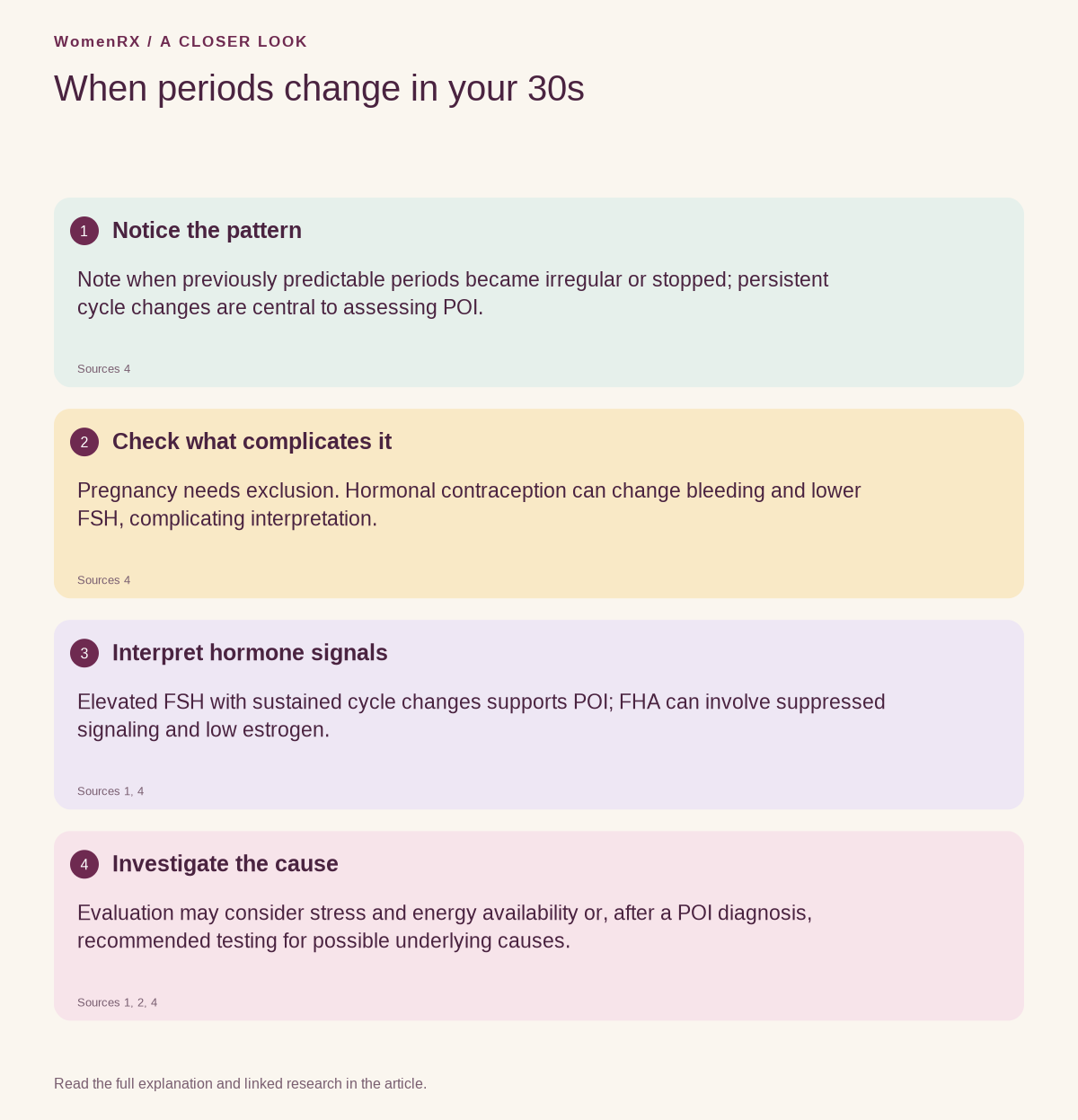
Notice the pattern: Note when previously predictable periods became irregular or stopped; persistent cycle changes are central to assessing POI.4
Check what complicates it: Pregnancy needs exclusion. Hormonal contraception can change bleeding and lower FSH, complicating interpretation.4
Interpret hormone signals: Elevated FSH with sustained cycle changes supports POI; FHA can involve suppressed signaling and low estrogen.14
Investigate the cause: Evaluation may consider stress and energy availability or, after a POI diagnosis, recommended testing for possible underlying causes.124
Read the figure as text
A menstrual change starts an evaluation; symptoms alone don’t choose the diagnosis.- Notice the pattern: Note when previously predictable periods became irregular or stopped; persistent cycle changes are central to assessing POI.4
- Check what complicates it: Pregnancy needs exclusion. Hormonal contraception can change bleeding and lower FSH, complicating interpretation.4
- Interpret hormone signals: Elevated FSH with sustained cycle changes supports POI; FHA can involve suppressed signaling and low estrogen.14
- Investigate the cause: Evaluation may consider stress and energy availability or, after a POI diagnosis, recommended testing for possible underlying causes.124
More questions, answered
Can I have functional hypothalamic amenorrhea at a normal weight?
Yes. FHA has been described in women at a range of body weights, including normal weight. A clinician considers menstrual changes and possible contributors such as energy intake, exercise, and stress while excluding other causes.12
Does a low estradiol result mean I have premature ovarian insufficiency?
No. The POI guideline says not to diagnose it from estradiol alone. The diagnosis depends on a sustained change in spontaneous cycles and an elevated FSH result; low estradiol can provide additional confirmation when FSH is elevated.4
Sources you can check
- Metabolic and Endocrine Alterations in Underweight and Normal-Weight Women with Functional Hypothalamic Amenorrhea.Kowalczyk K, Szymańska I, Zawistowska O, Bieńkowska J, Drosdzol-Cop A, Madej P. · Journal of clinical medicine · 2025Return to first citation
- Gene-environment interaction in functional hypothalamic amenorrhea.Barbagallo F, Bosoni D, Perone V, Cucinella L, Dealberti D, Cannarella R, Calogero AE, Nappi RE. · Frontiers in endocrinology · 2024Return to first citation
- Oral Chinese herbal formulas for premature ovarian insufficiency: a systematic review, meta-analysis, and exploratory therapeutic-principle subgroup analysis.Wu Y, Li S, Liu G, Zheng X, Cheng J, Jiang X. · Frontiers in endocrinology · 2026Return to first citation
- Evidence-based guideline: premature ovarian insufficiency.Panay N, Anderson RA, Bennie A, Cedars M, Davies M, Ee C, Gravholt CH, Kalantaridou S, Kallen A, Kim KQ, Misrahi M, Mousa A, Nappi RE, Rocca WA, Ruan X, Teede H, Vermeulen N, Vogt ... · Human reproduction open · 2024Return to first citation