Low Estrogen: Why Context Matters More Than One Test
A low estradiol result means something different during a menstrual cycle, after menopause, or alongside periods that have stopped unexpectedly.
Low estrogen can reflect the usual decline around menopause, removal of both ovaries, premature ovarian insufficiency, or a disruption in the signals between the brain and ovaries. A missed period alone doesn’t establish which is happening. Evaluation depends on your age, menstrual pattern, pregnancy possibility, hormone use, and sometimes tests such as follicle-stimulating hormone (FSH) and estradiol. Treatment depends on the cause and what needs attention, not a single number.521
First, what does “low estrogen” mean?
Estradiol is the main circulating estrogen during the reproductive years. Its level changes across a menstrual cycle, so a result that looks low on its own may not explain a symptom or a missed period. When periods stop unexpectedly, estradiol becomes more useful alongside the menstrual history and other hormone results, particularly FSH, which helps distinguish reduced ovarian activity from some causes involving the brain’s signaling to the ovaries.5
That distinction matters because a missing period is not the same thing as estrogen deficiency. Pregnancy, thyroid disorders, elevated prolactin, chronic problems with ovulation, and changes involving the uterus can all enter the evaluation of absent periods. They don’t all call for estrogen treatment.5
The main contexts point in different directions
Around the usual age of menopause: Ovarian estrogen production declines as menstrual periods come to an end. Hot flashes can accompany that change, but their severity varies. A blood test isn’t necessarily the deciding factor in whether bothersome postmenopausal symptoms need treatment; FSH and estradiol levels haven’t been shown to be useful for managing moderate to severe hot flashes or vulvar and vaginal symptoms after menopause.1
After removal of both ovaries: Estrogen levels can fall suddenly rather than through the usual menopausal transition. That surgical history may make the reason for a change in symptoms clear without treating a lab value as a mystery to solve.1
Before age 40: Irregular or absent periods may raise the possibility of premature ovarian insufficiency, or POI, a loss of ovarian activity before 40. It isn’t diagnosed from a low estradiol result alone. The POI guideline calls for a history of disordered menstrual cycles for at least four months and biochemical confirmation with elevated FSH. Low estradiol can provide additional support when FSH is elevated. The guideline calls the loss of ovarian function at ages 40 through 44 early menopause, a separate context from POI.2
During the reproductive years for other reasons: The ovaries may be capable of making estrogen but receive reduced signals from the hypothalamus and pituitary, the parts of the brain involved in regulating the menstrual cycle. Functional hypothalamic amenorrhea is one possibility; disorders involving prolactin or the pituitary are others. Thyroid problems and chronic ovulation disorders can also stop or disrupt periods, though an absent period in those settings does not by itself establish low estrogen. This is why the pattern of hormone results matters more than assigning every missed period the same cause.5
Pregnancy and lactation are also distinct reproductive contexts when periods may be absent. If pregnancy is possible, it needs to be considered before interpreting a missed period as evidence of ovarian insufficiency.52
What an evaluation may actually sort out
A clinician starts with the pattern: Have periods always been irregular, or did they stop after previously regular cycles? Was there ovarian surgery, a pregnancy, or a change in hormone use? Those details can change which explanation fits. Hormonal contraception, for example, may cause or hide absent periods and can affect FSH interpretation when POI is being assessed.52
For absent periods during the reproductive years, evaluation generally begins by excluding pregnancy. Depending on the history and examination, initial blood tests may include thyroid-stimulating hormone (TSH), prolactin, FSH, and estradiol. FSH and estradiol together help separate a pattern suggesting reduced ovarian activity from a pattern suggesting reduced signaling to the ovaries. A pelvic ultrasound may help when the question concerns the ovaries or uterus. Not everyone needs every test.5
If periods were previously regular and have been absent for more than three months, or previously irregular and absent for six months, the American Society for Reproductive Medicine recommends investigation. Pregnancy may need to be excluded much sooner when a period is late.5
A few distinctions make the results easier to understand:
- High FSH with low estradiol can point toward ovarian insufficiency. For possible POI, the menstrual history and the guideline’s diagnostic criteria still matter; estradiol alone is not the diagnostic test.52
- Low estradiol without high FSH can point toward reduced hypothalamic-pituitary signaling rather than the same ovarian pattern. The history helps identify what might be affecting that signaling.5
- A normal-looking estradiol result may not identify the cause of absent periods. Other forms of disrupted ovulation, thyroid disease, elevated prolactin, or a uterine cause may still need consideration.5
Treatment follows the cause, not the label
For bothersome symptoms after usual-age menopause, hormone therapy is one option. The Menopause Society describes it as the most effective treatment for hot flashes and other vasomotor symptoms; benefits and risks vary with the type of therapy, timing, route, and individual circumstances. Evidence-supported nonhormonal options for hot flashes also exist, including cognitive behavioral therapy and certain prescription medicines. Mild symptoms may not call for treatment at all.341
POI leads to a different conversation. Its guideline recommends hormone therapy until the usual age of menopause even when estrogen-deficiency symptoms aren’t noticeable, in part because care also addresses longer-term health, including bone health. That recommendation should not be transferred automatically to someone with a low result at the usual age of menopause or to someone whose missed periods have another cause. Hormone therapy for POI also does not provide contraception.2
If elevated prolactin, thyroid disease, or another cause explains absent periods, the discussion turns to that condition rather than assuming estrogen replacement is the answer. A useful question after any low result is: Does my menstrual history and the rest of the evaluation show reduced ovarian activity, reduced signaling to the ovaries, or something else entirely? The answer is what makes a treatment discussion specific to you.5
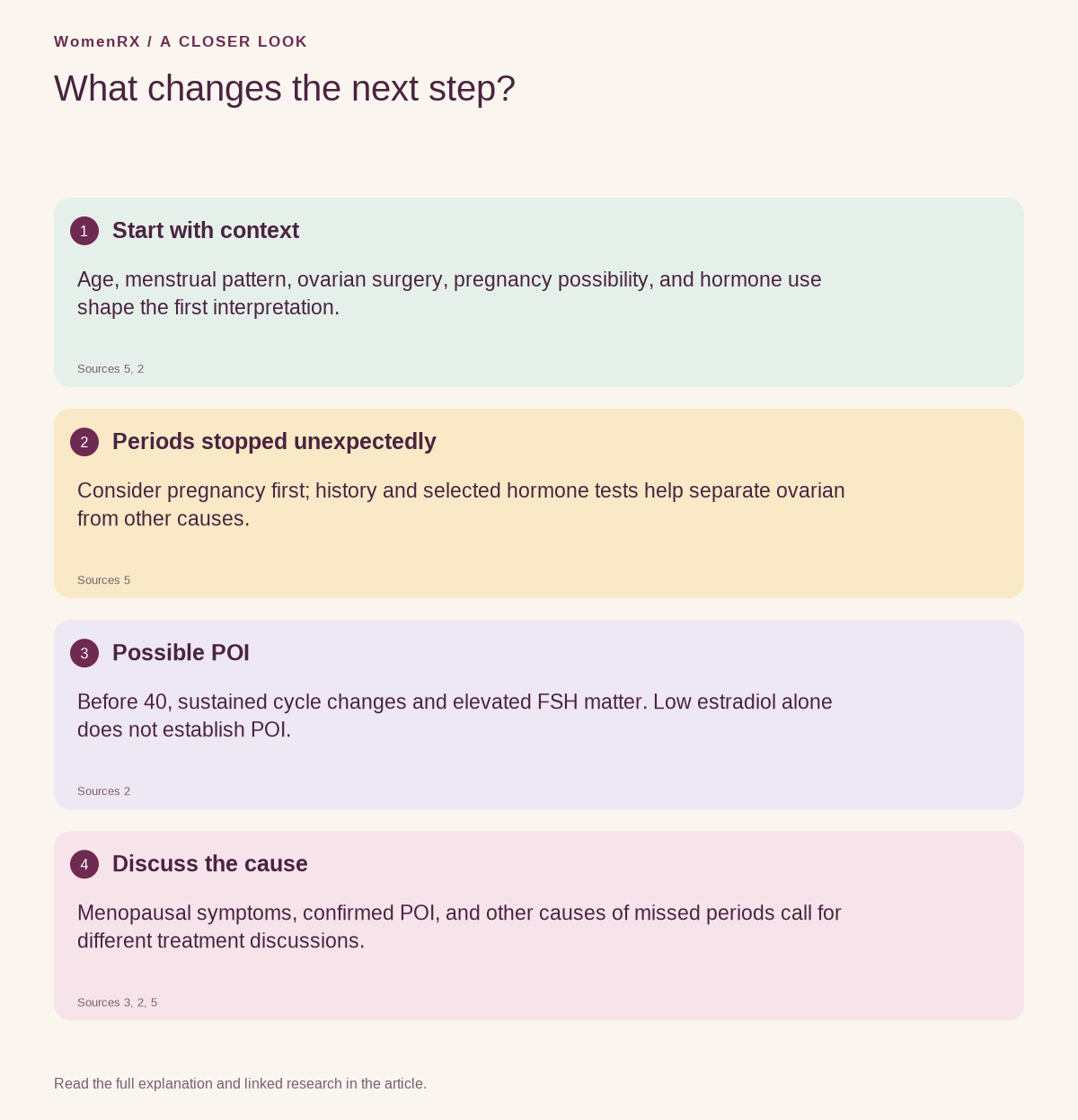
What changes the next step?
Start with context: Age, menstrual pattern, ovarian surgery, pregnancy possibility, and hormone use shape the first interpretation.52
Periods stopped unexpectedly: Consider pregnancy first; history and selected hormone tests help separate ovarian from other causes.5
Possible POI: Before 40, sustained cycle changes and elevated FSH matter. Low estradiol alone does not establish POI.2
Discuss the cause: Menopausal symptoms, confirmed POI, and other causes of missed periods call for different treatment discussions.325
Read the figure as text
The same concern about estrogen can lead to different questions depending on when periods changed and what else was happening.- Start with context: Age, menstrual pattern, ovarian surgery, pregnancy possibility, and hormone use shape the first interpretation.52
- Periods stopped unexpectedly: Consider pregnancy first; history and selected hormone tests help separate ovarian from other causes.5
- Possible POI: Before 40, sustained cycle changes and elevated FSH matter. Low estradiol alone does not establish POI.2
- Discuss the cause: Menopausal symptoms, confirmed POI, and other causes of missed periods call for different treatment discussions.325
More questions, answered
Can one low estradiol result diagnose premature ovarian insufficiency?
No. The POI guideline uses a sustained change in menstrual cycles and elevated FSH for diagnosis. Low estradiol adds support when FSH is elevated, but the guideline specifically advises against diagnosing POI from estradiol alone. Hormonal contraception can complicate interpretation.2
If I don’t have hot flashes, does low estrogen still matter?
It depends on the cause. In confirmed POI, the guideline recommends discussing hormone therapy until the usual age of menopause even without symptoms. That is different from deciding whether to treat mild symptoms around usual-age menopause.21
Sources you can check
- CLIMARA (ESTRADIOL) PATCH [BAYER HEALTHCARE PHARMACEUTICALS INC.] | US prescribing information and patient instructionsAccessed 2026-09-25Return to first citation
- Evidence-based guideline: premature ovarian insufficiency.Panay N, Anderson RA, Bennie A, Cedars M, Davies M, Ee C, Gravholt CH, Kalantaridou S, Kallen A, Kim KQ, Misrahi M, Mousa A, Nappi RE, Rocca WA, Ruan X, Teede H, Vermeulen N, Vogt ... · Human reproduction open · 2024Return to first citation
- The 2022 hormone therapy position statement of The North American Menopause Society.“The 2022 Hormone Therapy Position Statement of The North American Menopause Society” Advisory Panel. · Menopause (New York, N.Y.) · 2022Return to first citation
- The 2023 nonhormone therapy position statement of The North American Menopause Society.Menopause (New York, N.Y.) · 2023Return to first citation
- Current evaluation of amenorrhea: a committee opinion (2024) | American Society for Reproductive Medicine | ASRMAccessed 2026-09-25Return to first citation