Progesterone and Weight: Why Treatment Context Matters
A weight finding for the contraceptive injection DMPA doesn’t automatically apply to micronized progesterone or menopause hormone therapy.
Yes, the type and use matter. Research has found a possible association between the contraceptive injection depot medroxyprogesterone acetate (DMPA) and weight gain, but the evidence has limitations. It doesn’t establish what happens with oral micronized progesterone or other hormone regimens. To compare the evidence with your prescription, match the exact product, reason for use, regimen, timing, and weight measure studied. 3 5

The name alone doesn’t tell you which treatment was studied
“Progesterone” and “progestin” aren’t interchangeable names for one identical treatment. Oral Prometrium, for example, contains micronized progesterone. DMPA is a progestin-only contraceptive injection, and medroxyprogesterone acetate is a synthetic progestin. A weight finding about one product can’t automatically be applied to another. 3 4 7
The reason for use matters, too. The human weight evidence summarized here concerns DMPA used for contraception in people of reproductive age. Menopause treatment can involve a different product and regimen: Bijuva, for example, combines estradiol with progesterone. These aren’t direct comparisons of the same treatment in different settings. 2 5
What the evidence says about DMPA
DMPA has the clearest reported weight association in this evidence. A systematic review of 24 studies in healthy, nonbreastfeeding females ages 13 to 49 found that studies judged to have moderate or high risk of bias suggested an association between DMPA use and weight gain or increased body fat. None of the studies in that review were randomized controlled trials. This suggests a possible association, not that everyone using DMPA will gain weight or that DMPA is necessarily the cause of a change for one person. 5
A separate review looked at whether DMPA might affect appetite or eating in ways that lead to weight gain. It found seven relevant studies, including one randomized trial, with inconsistent results. The reviewers concluded that the evidence wasn’t sufficient to determine whether DMPA changes eating behavior in a way that leads to weight gain. 4
The studies also don’t give one simple answer about timing or amount of change. The review of eating behavior notes that some studies reported no change, while others reported increased appetite in the first six months; the findings were inconsistent. That is not a reliable prediction of when weight might change, or how much, for an individual. 4
Route comparisons have limits as well. A review found similar reported weight changes with DMPA given under the skin or into muscle in general populations of women. That comparison is between two ways of giving DMPA. It doesn’t compare DMPA with oral micronized progesterone. 6
Why those findings don’t settle the menopause question
The DMPA research doesn’t establish the weight effects of micronized progesterone used in menopause care. One study compared estradiol alone with estradiol combined with micronized progesterone or medroxyprogesterone acetate in 26 female macaques. Both progestogens attenuated estradiol’s effects on body weight in the animals. This is an animal finding, and the study summary doesn’t specify the direction of the effect. It can’t tell us how women’s weight changes on either treatment. 7
There is a separate, practical distinction for combined menopause therapy: US prescribing information for estradiol plus progesterone says estrogen with progestogens may cause some fluid retention. That information concerns combined therapy. It doesn’t establish that progesterone alone causes weight gain or identify how much a person’s weight might change. 2
The measure matters, too. Scale weight includes water, muscle, bone, and fat; the number alone can’t tell you which component changed. The DMPA review discusses both weight and body fat, but those outcomes aren’t interchangeable. A scale change isn’t, by itself, proof of increased body fat. 1 5
Match the study to your prescription
If you’re trying to understand a change, start with the exact medication name and form. Is it a DMPA injection for contraception, oral micronized progesterone, or a product combining estrogen and a progestogen? Then consider the indication, the regimen you were prescribed, when you started, and what changed: scale weight, body composition, or a sense of swelling. These details help show whether a study is relevant to your situation; they don’t prove that a hormone caused the change.
If weight has changed suddenly or unexpectedly, MedlinePlus recommends discussing it with a health care provider. 1 For other changes, sharing the product name and when the change began can make the conversation more specific. The main takeaway is that DMPA studies suggest a possible weight association, but they don’t show that progesterone or every progestin uniformly causes weight gain.
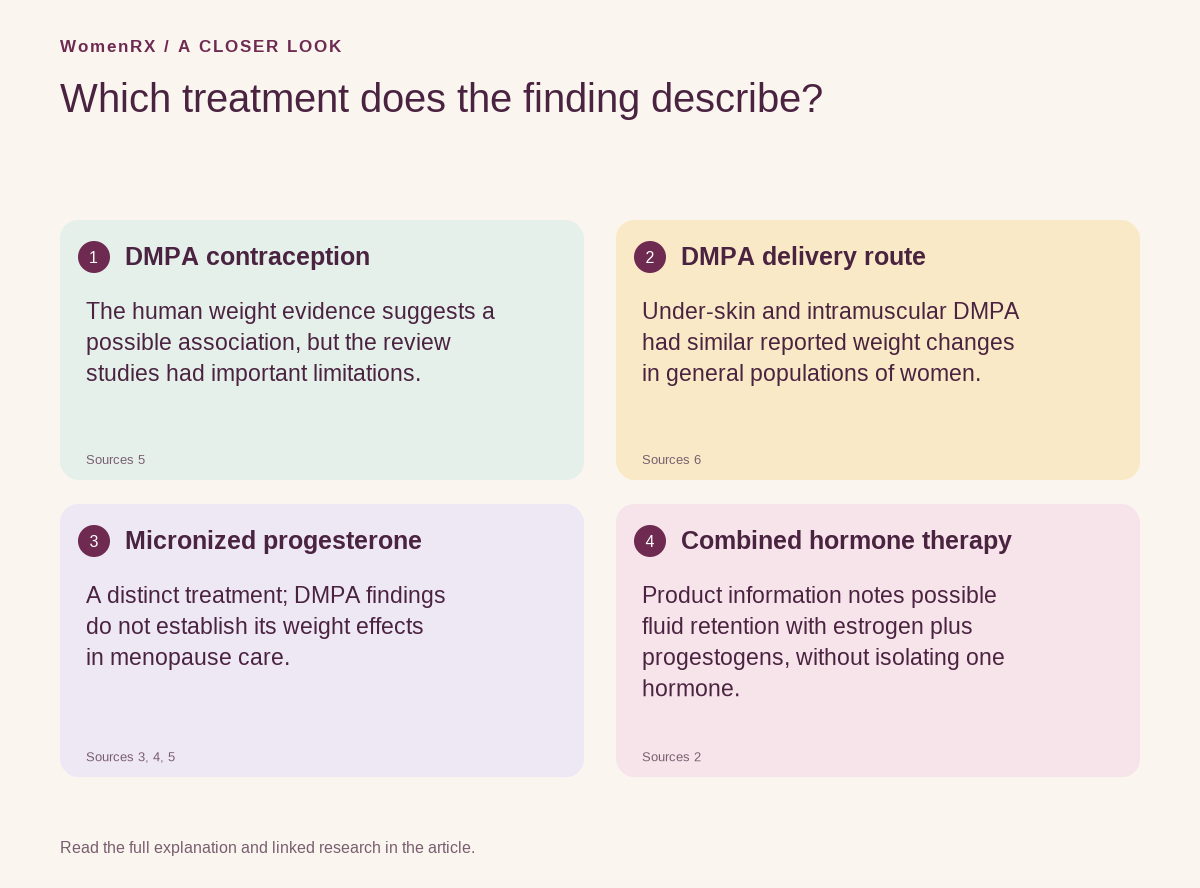
Which treatment does the finding describe?
DMPA contraception: The human weight evidence suggests a possible association, but the review studies had important limitations.5
DMPA delivery route: Under-skin and intramuscular DMPA had similar reported weight changes in general populations of women.6
Micronized progesterone: A distinct treatment; DMPA findings do not establish its weight effects in menopause care.345
Combined hormone therapy: Product information notes possible fluid retention with estrogen plus progestogens, without isolating one hormone.2
Read the figure as text
The product, reason for use, and outcome measured affect how closely a weight finding matches your prescription.- DMPA contraception: The human weight evidence suggests a possible association, but the review studies had important limitations.5
- DMPA delivery route: Under-skin and intramuscular DMPA had similar reported weight changes in general populations of women.6
- Micronized progesterone: A distinct treatment; DMPA findings do not establish its weight effects in menopause care.345
- Combined hormone therapy: Product information notes possible fluid retention with estrogen plus progestogens, without isolating one hormone.2
More questions, answered
Does a higher number on the scale mean I gained body fat?
Not necessarily. Weight includes water, muscle, bone, and fat, and the scale alone can’t show which of those changed. 1
Sources you can check
- Body Weight: MedlinePlusAccessed 2026-09-25Return to first citation
- BIJUVA (ESTRADIOL AND PROGESTERONE) CAPSULE [MAYNE PHARMA] | US prescribing information and patient instructionsAccessed 2026-09-25Return to first citation
- PROMETRIUM (PROGESTERONE) CAPSULE [ACERTIS PHARMACEUTICALS, LLC] | US prescribing information and patient instructionsAccessed 2026-09-25Return to first citation
- Dietary intake and eating behavior in depot medroxyprogesterone acetate users: a systematic review.Silva P, Qadir S, Fernandes A, Bahamondes L, Peipert JF. · Brazilian journal of medical and biological research = Revista brasileira de pesquisas medicas e biologicas · 2018Return to first citation
- Side Effects and Health Benefits of Depot Medroxyprogesterone Acetate: A Systematic Review.Dianat S, Fox E, Ahrens KA, Upadhyay UD, Zlidar VM, Gallo MF, Stidd RL, Moskosky S, Dehlendorf C. · Obstetrics and gynecology · 2019Return to first citation
- The safety of subcutaneously administered depot medroxyprogesterone acetate (104mg/0.65mL): A systematic review.Dragoman MV, Gaffield ME. · Contraception · 2016Return to first citation
- Effects of estradiol with micronized progesterone or medroxyprogesterone acetate on risk markers for breast cancer in postmenopausal monkeys.Wood CE, Register TC, Lees CJ, Chen H, Kimrey S, Cline JM. · Breast cancer research and treatment · 2007Return to first citation