Progesterone Side Effects Depend on the Product and Regimen
Sleepiness, dizziness and bleeding changes are worth checking against your exact product and treatment schedule.
Oral micronized progesterone can cause drowsiness and dizziness; headache, nausea and breast pain have also been reported in a small study using a different dose. Bleeding patterns depend partly on whether hormone therapy is sequential or continuous. When estrogen is part of treatment, longer-term risks need to be considered separately from day-to-day side effects. The product, dose and reason for taking it all matter. 2 3 5
Start with the name on the prescription
The micronized progesterone product discussed below is taken by mouth. Other progestogens are different compounds, so a side effect described for one product shouldn’t automatically be assigned to another formulation or route. 2 4
When a symptom starts, note the exact product, whether it includes estrogen, how you take it, and when the symptom tends to happen. These details help distinguish a possible medicine effect from a change related to menopause or another cause. Hormone-therapy effects can resemble menopause symptoms, too. 3
Oral micronized progesterone: watch for drowsiness and dizziness
US prescribing information for oral micronized progesterone describes temporary dizziness and drowsiness. It also warns that some people may have pronounced symptoms, including blurred vision, difficulty speaking or walking, or feeling abnormal. If those severe symptoms occur, the product instructions say to contact the prescriber right away. 2
Other effects have been reported, but the dose and reason for treatment matter when reading the figures. In a small placebo-controlled study of 49 estrogen-primed postmenopausal women treated for secondary amenorrhea, dizziness was reported by 24% of the 25 women taking oral micronized progesterone at 400 mg per day, versus 4% of the 24 taking placebo. Headache was reported by 16% versus 8%, breast pain by 16% versus 8%, and nausea by 8% versus 0%. Abdominal cramping and irritability were also reported. This was a different treatment context from the estrogen-plus-progesterone regimen described below, so the percentages don’t predict your experience on that regimen. 2
Bleeding depends partly on the schedule
Spotting or other bleeding changes may occur with progestogens used in hormone therapy. With a sequential regimen, where progestogen is taken for part of the treatment cycle, bleeding may happen around the end of that course. Spotting can also occur with continuous combined treatment, particularly in its first months. The expected pattern therefore depends on the regimen, not just the word “progesterone.” 3
If bleeding is unexpected, concerning, or persistent, tell the clinician who manages your hormone therapy. Include when it happens in relation to your medication schedule. That context can help clarify whether the pattern fits the regimen or needs further attention. 3
Why the uterus matters when estrogen is part of treatment
A progestogen may be prescribed alongside estrogen to help protect the uterine lining. In a randomized trial described in the US prescribing information, postmenopausal women with an intact uterus received either 0.625 mg of conjugated estrogen daily alone or that estrogen with 200 mg of oral micronized progesterone daily for 12 days of each 28-day cycle. Over up to 36 months, endometrial hyperplasia was reported in 6% of women receiving the combination and 64% receiving estrogen alone. Those figures apply to the specific regimens studied, not to every product or schedule. 2
If you’ve had a hysterectomy, you do not need a progestogen for uterine-lining protection because you no longer have a uterus. Ask your clinician whether it serves another purpose in your plan. If side effects are troublesome, discuss them and possible regimen changes with the clinician managing your treatment. 4 5 3
Separate daily effects from combined-treatment risks
A 2026 review describes a small breast-cancer risk with combined estrogen-progestogen therapy that increases with treatment duration. It describes a more favorable breast-risk profile for micronized progesterone than for synthetic progestins, but that does not establish that one product is risk-free. A randomized comparison of micronized progesterone and norethisterone acetate published in 2024 was a trial protocol, not a report of outcomes. 5 6
In the Women’s Health Initiative trial, postmenopausal women aged 50 to 79 taking daily oral conjugated estrogens with medroxyprogesterone acetate had higher risks of blood clots in the legs and lungs, stroke, and heart attack than those taking placebo during 5.6 years of treatment. That trial did not test oral micronized progesterone, other progestogens or other routes. 1
Prescribing information for a combined estradiol-and-progesterone product also warns that estrogen plus a progestogen may cause fluid retention. That warning concerns combined treatment, not proof that progesterone alone caused swelling. 1
Route and product don’t provide a simple side-effect ranking
Progestogens come in different forms and routes. For example, the reviewed options include oral or vaginal progestogens and an intrauterine levonorgestrel device. A change of route can also mean a change of compound, not just a different way of taking the same medicine. 4
For a useful conversation about troublesome symptoms, bring the exact product name and describe your schedule and when the symptom occurs. Ask whether it could fit that particular medicine or regimen, and what alternatives would preserve the treatment’s intended purpose. 3 4
Match the effect to the treatment
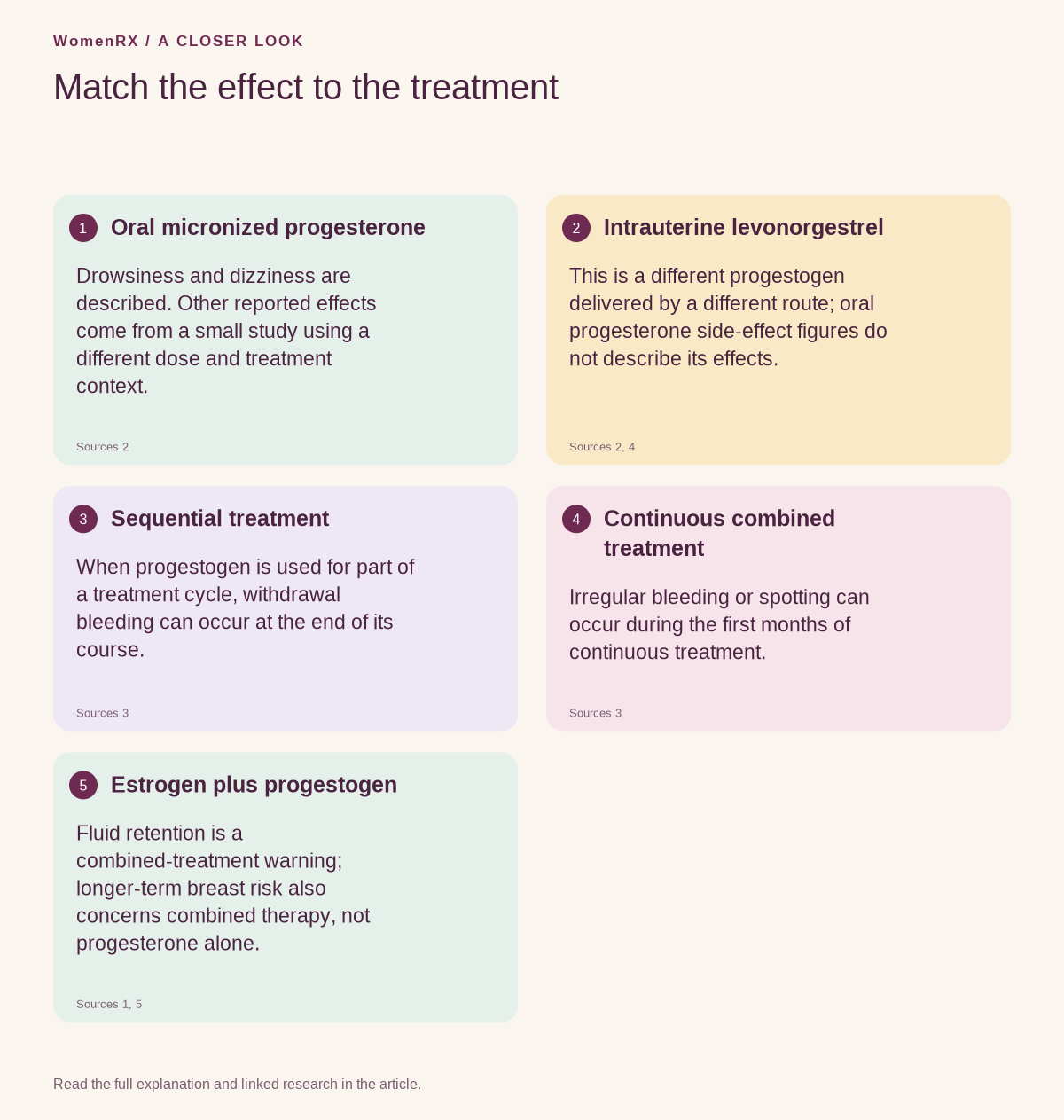
Oral micronized progesterone: Drowsiness and dizziness are described. Other reported effects come from a small study using a different dose and treatment context.2
Intrauterine levonorgestrel: This is a different progestogen delivered by a different route; oral progesterone side-effect figures do not describe its effects.24
Sequential treatment: When progestogen is used for part of a treatment cycle, withdrawal bleeding can occur at the end of its course.3
Continuous combined treatment: Irregular bleeding or spotting can occur during the first months of continuous treatment.3
Estrogen plus progestogen: Fluid retention is a combined-treatment warning; longer-term breast risk also concerns combined therapy, not progesterone alone.15
Read the figure as text
The product, route and schedule answer different parts of the side-effects question. These distinctions are also explained in the article.- Oral micronized progesterone: Drowsiness and dizziness are described. Other reported effects come from a small study using a different dose and treatment context.2
- Intrauterine levonorgestrel: This is a different progestogen delivered by a different route; oral progesterone side-effect figures do not describe its effects.24
- Sequential treatment: When progestogen is used for part of a treatment cycle, withdrawal bleeding can occur at the end of its course.3
- Continuous combined treatment: Irregular bleeding or spotting can occur during the first months of continuous treatment.3
- Estrogen plus progestogen: Fluid retention is a combined-treatment warning; longer-term breast risk also concerns combined therapy, not progesterone alone.15
More questions, answered
Does sleepiness mean progesterone is causing it?
Not necessarily. Drowsiness is described with oral micronized progesterone, but menopause symptoms and other causes can overlap with hormone-therapy effects. Note when the sleepiness occurs and whether it comes with dizziness or other symptoms. 2 3
Are micronized progesterone and other progestogens interchangeable?
No. Micronized progesterone is one type of progestogen, while others are different compounds. Its reported side effects and the protection provided by a particular regimen shouldn’t be assumed to apply to another product or route. 2 4
Sources you can check
- BIJUVA (ESTRADIOL AND PROGESTERONE) CAPSULE [MAYNE PHARMA] | US prescribing information and patient instructionsAccessed 2026-09-25Return to first citation
- PROMETRIUM (PROGESTERONE) CAPSULE [ACERTIS PHARMACEUTICALS, LLC] | US prescribing information and patient instructionsAccessed 2026-09-25Return to first citation
- Side effects of hormone replacement therapy (HRT) - NHSAccessed 2026-09-25Return to first citation
- Progestogens in Menopausal Hormone Therapy: A Double-Edged Sword.Ylikorkala O, Joensuu JM, Siitonen H, Mikkola TS. · Seminars in reproductive medicine · 2025Return to first citation
- Menopausal hormone therapy and breast cancer: risk and management.Sanserino K. · Current opinion in obstetrics & gynecology · 2026Return to first citation
- Breast and endometrial safety of micronised progesterone versus norethisterone acetate in menopausal hormone therapy (PROBES): study protocol of a double-blind randomised controlled trial.Lundell C, Stergiopoulos N, Blomberg L, Ujvari D, Schuppe-Koistinen I, Kopp-Kallner H, Iliadis SI, Skalkidou A, Hirschberg AL. · BMJ open · 2024Return to first citation