When to Take a Probiotic: Does Timing Depend on the Product?
There’s no universal morning, evening, or mealtime rule: follow your product’s directions, then choose a routine you can stick with.
The best time depends first on the specific product’s instructions, not a universal probiotic schedule. A lab study found that taking one strain, Lactobacillus rhamnosus GG, with or after food improved its survival during simulated digestion, but that does not prove every product works better with a meal or improves health outcomes that way. Check the label and choose a time that’s easy to repeat. 2 1
Start with the directions for your product
Probiotics aren’t one interchangeable ingredient. Supplements can contain different strains and combinations, and manufacturers’ directions aren’t consistent across products. Check the label for whether yours should be taken with food, before a meal, or at another time. If the label gives a specific instruction, use that rather than applying a general rule you’ve heard about probiotics. 1 2
Also check how the product describes its viable organisms. NIH’s Office of Dietary Supplements notes that probiotics can lose viability during shelf life, and advises looking for a CFU amount stated for the end of shelf life, rather than only at manufacture. A larger CFU number by itself doesn’t mean a product will be more effective. 1
What the meal-timing research can, and can’t, tell you
It’s plausible that food could affect how many live bacteria survive the stomach. In a 2025 laboratory study, researchers tested one strain, Lactobacillus rhamnosus GG, in simulated digestion. The strain survived better when taken with or after food than under the study’s empty-stomach condition; results also differed between the foods tested. 2
That’s a finding about bacterial survival in a lab model, not proof that taking probiotics with a meal leads to better health in people. It tested one strain and specific food matrices, so it can’t establish a best time for all strains, capsules, powders, or other formulations. The study itself describes a lack of consensus about optimal timing relative to meals. 2
So, if your product doesn’t specify meal timing, you can choose a convenient, repeatable time. You don’t need to assume that morning is better than night, or that all probiotics must be taken with food. If you’re deciding between taking it with a meal or on an empty stomach, the lab finding offers a reason to consider meal-time use for that particular strain, but not a universal clinical rule. 2
If you’re taking it for a particular reason
The purpose matters as much as the clock. For antibiotic-associated diarrhea, NIH’s fact sheet summarizes evidence that certain probiotics, including L. rhamnosus GG and Saccharomyces boulardii, may reduce risk in some groups, and that starting within two days of the first antibiotic dose was more effective than starting later. This is about when to begin a specific probiotic strategy, not evidence that you should take a probiotic at a particular hour or separate it from an antibiotic by a set interval. The evidence also varies by strain and age group. 1
Pregnancy studies summarized by NIH examine probiotic exposure during pregnancy and after birth in relation to children’s eczema outcomes. They don’t establish a best time of day or whether to take a probiotic with food during pregnancy. That evidence doesn’t support a pregnancy-specific clock-time rule. 1
A simple way to choose your routine
- Read the product directions. Look for instructions about meals and any formulation-specific handling or use.
- Keep the purpose in view. Evidence for one strain and use doesn’t automatically apply to another product or goal. 1
- Choose a time you’ll remember. A steady routine can be more practical than trying to follow an unsupported morning-or-night rule.
- Recheck if the product changes. Different strains and products may have different directions, and probiotic recommendations are not consistent across products. 1
The short version: follow your specific label, and don’t let a general timing claim overrule it. If there’s no meal instruction, choose a repeatable time that fits your day. The available meal-survival result is interesting, but it isn’t a proven schedule for every probiotic or a demonstrated health benefit in women. 2
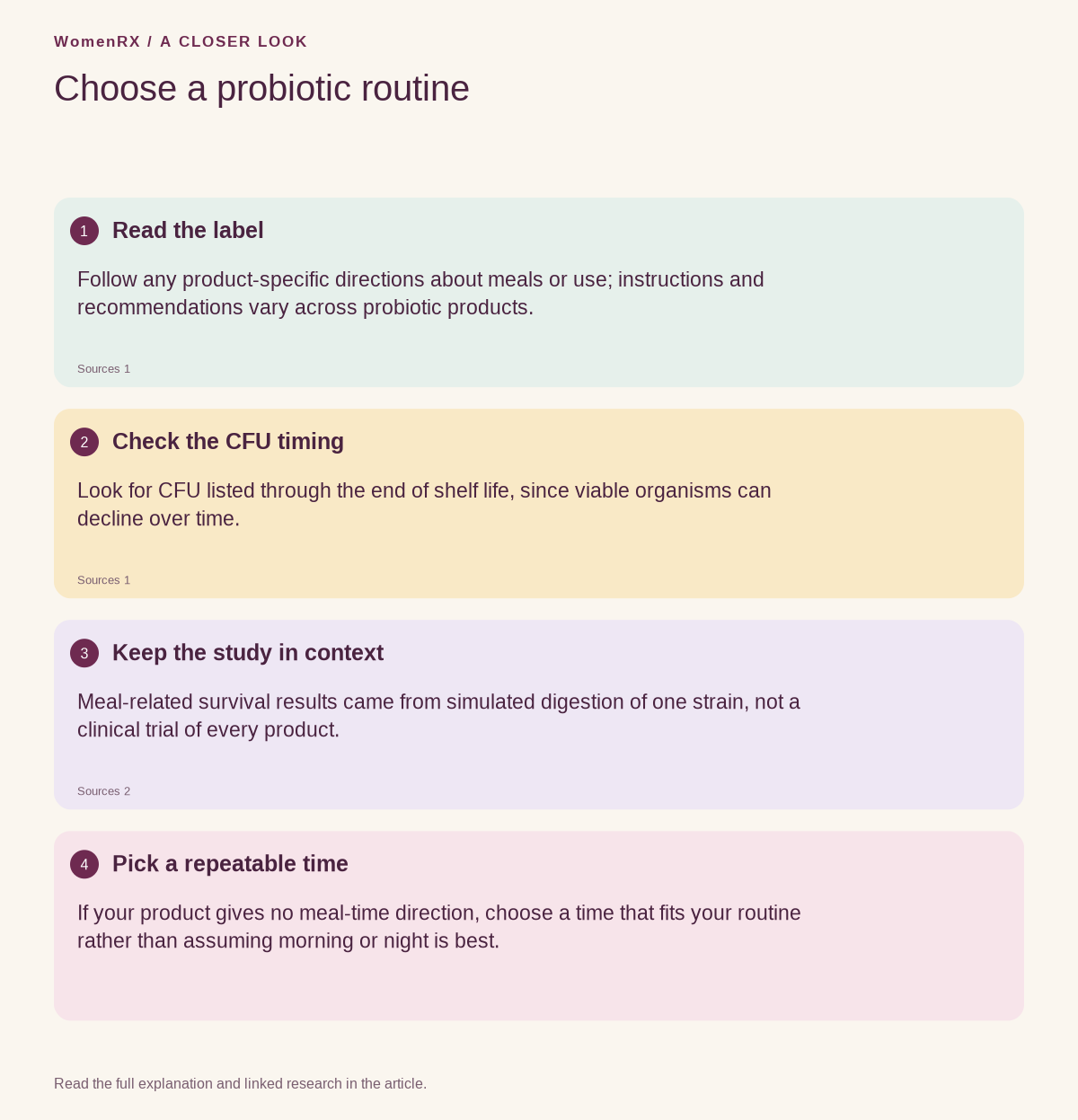
Choose a probiotic routine
Read the label: Follow any product-specific directions about meals or use; instructions and recommendations vary across probiotic products.1
Check the CFU timing: Look for CFU listed through the end of shelf life, since viable organisms can decline over time.1
Keep the study in context: Meal-related survival results came from simulated digestion of one strain, not a clinical trial of every product.2
Pick a repeatable time: If your product gives no meal-time direction, choose a time that fits your routine rather than assuming morning or night is best.
Read the figure as text
Use these checks to separate product instructions, limited timing evidence, and everyday convenience.- Read the label: Follow any product-specific directions about meals or use; instructions and recommendations vary across probiotic products.1
- Check the CFU timing: Look for CFU listed through the end of shelf life, since viable organisms can decline over time.1
- Keep the study in context: Meal-related survival results came from simulated digestion of one strain, not a clinical trial of every product.2
- Pick a repeatable time: If your product gives no meal-time direction, choose a time that fits your routine rather than assuming morning or night is best.
More questions, answered
Should I take a probiotic at the same time as an antibiotic?
Evidence summarized by NIH suggests that for certain probiotics used to help prevent antibiotic-associated diarrhea, starting within two days of the first antibiotic dose was more effective than starting later. That does not establish a required same-hour schedule or a specific separation interval. Check the product directions, since the evidence depends on the strain and user group. 1
Does probiotic timing need to change during pregnancy?
The pregnancy-related research summarized by NIH addresses exposure during pregnancy and after birth in relation to children’s eczema outcomes, not time of day or meal timing. It doesn’t establish a pregnancy-specific probiotic schedule. 1
Sources you can check
- Probiotics - Health Professional Fact SheetAccessed 2026-09-25Return to first citation
- Effect of Food Matrix and Administration Timing on the Survival of Lactobacillus rhamnosus GG During In Vitro Gastrointestinal Digestion.Wang J, Wu P, Chen XD, Yu A, Dhital S. · Foods (Basel, Switzerland) · 2025Return to first citation