How to Judge Long-Term Probiotic Use
Whether it makes sense to keep taking a probiotic depends on the exact strain, the reason you take it, and how long that product has been studied.
There’s no single duration that makes every probiotic appropriate for long-term use. Benefits and safety findings apply to particular strains, products, health conditions, and study periods. Check the full strain name, the outcome it was studied for, and whether your label matches the research. Healthy people usually have few or mild side effects, but serious illness or a weakened immune system changes the safety picture. 1
“Probiotic” isn’t a complete description
Two products can both say “probiotic” and contain different microorganisms with different effects. Research findings are tied to the strain, not just to a familiar genus such as Lactobacillus or Bifidobacterium. A strain name may include the genus, species, and an alphanumeric designation, such as Lacticaseibacillus rhamnosus GG (often called LGG). A label listing only a genus or species may not give you enough information to match it to a study. 1
That matters because a result for one strain and one health goal cannot automatically be applied to another strain, product, or condition. A higher colony-forming unit (CFU) count isn’t proof of greater benefit, either. 1
Match the product to the question
Before continuing, pin down what you hope the probiotic will do. Then compare the research and the package on four points:
- Strain: Does the label give the same strain designation as the product studied, rather than only a genus or species?
- Purpose: Was that strain studied for your particular outcome? Digestive symptoms, preventing diarrhea during antibiotics, and vaginal or pregnancy-related outcomes are separate questions.
- Duration: How long did people take it in the relevant human studies? That tells you the period studied, not how long it’s safe or useful for everyone.
- Product details: Does the label identify CFU through the use-by date and give storage instructions? Live cultures can decline over a product’s shelf life, and storage needs differ. 1
For example, studies summarized for IBS included treatment periods from four weeks to six months. That range is not evidence that every probiotic helps IBS, or that taking one beyond six months is beneficial or harmful. It shows why the condition, strain, and study period all matter. 1
What “long-term” evidence can and can’t tell you
Many probiotic studies are designed to test a specific outcome over a defined period, not to establish whether a person should take a supplement indefinitely. The NIH Office of Dietary Supplements notes that some trials don’t adequately address safety questions. So a history of use over a limited study period is not the same as proof of long-term safety for every person or every product. 1
The same specificity applies to benefits. For instance, some trials of LGG for antibiotic-associated diarrhea lasted from 10 days to three months, but that evidence concerns a particular strain and outcome, not daily use for general digestive or vaginal health. 1
A practical reason to reassess is that you can ask whether the original goal still applies and whether you noticed a meaningful change during the period the product was intended to be used. If you can’t identify the strain, intended outcome, or relevant study period, the label alone doesn’t establish a reason to continue indefinitely.
Safety depends partly on your health
In healthy people, probiotics are unlikely to cause harm, and reported side effects are usually mild, short-lived digestive symptoms such as gas. Rare serious infections have been associated with probiotic use, most often in people who were severely ill or immunocompromised. People with compromised immune function or serious underlying illness should not assume a product with a familiar probiotic name is automatically appropriate; guidance recommends restricting use to strains and indications with evidence of benefit. 1
Pregnancy and vaginal health deserve their own evidence check rather than an assumption that digestive findings apply. A review of 56 pregnancy and lactation trials describes substantial variation in formulations, timing, methods, and study duration, and calls for more research on effectiveness and safety. 3 In a review of seven small randomized trials in women undergoing fertility treatment, adverse events weren’t reported; that is not the same as showing they did not occur, or establishing safety for long-term use or for pregnancy generally. 2
For bacterial vaginosis during pregnancy, a review found that evidence for probiotic treatment was inadequate, despite a promising ranking for oral probiotics based on low-quality evidence. That doesn’t establish probiotics as treatment or prevention for BV, or as a way to prevent pregnancy complications. 4 These findings also don’t answer whether probiotics prevent or treat urinary problems.
A sensible decision rule
Continuing is easier to justify when you can name the specific goal, find research on the same strain and outcome, and check that your product’s label and use period fit that research. If you’re taking it without a clear goal, or your product doesn’t identify its strains, the evidence may not give you a useful basis for indefinite use. If you have a weakened immune system or serious illness, the safety considerations are different and strain-and-indication-specific advice matters. 1
Check the match before continuing
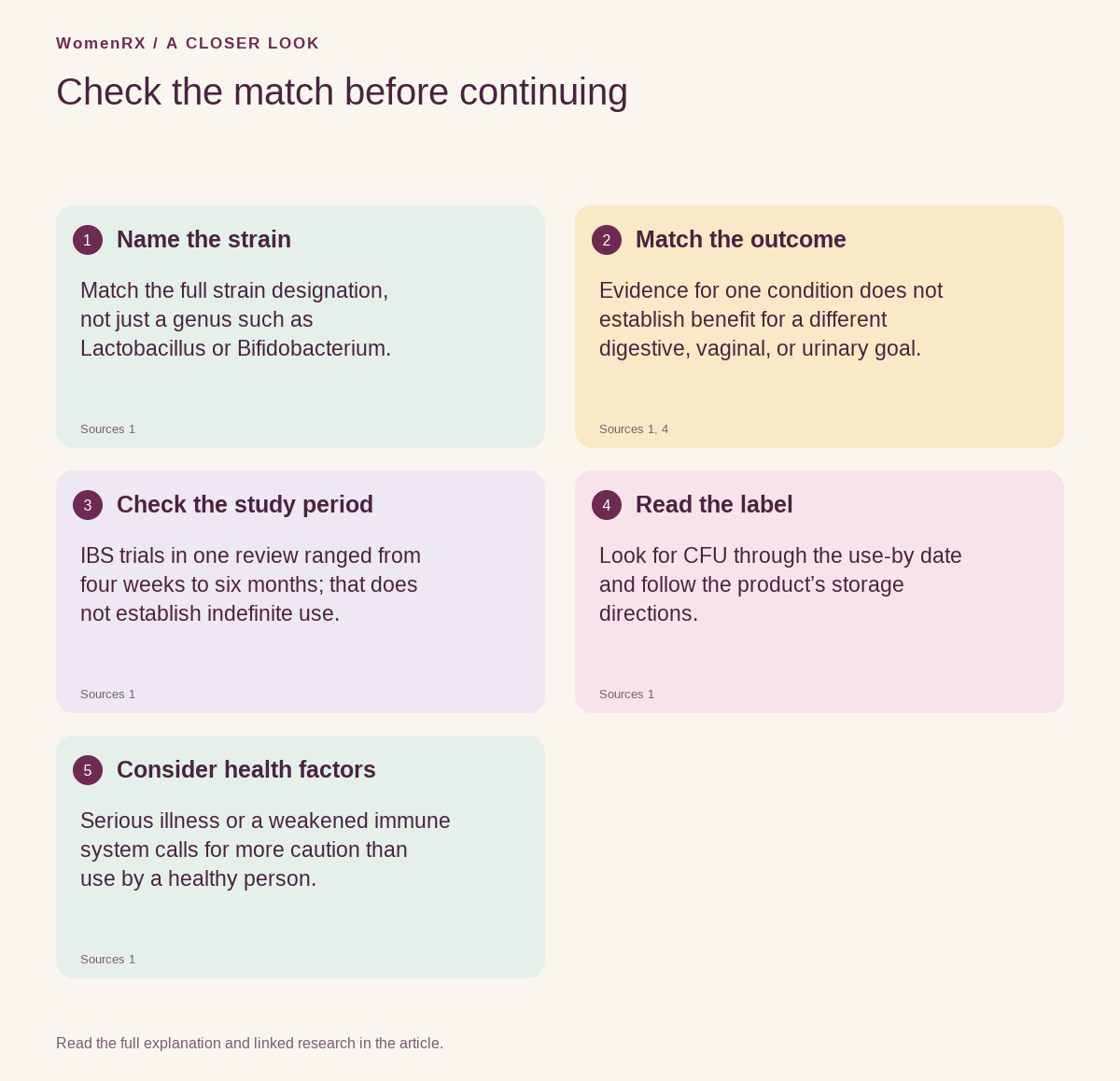
Name the strain: Match the full strain designation, not just a genus such as Lactobacillus or Bifidobacterium.1
Match the outcome: Evidence for one condition does not establish benefit for a different digestive, vaginal, or urinary goal.14
Check the study period: IBS trials in one review ranged from four weeks to six months; that does not establish indefinite use.1
Read the label: Look for CFU through the use-by date and follow the product’s storage directions.1
Consider health factors: Serious illness or a weakened immune system calls for more caution than use by a healthy person.1
Read the figure as text
A probiotic study applies most directly when the strain, intended outcome, and studied period match the product and reason you’re considering it.- Name the strain: Match the full strain designation, not just a genus such as Lactobacillus or Bifidobacterium.1
- Match the outcome: Evidence for one condition does not establish benefit for a different digestive, vaginal, or urinary goal.14
- Check the study period: IBS trials in one review ranged from four weeks to six months; that does not establish indefinite use.1
- Read the label: Look for CFU through the use-by date and follow the product’s storage directions.1
- Consider health factors: Serious illness or a weakened immune system calls for more caution than use by a healthy person.1
More questions, answered
Does a higher CFU count mean a probiotic works better?
No. A higher CFU count does not necessarily mean greater effectiveness. The strain and the health outcome matter, and labels should ideally state CFU through the product’s use-by date. 1
Can digestive probiotic research tell me whether a product helps vaginal or urinary health?
No. Evidence for digestive outcomes can’t establish benefits for vaginal or urinary conditions. Pregnancy-related BV and fertility-treatment studies address distinct questions, and the available findings don’t establish a general vaginal or urinary benefit. 2 4
Sources you can check
- Probiotics - Health Professional Fact SheetAccessed 2026-09-25Return to first citation
- Lactobacillus-containing probiotics and clinical pregnancy in infertile women undergoing ART: a systematic review and meta-analysis.Hiratsuka D, Hirota Y. · European journal of obstetrics, gynecology, and reproductive biology · 2026Return to first citation
- The Influences of Oral Probiotics on the Immunometabolic Response During Pregnancy and Lactation: A Systematic Review.Varlas VN, Bohîlțea LC, Suciu N. · Nutrients · 2025Return to first citation
- Effects of bacterial vaginosis treatment during pregnancy on maternal-fetal outcome: A systematic review and network meta-analysis.Wu J, Zhu X, Tang B, Wu J, Wei F, Wang X, Li L, Li H, Zhang Y, Wang B, Wu W, Hong X. · European journal of obstetrics, gynecology, and reproductive biology · 2025Return to first citation