Probiotics: Match the Strain to Your Goal
A probiotic’s strain and the outcome it was studied for matter more than a large CFU number by itself.
There isn’t one daily probiotic amount that fits every woman or every goal. Compare the full strain name, the CFU count through the product’s end of shelf life, and the amount and duration studied for your intended outcome. For example, trials studied different amounts for antibiotic-associated diarrhea and vaginal-health markers; neither amount is a universal target. 1 2 4
Start with the outcome, not the number
Before comparing bottles, name the reason you’re considering a probiotic: for example, a digestive concern during antibiotic use, a vaginal-health question, or an attempt to prevent urinary tract infections (UTIs). A product studied for one of these goals hasn’t thereby been shown to help with the others. Probiotic effects can differ by strain, dose, and product, and a higher CFU count alone doesn’t mean a product works better. 1
CFU, or colony-forming units, is a measure of viable microbes. Check whether a label gives the CFU amount through the end of the product’s shelf life, rather than only the amount at manufacture, because live microbes can die over time. Also look for a strain designation, not just a broad species name. A label that names a species but not the strain gives you less to compare with studies of a particular strain. 1
For digestive goals, match the specific problem
Digestive effects aren’t interchangeable either. NIH’s Office of Dietary Supplements summarizes evidence for certain probiotics in antibiotic-associated diarrhea, including Lactobacillus rhamnosus GG (LGG) and Saccharomyces boulardii. In one meta-analysis of 12 randomized trials involving 1,499 children and adults taking antibiotics, LGG was associated with a lower overall risk of antibiotic-associated diarrhea, from 22.4% in the comparison groups to 12.3% in the LGG groups. When children and adults were analyzed separately, the difference was statistically significant only among children. That result doesn’t establish a benefit for every adult, every antibiotic, or every probiotic labeled “Lactobacillus.” 1
The studies don’t point to one universal LGG amount. In the 12-trial analysis, LGG amounts ranged from 4 × 10⁸ to 12 × 10¹⁰ CFU, with treatment lasting from 10 days to 3 months; the optimal dose was unclear, and the statistically significant subgroup result was in children. Treat those figures as a description of what was studied, not a daily target for women. 1
Vaginal studies are product- and population-specific
Some trials have tested particular probiotics for vaginal microbiota outcomes, but they have not all produced the same result. In a 12-week randomized, placebo-controlled trial, 101 reproductive-aged women with Nugent scores of 4-6 took a five-strain product called MED-01 at 5.0 × 10⁹ CFU once daily or placebo; 76 participants completed the study. The researchers reported a greater reduction in Nugent score with MED-01 than with placebo. This is a finding about that formula and a measured vaginal-health marker in that study population, not proof that any probiotic prevents or treats vaginal infections. 2
A separate randomized trial enrolled 60 women with signs and symptoms of vaginal dysbiosis and tested oral Lacticaseibacillus rhamnosus CA15, strain DSM 33960, at 1.0 × 10¹⁰ CFU once daily for 10 days against placebo. Its abstract reports improvements in clinical and microbiological measures in the probiotic group. That result, too, applies to the tested strain and study conditions, not to all products containing L. rhamnosus. 4
The contrast matters: a randomized trial of vaginal capsules containing Lactobacillus gasseri and L. rhamnosus in 74 women preparing for fertility treatment found no significant advantage over placebo in improving the study’s vaginal microbiota measure. The population and outcome differed from studies of symptomatic vaginal dysbiosis, so the results aren’t a direct head-to-head comparison. They do show why a label or advertisement shouldn’t turn a result for one product and situation into a promise for another. 3
For a vaginal-health goal, look for the actual strain or strains, whether the product was taken orally or used vaginally, and what the study measured. A shift in a microbiota measure is not the same as demonstrated prevention of recurrence, symptom relief, or treatment of an infection. The MED-01 and CA15 amounts and durations above are study examples, not general dosing recommendations. 2 3 4
Don’t read vaginal findings as UTI evidence
Vaginal microbiota studies don’t establish that a probiotic prevents UTIs. The vaginal trials described above measured vaginal microbiota or dysbiosis-related outcomes, not UTI prevention. A product’s “women’s health” positioning, or a vaginal-health result, isn’t enough to support a urinary-health claim. 2 3 4
Pregnancy needs its own evidence
The MED-01 vaginal probiotic trial excluded participants who were pregnant or planning pregnancy. Its findings therefore don’t answer whether that product is useful or appropriate during pregnancy. Don’t assume that evidence from nonpregnant adults applies to pregnancy. 2
A quick label comparison
For any goal, ask three questions: Does the label identify the same strain studied for that outcome? Does it state the viable CFU amount through the end of shelf life? Was the study population, route, amount, and duration similar to your situation? If one of those details doesn’t match, the evidence may be a poor fit, even if the product has a high CFU count. 1 2 3 4
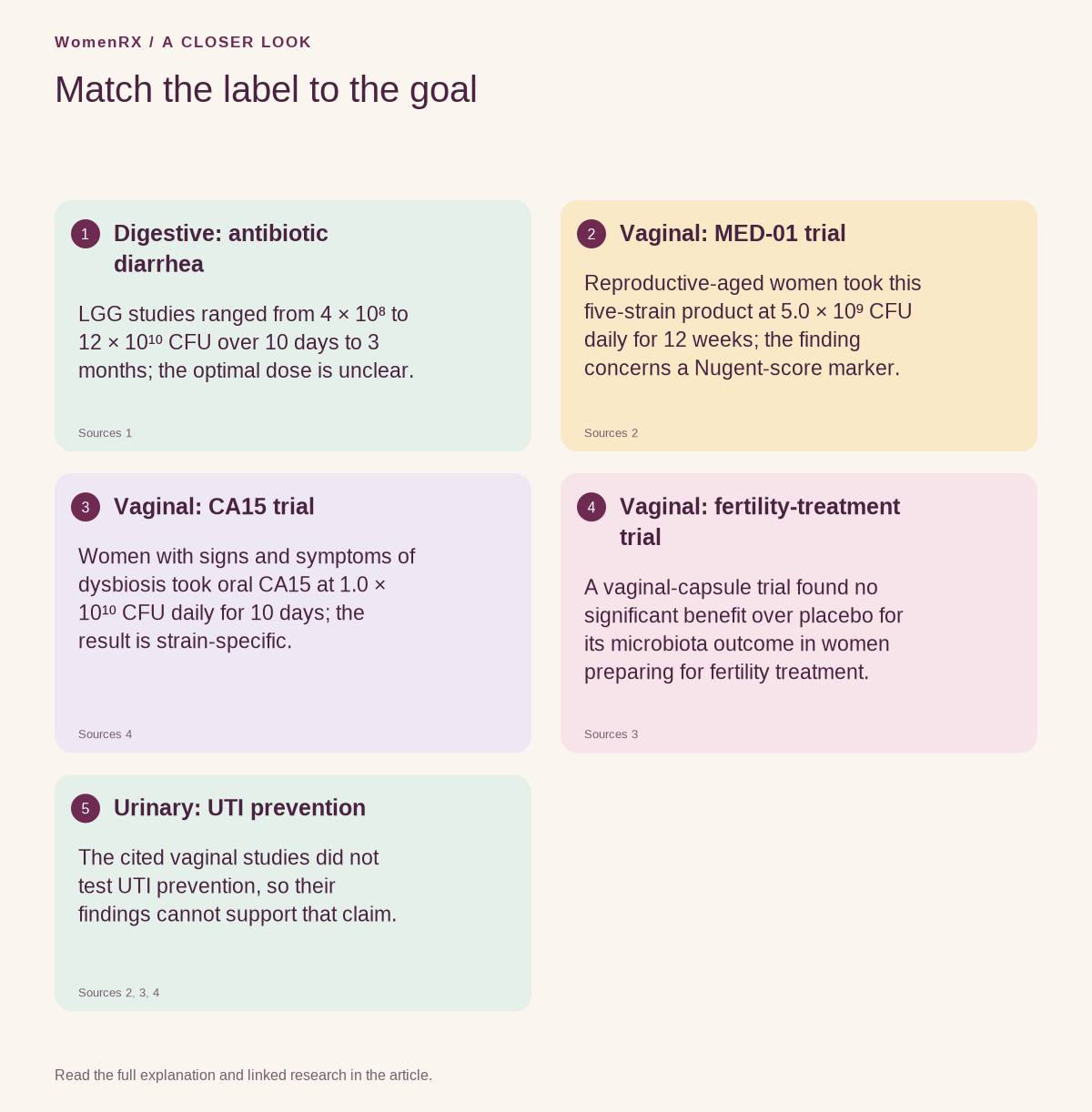
Match the label to the goal
Digestive: antibiotic diarrhea: LGG studies ranged from 4 × 10⁸ to 12 × 10¹⁰ CFU over 10 days to 3 months; the optimal dose is unclear.1
Vaginal: MED-01 trial: Reproductive-aged women took this five-strain product at 5.0 × 10⁹ CFU daily for 12 weeks; the finding concerns a Nugent-score marker.2
Vaginal: CA15 trial: Women with signs and symptoms of dysbiosis took oral CA15 at 1.0 × 10¹⁰ CFU daily for 10 days; the result is strain-specific.4
Vaginal: fertility-treatment trial: A vaginal-capsule trial found no significant benefit over placebo for its microbiota outcome in women preparing for fertility treatment.3
Urinary: UTI prevention: The cited vaginal studies did not test UTI prevention, so their findings cannot support that claim.234
Read the figure as text
Compare the strain, amount, duration, population, and outcome actually studied before weighing the CFU number.- Digestive: antibiotic diarrhea: LGG studies ranged from 4 × 10⁸ to 12 × 10¹⁰ CFU over 10 days to 3 months; the optimal dose is unclear.1
- Vaginal: MED-01 trial: Reproductive-aged women took this five-strain product at 5.0 × 10⁹ CFU daily for 12 weeks; the finding concerns a Nugent-score marker.2
- Vaginal: CA15 trial: Women with signs and symptoms of dysbiosis took oral CA15 at 1.0 × 10¹⁰ CFU daily for 10 days; the result is strain-specific.4
- Vaginal: fertility-treatment trial: A vaginal-capsule trial found no significant benefit over placebo for its microbiota outcome in women preparing for fertility treatment.3
- Urinary: UTI prevention: The cited vaginal studies did not test UTI prevention, so their findings cannot support that claim.234
More questions, answered
Does a higher CFU count mean a probiotic is stronger?
Not necessarily. CFU estimates viable microbes, but products with higher counts aren’t automatically more effective. The strain and the outcome studied are part of the comparison, too. 1
Can a vaginal-health probiotic claim mean it prevents UTIs?
No. A study measuring vaginal microbiota doesn’t establish UTI prevention. Look for evidence that actually tested the urinary outcome before treating the two claims as equivalent. 2 3
Sources you can check
- Probiotics - Health Professional Fact SheetAccessed 2026-09-25Return to first citation
- Efficacy and Safety of MED-01 Probiotics on Vaginal Health: A 12-Week, Multicenter, Randomized, Double-Blind, Placebo-Controlled Clinical Trial.Park SH, Lee ES, Park ST, Jeong SY, Yun Y, Kim Y, Jeong Y, Kang CH, Choi HJ. · Nutrients · 2023Return to first citation
- Probiotic treatment with specific lactobacilli does not improve an unfavorable vaginal microbiota prior to fertility treatment-A randomized, double-blinded, placebo-controlled trial.Jepsen IE, Saxtorph MH, Englund ALM, Petersen KB, Wissing MLM, Hviid TVF, Macklon N. · Frontiers in endocrinology · 2022Return to first citation
- Lacticaseibacillus rhamnosus CA15 (DSM 33960) strain as a new driver in restoring the normal vaginal microbiota: A randomized, double-blind, placebo-controlled clinical trial.Rapisarda AMC, Pino A, Grimaldi RL, Caggia C, Randazzo CL, Cianci A. · Frontiers in surgery · 2022Return to first citation