How to Compare Probiotics by Strain, Goal, and Label
A useful probiotic comparison starts with the health outcome you want, then checks whether the exact strain and product setup were studied for it.
Start with the goal, such as bacterial vaginosis (BV), and look for the exact strain name, not just a species such as Lactobacillus rhamnosus. Then compare the study’s population, outcome, route, and formulation with the product. A viable-count number or familiar species name alone doesn’t show that a product has evidence for your goal. 23
Begin with the claim you want to check
“Vaginal health” can mean different things, including BV, yeast infections, and urinary concerns. Evidence about one outcome doesn’t establish a benefit for another. For example, a study that measures changes in vaginal bacteria may not show that people felt better or had fewer recurrences. First decide what you want the product to do, then look for research that measured that same result. 24
This matters if you’re looking at a urinary claim: the BV findings discussed here don’t answer whether a probiotic prevents or treats urinary problems.
Find the strain, not just the species
A species name identifies a broad category of bacteria; a strain name or code points to the particular version studied. In research, that extra identifier can make the difference between a product that matches a study and one that merely shares a species name.
For example, a randomized, placebo-controlled study tested oral Lacticaseibacillus rhamnosus CA15 in women with BV and mixed vaginitis. Two hundred participants completed the study. The researchers assessed outcomes at the start, after 10 days of treatment, and 30 days after treatment. Those results apply to the CA15 product and study setup, not automatically to every product labeled L. rhamnosus. 3
On a label, look for the full strain designation alongside the species. If it lists only a species, you may not be able to tell whether the product matches research on a particular strain. A strain name makes the comparison possible; it doesn’t prove the product works.
Match the study to the product
Once you’ve found the strain, compare the study and label across a few practical questions:
- Was it studied for the same goal? Research on BV doesn’t establish an effect on yeast infections or urinary concerns.
- Did it measure a result you care about? A change in the vaginal microbiota is different from symptom improvement, clinical diagnosis, or fewer recurrences. One observational pilot in reproductive-age women with asymptomatic BV reported microbiota changes after two months, but its pre-and-post design does not establish that the product caused symptom relief or prevented recurrence. 4
- Was the route and use similar? Compare oral capsules with vaginal products, and check whether the probiotic was tested alone or alongside another treatment. The BV trials reviewed in 2025 varied in strains, amounts, and duration, so a matching species name doesn’t make study regimens interchangeable. 2
- Was the study population relevant? Results in people with diagnosed BV may not answer a question about prevention in someone without BV or about a different condition.
A 2025 study of CA15, for instance, tested an oral capsule in women with BV and mixed vaginitis. If a product has the same species but a different strain, route, or formulation, the study isn’t a direct match. 3
Treat the count as one label detail
If the label gives a viable count, check what the number refers to and whether it is tied to the listed strains. Then read the product’s own storage and use-by directions. These are useful label checks, but they don’t establish that a product is effective or equivalent to one used in a study.
A higher count isn’t automatically a better match. A systematic review of 16 randomized trials found variation in strains, regimens, and outcomes, and concluded that there isn’t a settled best probiotic regimen for BV. 2
What BV research can tell you
Evidence for probiotics and BV depends on the particular product and how it was used. A 2019 review reported that adding probiotics to metronidazole had not been shown to provide extra benefit. A later review described a phase 2b trial in which a specific Lactobacillus crispatus product added to standard metronidazole reduced BV recurrence by 12 weeks compared with placebo. These findings differ in timing and in the specific evidence considered; the later result is about one strain-specific add-on approach, not probiotics as a whole. 56
If you have unusual discharge, a probiotic label can’t confirm the cause. BV can cause thin, greyish-white discharge with a fishy smell, but some people with BV have no symptoms, and other conditions can also change discharge. BV is commonly treated with antibiotics, so suspected BV is a reason to seek an evaluation rather than rely on a product claim. 1
The most useful comparison is a chain of matches: the health goal, the full strain, the population and outcome studied, and the product’s route and formulation. If one of those links is missing, the evidence may not answer your question.
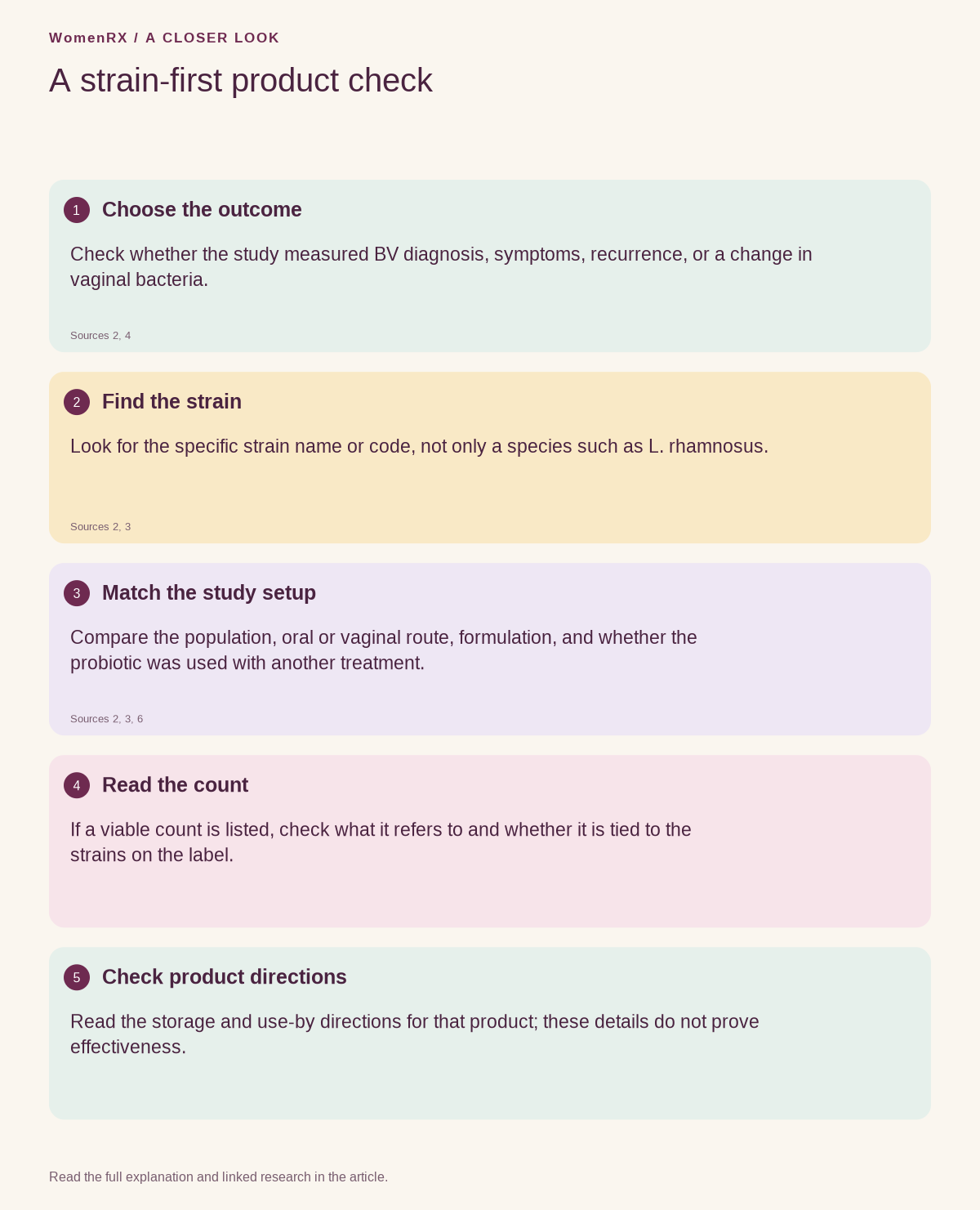
A strain-first product check
Choose the outcome: Check whether the study measured BV diagnosis, symptoms, recurrence, or a change in vaginal bacteria.24
Find the strain: Look for the specific strain name or code, not only a species such as L. rhamnosus.23
Match the study setup: Compare the population, oral or vaginal route, formulation, and whether the probiotic was used with another treatment.236
Read the count: If a viable count is listed, check what it refers to and whether it is tied to the strains on the label.
Check product directions: Read the storage and use-by directions for that product; these details do not prove effectiveness.
Read the figure as text
Use these checks to see whether a probiotic label and the research for your goal actually line up.- Choose the outcome: Check whether the study measured BV diagnosis, symptoms, recurrence, or a change in vaginal bacteria.24
- Find the strain: Look for the specific strain name or code, not only a species such as L. rhamnosus.23
- Match the study setup: Compare the population, oral or vaginal route, formulation, and whether the probiotic was used with another treatment.236
- Read the count: If a viable count is listed, check what it refers to and whether it is tied to the strains on the label.
- Check product directions: Read the storage and use-by directions for that product; these details do not prove effectiveness.
Sources you can check
- Bacterial vaginosis - NHSAccessed 2026-09-25Return to first citation
- Effective probiotic regimens for bacterial vaginosis treatment and recurrence prevention: A systematic review.Udjianto U, Sirat NA, Rahardjo B, Zuhriyah L. · Narra J · 2025Return to first citation
- Oral Administration of the Probiotic Lacticaseibacillus rhamnosus CA15 in a Large Cohort of Women with Bacterial Vaginosis and Mixed Vaginitis: Clinical Evidence from a Randomized, Double-Blind, Placebo-Controlled Study.Pino A, Vaccalluzzo A, Cianci S, Palumbo M, Caruso G, Caggia C, Randazzo CL. · Microorganisms · 2025Return to first citation
- A Multi-Strain Oral Probiotic Improves the Balance of the Vaginal Microbiota in Women with Asymptomatic Bacterial Vaginosis: Preliminary Evidence.Filardo S, Di Pietro M, Mastromarino P, Porpora MG, Sessa R. · Nutrients · 2024Return to first citation
- Probiotics and vaginal microecology: fact or fancy?Buggio L, Somigliana E, Borghi A, Vercellini P. · BMC women's health · 2019Return to first citation
- Lactobacilli and Their Probiotic Effects in the Vagina of Reproductive Age Women.Pendharkar S, Skafte-Holm A, Simsek G, Haahr T. · Microorganisms · 2023Return to first citation