Probiotics After 40: Match the Strain to the Goal
Turning 40 doesn’t create a reason to start a probiotic; a specific symptom and evidence for a particular strain may.
No, age over 40 alone isn’t a reason to take a probiotic. The more useful question is whether a particular strain has been studied for the health goal you have. Research in adults can’t automatically be applied to midlife women, and a trial involving older adults with constipation, for example, doesn’t establish a benefit for menopause symptoms. 1 4
Start with a health goal, not your age
Probiotics are live microorganisms that can benefit health when used in adequate amounts, but not every product labeled “probiotic” has a demonstrated benefit. Effects can differ by strain, so a finding for one product or health outcome doesn’t establish that another probiotic will work for the same purpose. 1
That makes “I’m over 40” a weak reason to start one. If you’re generally healthy and feel well, there’s no formal recommendation for or against probiotic use in healthy people. The useful starting point is a specific question, such as whether a product might help with a particular digestive symptom. 1
What older-adult studies can tell you
Some trials have studied probiotics in middle-aged or older adults, but they address particular conditions rather than the effects of aging itself. A 2026 randomized, placebo-controlled trial studied a multi-strain probiotic in adults with chronic constipation. Among the 100 participants who completed the study per protocol, after 28 days the probiotic group averaged 4.53 complete spontaneous bowel movements a week, compared with 2.40 in the placebo group. The study’s responder rate was 44 of 50 in the probiotic group and 13 of 50 in the placebo group. 4
That’s a potentially useful result for people with chronic constipation, but it’s one trial of one formulation. The abstract doesn’t identify the strains, so these results aren’t a way to select a matching product on a store shelf. Nor do they show that probiotics prevent constipation in everyone over 40 or help with other symptoms. 4
Cognitive findings come from different analyses of the same registered trial, not two independent trials. One report describes 169 community-dwelling adults aged 52 to 75, including people with and without mild cognitive impairment. In the group with mild cognitive impairment, changes in certain gut bacteria were correlated with changes in cognitive scores; that correlation doesn’t establish that probiotics improve cognition. 2 Another analysis of archival data from 127 physically active, middle-aged to older adults found no significant cognitive improvement attributable to Lactobacillus rhamnosus GG. Both reports list the same trial registration number. 2 3
These examples show why a study needs to match both the population and the outcome you care about. The older-adult trials described here examine constipation or cognition, not menopause symptoms. They don’t establish probiotics as a treatment for hot flashes or other menopause concerns. 2 3 4
If you’re considering a product, check the match
Look for the full strain name on the label, not just a familiar genus such as Lactobacillus or Bifidobacterium. Check whether that exact strain and formulation have been studied for your intended outcome. A larger colony-forming unit (CFU) number isn’t automatically better; different strains and products have different evidence. 1
Also check whether the label lists CFU through the expiration or use-by date, rather than only at manufacture, and follow the stated storage conditions. Live microorganisms can decline over a product’s shelf life. 1
If your reason is antibiotic-associated diarrhea, age may matter to the evidence: NIH’s review reports benefits for some probiotic treatments in adults aged 18-64, but not in adults 65 and older. The findings depend on the strain and other factors, so they shouldn’t be treated as a recommendation for every probiotic or every person taking antibiotics. 1
Safety depends on more than age
In healthy people, side effects are usually mild, such as temporary gas. Rare serious infections have been reported, mostly in people who were severely ill or immunocompromised. If either applies to you, don’t assume that a product considered low-risk for healthy people is automatically appropriate; probiotic use should be limited to strains and uses with evidence for that situation. 1
So, after 40, a probiotic may be worth considering for a defined health goal when evidence supports the particular strain and product. Age itself, or a general wish to “support the gut,” isn’t enough to tell you that a supplement will help.
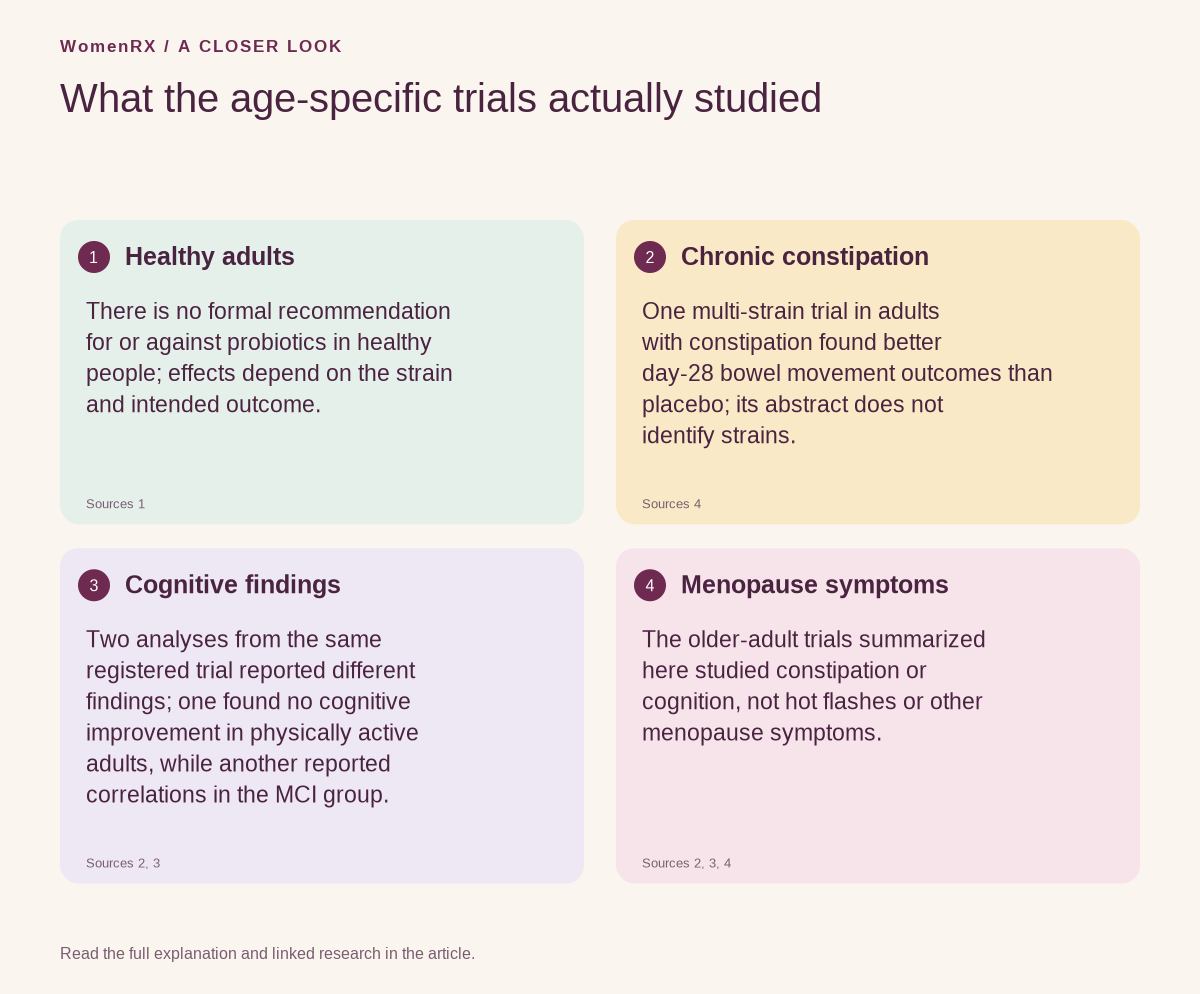
What the age-specific trials actually studied
Healthy adults: There is no formal recommendation for or against probiotics in healthy people; effects depend on the strain and intended outcome.1
Chronic constipation: One multi-strain trial in adults with constipation found better day-28 bowel movement outcomes than placebo; its abstract does not identify strains.4
Cognitive findings: Two analyses from the same registered trial reported different findings; one found no cognitive improvement in physically active adults, while another reported correlations in the MCI group.23
Menopause symptoms: The older-adult trials summarized here studied constipation or cognition, not hot flashes or other menopause symptoms.234
Read the figure as text
These examples show why evidence for one outcome or group doesn’t establish a general reason for probiotics after 40.- Healthy adults: There is no formal recommendation for or against probiotics in healthy people; effects depend on the strain and intended outcome.1
- Chronic constipation: One multi-strain trial in adults with constipation found better day-28 bowel movement outcomes than placebo; its abstract does not identify strains.4
- Cognitive findings: Two analyses from the same registered trial reported different findings; one found no cognitive improvement in physically active adults, while another reported correlations in the MCI group.23
- Menopause symptoms: The older-adult trials summarized here studied constipation or cognition, not hot flashes or other menopause symptoms.234
More questions, answered
Does a higher CFU count mean a probiotic works better?
No. A higher CFU number doesn’t guarantee greater effectiveness; benefits depend on the strain and the health outcome being studied. Check that the label identifies the strain and lists CFU through the expiration or use-by date. 1
Sources you can check
- Probiotics - Health Professional Fact SheetAccessed 2026-09-25Return to first citation
- The gut microbiome, mild cognitive impairment, and probiotics: A randomized clinical trial in middle-aged and older adults.Aljumaah MR, Bhatia U, Roach J, Gunstad J, Azcarate Peril MA. · Clinical nutrition (Edinburgh, Scotland) · 2022Return to first citation
- Examining the cognitive benefits of probiotic supplementation in physically active older adults: A randomized clinical trial.Sanborn V, Aljumaah M, Azcarate-Peril MA, Gunstad J. · Applied physiology, nutrition, and metabolism = Physiologie appliquee, nutrition et metabolisme · 2022Return to first citation
- A multi-strain probiotic formulation alleviates chronic constipation in middle-aged and older adults: A randomized, double-blind, placebo-controlled trial.Xiao R, He Y, Mao X, Sun L, Ao L, Wang L, Zhai Q, Zhao J, Chen W, Wang G, Guo J. · Clinical nutrition (Edinburgh, Scotland) · 2026Return to first citation