CoQ10 After 40: Match the Evidence to Your Goal
These studies don’t establish age 40 as a reason to take CoQ10; they test specific outcomes, mostly in adults 60 and older.
Age 40 alone isn’t a reason the studies here establish for taking CoQ10. Research in older adults has tested defined goals, including physical function and cognition, with results that vary by outcome. Those findings don’t show that CoQ10 generally boosts energy or relieves menopause symptoms in women over 40. A result about fertility would be a separate question, not evidence about menopause. 1 2 4
Start with the outcome you want to change
CoQ10 has a role in cellular energy production. But a role inside cells doesn’t prove that taking a supplement will make you feel more energetic. The useful question is whether it has been tested for your goal, in people like you, and on an outcome you care about. 3
Age 40 isn’t a cutoff tested in the trials described here. The older-adult research mostly concerns people in their 60s and beyond, often with a particular health condition or activity program. It can’t establish a general need for CoQ10 in midlife.
What older-adult studies measured
One randomized trial enrolled adults aged 65 to 80 who reported ongoing weakness they associated with statin use. Over eight weeks, people given a specific CoQ10 phytosome formulation had greater improvements than those taking placebo in reported weakness and several physical-performance measures. This finding applies to that group and formulation. It doesn’t establish that CoQ10 treats general tiredness in women over 40, and the reported results don’t show whether women responded differently. 1
A separate randomized trial studied 38 adults aged 65 to 75, including 16 women, during an eight-week supervised high-intensity interval training program. The CoQ10 group improved more than the placebo group on two chair-based strength and power tests. There were no between-group differences on several other measures, including grip strength, balance, and walking endurance. The study didn’t report results separately for women, so it can’t show whether the findings apply specifically to women in midlife or after menopause. 2
Cognition offers another example of why the exact outcome matters. In a randomized trial of 111 adults aged 60 and older, 90 days of ubiquinol raised blood CoQ10 levels but didn’t produce group differences in cognitive performance, mood, cardiovascular measures, or the measured markers of oxidative stress and inflammation. A change in a blood level isn’t the same as a demonstrated improvement in how someone feels or functions. 4
Menopause, fertility, and aging are different questions
The studies above don’t test whether CoQ10 eases hot flashes, sleep problems, or other menopause symptoms. They also don’t establish a benefit for fertility. Even if a study found an effect on a reproductive outcome, that would not by itself answer whether CoQ10 helps during perimenopause or after menopause. Those are different goals and need evidence from the relevant population and outcome.
“Older adults” also doesn’t mean “women over 40.” A systematic review of CoQ10 trials for cardiovascular conditions described participants as predominantly older men, with studies focused on conditions such as heart failure, hypertension, or ischemic heart disease. Those results don’t establish a general benefit for healthy women or for menopause-related concerns. 3
Use the evidence as a goal-by-goal filter
If you’re considering CoQ10 for general tiredness, the trials described here don’t show that it improves age-related fatigue in women over 40. If your goal is physical function, there are findings in older adults for particular measures, but they don’t amount to proof of a broad energy boost. If your question is about menopause or fertility, don’t treat evidence for a different outcome as an answer.
The study setup matters, too. The statin-related weakness trial tested a specific phytosome formulation, so its result shouldn’t automatically be applied to every CoQ10 product. The exercise trial paired supplementation with supervised training; it doesn’t show that CoQ10 on its own improves strength. 1 2
The clearest reason to weigh CoQ10 is a specific goal that matches the research, not age alone. For the findings described here, that means keeping the limits in view: older study populations, particular circumstances, and outcomes that don’t directly answer common questions about energy or menopause.
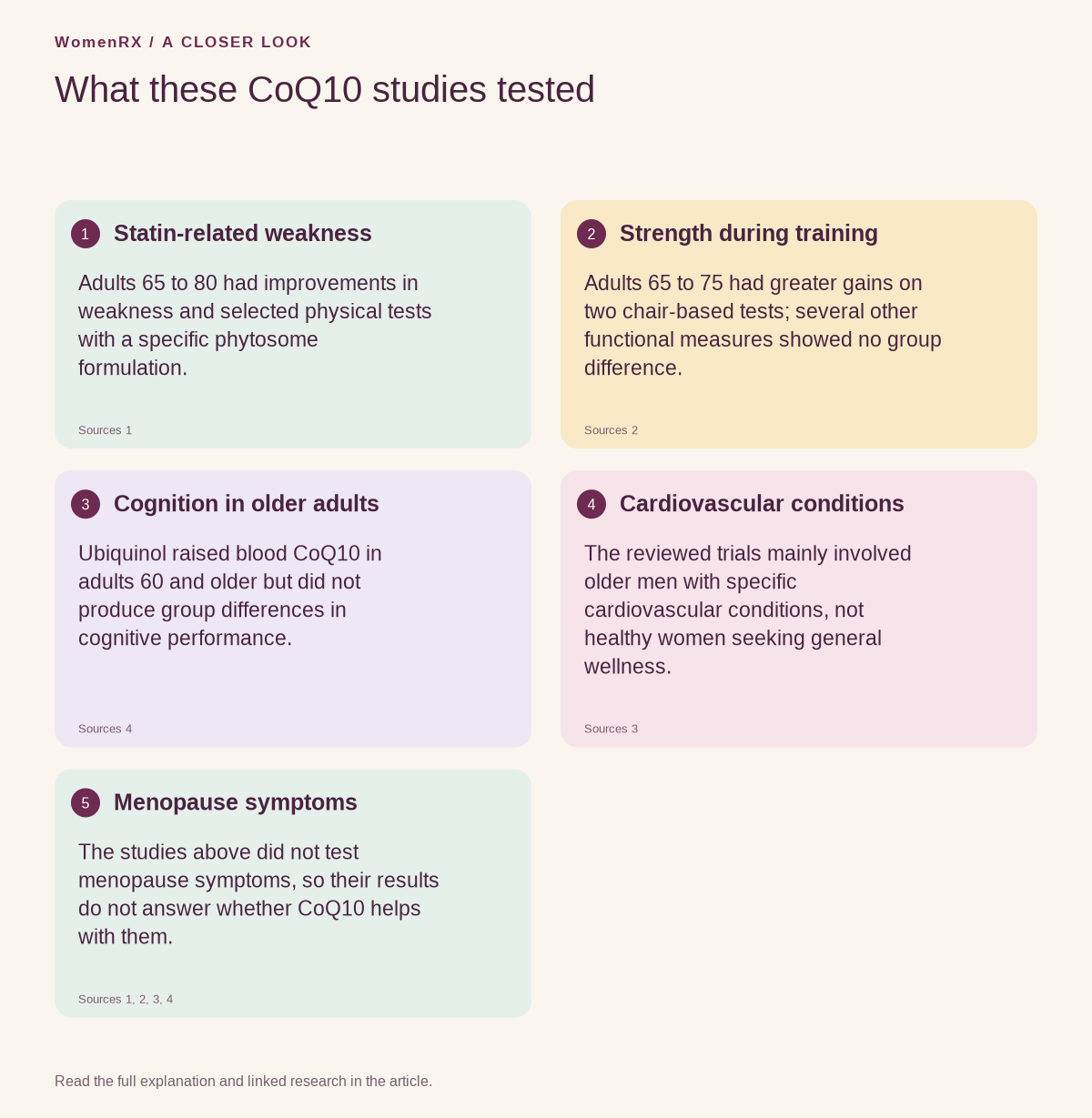
What these CoQ10 studies tested
Statin-related weakness: Adults 65 to 80 had improvements in weakness and selected physical tests with a specific phytosome formulation.1
Strength during training: Adults 65 to 75 had greater gains on two chair-based tests; several other functional measures showed no group difference.2
Cognition in older adults: Ubiquinol raised blood CoQ10 in adults 60 and older but did not produce group differences in cognitive performance.4
Cardiovascular conditions: The reviewed trials mainly involved older men with specific cardiovascular conditions, not healthy women seeking general wellness.3
Menopause symptoms: The studies above did not test menopause symptoms, so their results do not answer whether CoQ10 helps with them.1234
Read the figure as text
The findings concern defined outcomes in older-adult groups, not a general need for CoQ10 after 40.- Statin-related weakness: Adults 65 to 80 had improvements in weakness and selected physical tests with a specific phytosome formulation.1
- Strength during training: Adults 65 to 75 had greater gains on two chair-based tests; several other functional measures showed no group difference.2
- Cognition in older adults: Ubiquinol raised blood CoQ10 in adults 60 and older but did not produce group differences in cognitive performance.4
- Cardiovascular conditions: The reviewed trials mainly involved older men with specific cardiovascular conditions, not healthy women seeking general wellness.3
- Menopause symptoms: The studies above did not test menopause symptoms, so their results do not answer whether CoQ10 helps with them.1234
Sources you can check
- Effect of Coenzyme Q10 on Physical Performance in Older Adults with Statin-Associated Asthenia: A Double-Blind, Randomized, Placebo-Controlled Clinical Trial.Fogacci F, Giovannini M, Tocci G, Imbalzano E, Borghi C, Cicero AFG. · Journal of clinical medicine · 2024Return to first citation
- Effects of Coenzyme Q10 Supplementation on Physical Function Adaptations to High-Intensity Interval Training in Older Adults.Bagheri N, Kargarfard M, Bagheri R, Dutheil F. · Nutrients · 2025Return to first citation
- Coenzyme Q10 as Adjunctive Therapy for Cardiovascular Disease and Hypertension: A Systematic Review.Sue-Ling CB, Abel WM, Sue-Ling K. · The Journal of nutrition · 2022Return to first citation
- Effect of Ubiquinol on Cognitive Function, Blood Pressure, Arterial Stiffness, and Biomarkers of Oxidative Stress and Inflammation in the Elderly: A Randomized Trial.Nankivell MC, Rosenfeldt F, Reddan JM, de Haan JB, Zhang Ping C, Campbell-Brown B, Pipingas A, Pase MP, Ou R, Cooke MB, Hare DL, Stough C. · Antioxidants (Basel, Switzerland) · 2026Return to first citation