CoQ10 Dose: Match the Form and Amount to Your Goal
These studies don’t establish one CoQ10 dose that applies across uses; amounts depend on the condition and treatment being studied.
Use study doses as context, not universal targets. In one retrospective study of women with PCOS, CoQ10 was added to clomiphene at 50 mg three times daily; that design can’t establish a stand-alone fertility dose. 1 The conversion between ubiquinone and ubiquinol doesn’t establish that either form is better for fertility. 4 Pregnant? Ask your pregnancy care team; fertility studies lack pregnancy-specific safety findings. 1 2 Taking medicines? Check the product with your pharmacist. 3
Start with the reason, not the bottle
CoQ10 labels can make the choice look simple: pick a number of milligrams and a form. But a study dose is tied to a particular group, condition, and treatment plan. It isn’t automatically the right dose for another purpose, or a recommendation for you.
For fertility, a retrospective comparison studied women with polycystic ovary syndrome (PCOS). One group received clomiphene plus 50 mg of CoQ10 three times daily, or 150 mg per day; another received clomiphene alone. Because the study was retrospective, it can show an association but can’t establish that CoQ10 caused a difference in conception or that this amount is an effective dose for other women. It also tested CoQ10 alongside fertility medication, not as a replacement for treatment. 1
A narrative review summarizes research on CoQ10 for female infertility, including PCOS and poor ovarian response. Its live-birth findings are inconsistent: the abstract reports a significant increase, while the review’s own summary table and another analysis it summarizes indicate no significant live-birth effect. That conflict means the review doesn’t establish a dependable live-birth benefit. 2
Form matters less than the evidence for your goal
CoQ10 is sold as ubiquinone, its oxidized form, and ubiquinol, its reduced form. The body converts between these forms. That fact alone doesn’t show that one form leads to better fertility outcomes. Don’t treat a “reduced” or “active” label as proof that a product is more effective for your reason for taking it. 4
The dose descriptions in the PCOS comparison and liver-disease trial don’t specify whether the CoQ10 was ubiquinone or ubiquinol; those amounts alone can’t confirm a match to a product’s form. 1 4
Other research illustrates why a dose can’t simply be carried from one use to another. In a randomized trial of 60 people with metabolic-dysfunction-associated fatty liver disease, 240 mg daily was studied for six months. The group was mixed-sex, and the trial addressed liver and cardiovascular measures, not fertility. That dose is evidence about that study, not a general daily amount for women. 4
Check medicines and pregnancy before buying
A study of supplement-medicine combinations found potential interactions involving CoQ10 and conventional medicines, but most interaction evidence it reviewed was limited and the clinical significance was uncertain. A potential-interactions finding doesn’t tell you whether your own medicines pose a concern. Have a pharmacist or your prescribing clinician check your exact product and medication list rather than relying on a generic interaction claim. 3
If you’re pregnant, don’t assume that research on taking CoQ10 while trying to conceive establishes safety during pregnancy. The fertility studies described here don’t provide pregnancy-specific safety findings. 1 2 Ask your pregnancy care team whether to continue or start the supplement, and bring the bottle or a clear label photo so they can review the form and amount.
A practical label check is to write down your reason for considering CoQ10, the form and daily amount on the label, and any medicines or other supplements you take. Then ask whether evidence for that specific goal applies to that form and amount. If the answer rests on a study of a different condition, a different treatment combination, or a different outcome, the study doesn’t provide a personal dose recommendation.
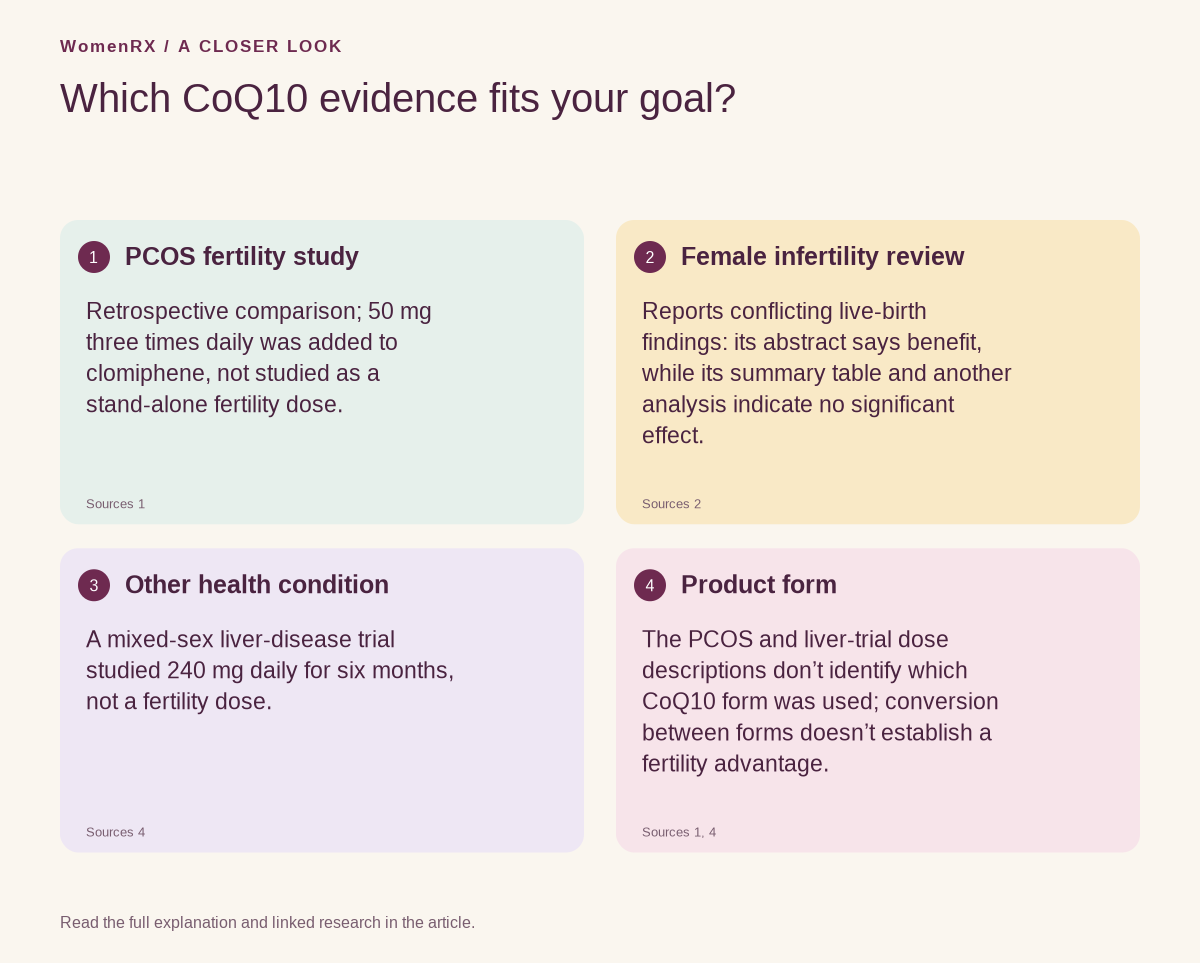
Which CoQ10 evidence fits your goal?
PCOS fertility study: Retrospective comparison; 50 mg three times daily was added to clomiphene, not studied as a stand-alone fertility dose.1
Female infertility review: Reports conflicting live-birth findings: its abstract says benefit, while its summary table and another analysis indicate no significant effect.2
Other health condition: A mixed-sex liver-disease trial studied 240 mg daily for six months, not a fertility dose.4
Product form: The PCOS and liver-trial dose descriptions don’t identify which CoQ10 form was used; conversion between forms doesn’t establish a fertility advantage.14
Read the figure as text
These examples show why a dose from one study should not be carried over to a different purpose or treated as a personal recommendation.- PCOS fertility study: Retrospective comparison; 50 mg three times daily was added to clomiphene, not studied as a stand-alone fertility dose.1
- Female infertility review: Reports conflicting live-birth findings: its abstract says benefit, while its summary table and another analysis indicate no significant effect.2
- Other health condition: A mixed-sex liver-disease trial studied 240 mg daily for six months, not a fertility dose.4
- Product form: The PCOS and liver-trial dose descriptions don’t identify which CoQ10 form was used; conversion between forms doesn’t establish a fertility advantage.14
More questions, answered
Does ubiquinol work better than ubiquinone for fertility?
Ubiquinone and ubiquinol are two forms of CoQ10 that convert in the body, but that doesn’t establish a fertility advantage for either one. A product’s form alone can’t establish that it’s the better choice for conception. 4
Can I use a study dose as my fertility dose?
Not by itself. The PCOS study used CoQ10 as an addition to clomiphene and was retrospective, so it doesn’t establish a stand-alone dose or prove that the result applies to other fertility situations. 1
Sources you can check
- Letrozole versus coenzyme Q10 plus Clomiphene citrate for women with Polycystic Ovarian Syndrome: An efficacy and safety analysis.Hou J, Chang Q. · Biomolecules & biomedicine · 2025Return to first citation
- Therapeutic Roles and Safety Profiles of Non-Vitamin Antioxidant Supplements in Female Infertility: A Narrative Review.Davoudi-Monfared E, Fotouk Kiaie SM, Ebrahimi M. · Journal of family & reproductive health · 2026Return to first citation
- Assessing Natural Health Product-Drug Interactions and Coding Feasibility: Analysis of a New Zealand General Population Dataset from an Online Market Research Panel.Lee EL, Ogle F, Nagra J, Ye SS, Harrison J, Barnes J. · Drug safety · 2026Return to first citation
- Six-month supplementation with high dose coenzyme Q10 improves liver steatosis, endothelial, vascular and myocardial function in patients with metabolic-dysfunction associated steatotic liver disease: a randomized double-blind, placebo-controlled trial.Vrentzos E, Ikonomidis I, Pavlidis G, Katogiannis K, Korakas E, Kountouri A, Pliouta L, Michalopoulou E, Pelekanou E, Boumpas D, Lambadiari V. · Cardiovascular diabetology · 2024Return to first citation