CoQ10: What to Track for Your Reason for Taking It
There’s no single timeline or outcome that shows whether CoQ10 is helping; the right measure depends on the condition and treatment goal.
Judge CoQ10 by the outcome it was meant to affect, not by a general feeling of more energy. A healing measure after surgery, a fertility outcome, and protein levels in a rare genetic kidney disease are not interchangeable. Agree on the measure and review point with the clinician managing that condition, and don’t change prescribed treatment based on supplement use.
Start with the reason, not a general energy check
CoQ10 is studied for different purposes, and the studies measure different things. Feeling more energetic may matter to you, but it doesn’t tell you whether a particular condition is improving. Before reviewing a supplement, name the health concern and the outcome that would count as meaningful for it.
For example, a study after wisdom tooth removal assessed tissue healing at follow-ups on days 7, 14, and 30. Those were the study’s measurement points for recovery after that specific procedure, not a general timeline for CoQ10 or a reason to expect the same result for another condition. 1
Match the measure to the condition
After a procedure: The wisdom tooth trial followed clinical measures of tissue healing and also recorded issues such as dry socket and jaw-joint symptoms. If you’re considering CoQ10 around a procedure, the relevant question is about that procedure and recovery plan, rather than a broad claim that the supplement improves healing in general. The trial included 70 participants; the results presented don’t establish whether women benefited differently. 1
For fertility treatment: Use outcomes that relate to the fertility plan, such as outcomes of ovarian stimulation or assisted reproduction, rather than relying on a general energy change. A 2025 review describes research in women and reports possible improvements in some reproductive outcomes, but it does not establish a dependable personal timeline or guarantee that CoQ10 improves the chance of pregnancy. Ask the fertility clinician which outcome matters for your situation and when it will be assessed. 4
For a diagnosed genetic CoQ10 kidney condition: The relevant measures may include urine protein and kidney function, followed over time by the kidney team. In a retrospective study of 12 Japanese patients with genetically confirmed CoQ10 nephropathy, the median urine protein-to-creatinine ratio fell from 1.66 to 0.19 g/gCr at 12 months; 7 patients had data at that point, and 6 of those 7 had at least a 50% reduction. This is a small study of a rare, specific disease, not evidence that CoQ10 treats ordinary kidney problems. 2
For a diagnosed psychiatric condition: A systematic review of nutraceutical studies in psychiatric conditions found substantial differences in products, study methods, and outcomes, with generally low methodological quality and high risk of bias. It does not provide a clear CoQ10-specific timeline or establish a general mental-health benefit. This research concerns psychiatric conditions, not a general energy or wellness goal. 3
For a general energy or wellness goal, decide what change you mean and whether it can be assessed reliably. The psychiatric review doesn’t establish whether CoQ10 helps with these broader goals. 3
Review CoQ10 alongside prescribed treatment
Bring the supplement into the same conversation as the condition’s prescribed treatment. A useful review can cover:
- What specific outcome are we trying to change, and how will it be measured?
- When is that outcome normally assessed for this condition or treatment?
- What would count as a meaningful improvement, no change, or worsening?
- Could the supplement affect how we interpret a test or symptom?
- Should it be continued alongside my current treatment?
These are questions for the clinician managing the relevant condition, not a reason to stop, delay, or adjust prescribed treatment yourself. This matters especially during cancer treatment: a systematic review of antioxidant supplements in breast cancer describes conflicting evidence and raises concern about concurrent antioxidant use during some cytotoxic chemotherapy. The review does not establish a specific CoQ10 interaction for every treatment, so bring the exact supplement and treatment plan to your oncology team before using them together. 5
Make the review useful
Write down the reason you started CoQ10, the outcome you and your clinician chose, and when that outcome will be checked. At the review, compare like with like: the same kind of measurement, taken in the context of the same condition and treatment plan. If the intended outcome hasn’t changed, that is useful information to discuss; don’t infer a benefit from an unrelated change or change prescribed care on your own.
These distinct conditions and outcomes don’t establish a universal CoQ10 timeline. Results presented for tooth-extraction recovery don’t establish whether women benefited differently; fertility research specifically concerns women, but doesn’t predict an individual result. 1 4
Choose the outcome that fits the reason
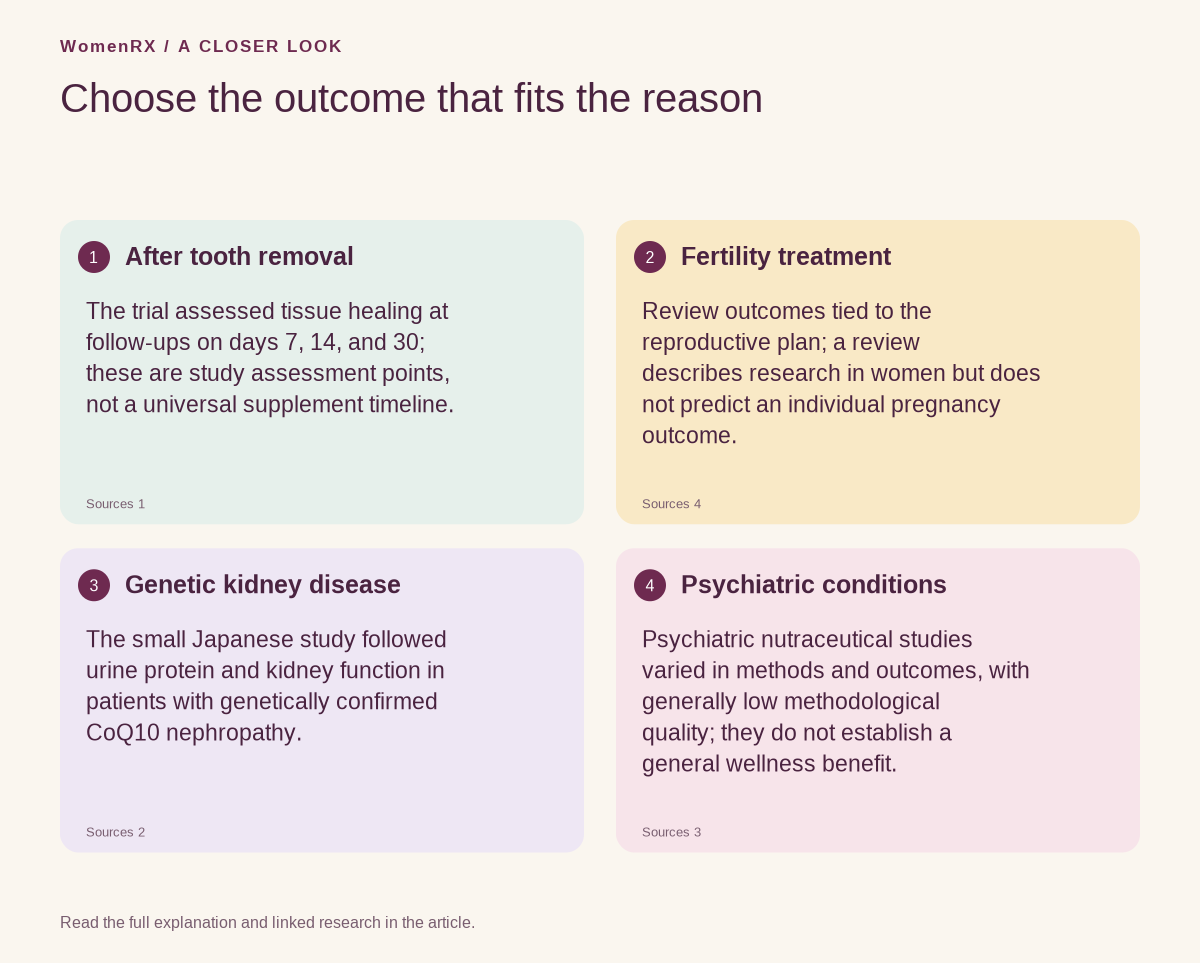
After tooth removal: The trial assessed tissue healing at follow-ups on days 7, 14, and 30; these are study assessment points, not a universal supplement timeline.1
Fertility treatment: Review outcomes tied to the reproductive plan; a review describes research in women but does not predict an individual pregnancy outcome.4
Genetic kidney disease: The small Japanese study followed urine protein and kidney function in patients with genetically confirmed CoQ10 nephropathy.2
Psychiatric conditions: Psychiatric nutraceutical studies varied in methods and outcomes, with generally low methodological quality; they do not establish a general wellness benefit.3
Read the figure as text
CoQ10 research measures different outcomes in different conditions. These examples show why one general feeling or timeline cannot stand in for a condition-specific review.- After tooth removal: The trial assessed tissue healing at follow-ups on days 7, 14, and 30; these are study assessment points, not a universal supplement timeline.1
- Fertility treatment: Review outcomes tied to the reproductive plan; a review describes research in women but does not predict an individual pregnancy outcome.4
- Genetic kidney disease: The small Japanese study followed urine protein and kidney function in patients with genetically confirmed CoQ10 nephropathy.2
- Psychiatric conditions: Psychiatric nutraceutical studies varied in methods and outcomes, with generally low methodological quality; they do not establish a general wellness benefit.3
More questions, answered
Is feeling more energetic enough to show that CoQ10 is working?
Not by itself. Energy is a broad experience and may not match the treatment goal for a defined condition. Choose an outcome that relates to why you’re taking it, then review that measure with the clinician managing the condition.
Does fertility research establish when CoQ10 will help?
No. A review describes research on CoQ10 in women’s fertility, but it doesn’t establish a dependable timeline or guarantee a pregnancy benefit for an individual. Ask your fertility clinician which outcome is relevant to your treatment plan. 4
Sources you can check
- Effect of coenzyme Q10 on post-extraction tissue healing in wisdom tooth Surgery: double-blind randomized clinical trial.Nejati Z, Ghadirzadeh B, Mohammadi H, Afraie M, Moradi Y. · Pain management · 2025Return to first citation
- Kidney outcomes of coenzyme Q10 supplementation in patients with genetically confirmed CoQ10 nephropathy in Japan.Nagano C, Ushijima K, Tezuka Y, Okamoto T, Inaba Y, Miyazono A, Takeda N, Aoki T, Mizutani A, Miyano H, Yamamoto M, Imai M, Kawaguchi T, Komiya T, Ishihara M, Nagao Y, Mikami N, In... · Clinical and experimental nephrology · 2026Return to first citation
- Clinical outcomes of mitochondrial-enhancing nutraceutical supplementation in psychiatric disorders: A systematic review.Tortajada J, Bulduk BK, Alfonso-Landete B, Alcaide-Barriga P, Ballvé-Gelonch B, Garrabou G, Vilella E, Alonso Y, Valiente-Pallejà A, Martorell L. · General psychiatry · 2026Return to first citation
- Exploring the protective effects of coenzyme Q10 on female fertility.Jiang Y, Han Y, Qiao P, Ren F. · Frontiers in cell and developmental biology · 2025Return to first citation
- Impact of Nutritional Supplements and Antioxidants in the Treatment of Breast Cancer: A Systematic Review.Uribe-Ramírez D, Laguna-Maldonado KD, Vázquez-Carrada M, Cortés-Peña LF, Vilchis-Landeros MM, Vázquez-Meza H, Matuz-Mares D. · Nutrients · 2026Return to first citation