CoQ10 for Migraine Prevention: What the Evidence Shows
CoQ10 may reduce how often migraines occur, but the evidence is about prevention, not stopping an attack once it starts.
CoQ10 has some evidence as an oral migraine preventive: a network meta-analysis estimated about 1.9 fewer attacks per month versus placebo, though the estimate combines a small set of trials and doesn’t predict your personal response. The evidence doesn’t establish that CoQ10 treats an active attack or works differently across menstrual, perimenopausal, or pregnancy-related migraine patterns. Discuss it alongside your current prevention plan. 2
The clearest signal is fewer attacks
Coenzyme Q10, also called CoQ10, has been studied as a preventive supplement: something taken over time with the aim of reducing future migraine attacks. In a 2026 network meta-analysis of 14 randomized trials involving 791 adults with migraine, CoQ10 was estimated to reduce migraine frequency by 1.91 attacks per month compared with placebo (95% confidence interval, 1.00 to 2.51 fewer). The analysis combined comparisons across studies, and no active supplement in the analysis was statistically better than the others. That estimate is a group result, not a forecast of what you’ll experience. 2
The same analysis did not find that CoQ10 or the other supplements significantly shortened migraine attacks. So a possible preventive effect shouldn’t be mistaken for a treatment to take once head pain or other migraine symptoms have begun. The trials included oral supplements used for at least four weeks, not a quick intervention for an active attack. 2
A 2025 review describes CoQ10’s prevention evidence as Level C and its reported adverse-event burden as low. That is a reason it may be worth discussing, not proof that it will help or that it is risk-free for every person. 5
Why combination studies can be hard to interpret
Some studies tested CoQ10 together with other ingredients, rather than on its own. For example, a pilot, open-label study followed 113 patients with episodic migraine who took a fixed combination of CoQ10, magnesium, vitamin B2, feverfew, and andrographis. Their average monthly migraine days fell from 9.4 at baseline to 6.1 after three months. Because there was no comparison group and five ingredients were combined, the study can’t show that CoQ10 caused the change. 3
An observational study of a different three-ingredient combination, CoQ10, feverfew, and magnesium, also reported fewer migraine days. It, too, cannot isolate CoQ10’s contribution or establish what would happen compared with placebo. 4
These results help explain why a positive finding for a blend isn’t the same as strong evidence for CoQ10 alone. When you’re looking at a supplement, check whether the study tested CoQ10 by itself or bundled it with other ingredients, and whether it measured migraine frequency, attack duration, or relief during an attack.
What this may mean for your migraine pattern
Migraine is more common in women, and some people notice attacks at predictable times, including before menstruation. 1 But the available findings don’t establish whether CoQ10 works differently for menstrual-related migraine, during perimenopause, or after menopause. A reduction in monthly attacks in a mixed adult migraine population can’t answer that more specific question. 2
Pregnancy is another distinct decision. These prevention results don’t establish whether CoQ10 is safe or effective for migraine prevention during pregnancy. If you’re pregnant, trying to conceive, or recently gave birth, discuss your migraine treatment and any supplement with your care team before starting it. That conversation matters for your whole prevention plan, not just CoQ10.
Put it beside your current prevention plan
If you’re considering CoQ10, bring the question to whoever helps manage your migraines. Discuss what you’re currently using to prevent attacks, what you take when an attack starts, and whether the goal is fewer attacks, less disability, or something else. MedlinePlus advises checking with a healthcare provider before taking supplements, and migraine prevention can include prescribed medicines as well as other approaches. Don’t treat a supplement as a reason to stop a prescribed preventive without agreeing on a plan. 1
A simple way to make the conversation concrete is to note your migraine days over time and whether they cluster around your period or another recognizable pattern. That helps distinguish a possible change in frequency from a change in how long or how severely an attack affects you. It won’t prove CoQ10 caused a change, but it keeps the outcome you care about visible.
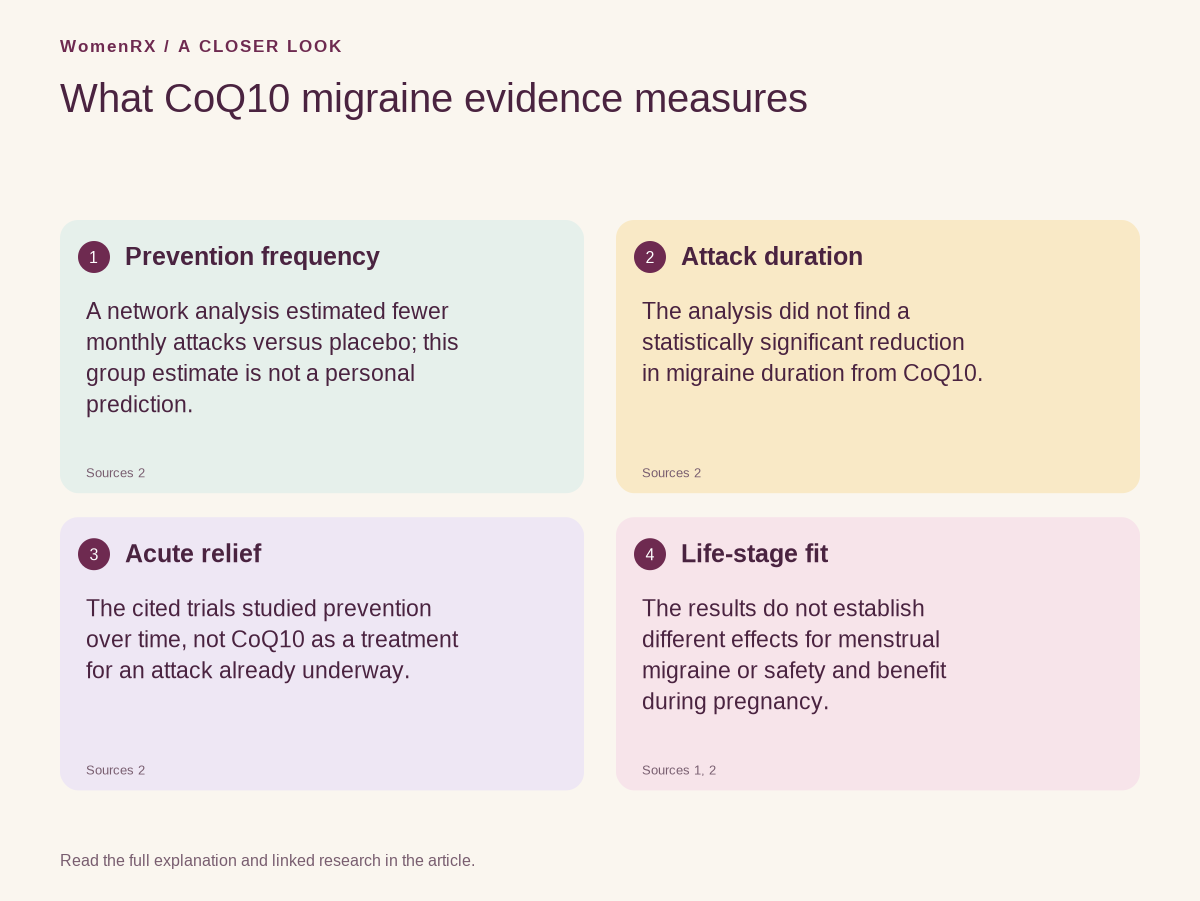
What CoQ10 migraine evidence measures
Prevention frequency: A network analysis estimated fewer monthly attacks versus placebo; this group estimate is not a personal prediction.2
Attack duration: The analysis did not find a statistically significant reduction in migraine duration from CoQ10.2
Acute relief: The cited trials studied prevention over time, not CoQ10 as a treatment for an attack already underway.2
Life-stage fit: The results do not establish different effects for menstrual migraine or safety and benefit during pregnancy.12
Read the figure as text
Separate the outcome studied from the question you may be asking: fewer attacks, shorter attacks, acute relief, or effects at a particular life stage.- Prevention frequency: A network analysis estimated fewer monthly attacks versus placebo; this group estimate is not a personal prediction.2
- Attack duration: The analysis did not find a statistically significant reduction in migraine duration from CoQ10.2
- Acute relief: The cited trials studied prevention over time, not CoQ10 as a treatment for an attack already underway.2
- Life-stage fit: The results do not establish different effects for menstrual migraine or safety and benefit during pregnancy.12
More questions, answered
Can CoQ10 stop a migraine that has already started?
CoQ10 has been studied as a preventive taken over time, not as treatment for a migraine attack already underway. The available analysis does not establish it as an acute treatment. 2
Does CoQ10 work better for menstrual migraine?
The evidence does not establish that CoQ10 works differently for migraine linked to menstruation. Some people have predictable attacks before their period, but that pattern alone does not tell us whether this supplement will help. 12
Sources you can check
- Migraine | MedlinePlusAccessed 2026-09-25Return to first citation
- Nutritional supplements for migraine prevention: evaluating evidence sufficiency and effect modifiers through network meta-analysis, trial sequential analysis, and meta-regression.Peng J, Zhou L, Chen Y, Li J, Zhang R. · Frontiers in nutrition · 2026Return to first citation
- Open Label Prospective Experience of Supplementation with a Fixed Combination of Magnesium, Vitamin B2, Feverfew, Andrographis Paniculata and Coenzyme Q10 for Episodic Migraine Prophylaxis.Vikelis M, Dermitzakis EV, Vlachos GS, Soldatos P, Spingos KC, Litsardopoulos P, Kararizou E, Argyriou AA. · Journal of clinical medicine · 2020Return to first citation
- A combination of coenzyme Q10, feverfew and magnesium for migraine prophylaxis: a prospective observational study.Guilbot A, Bangratz M, Ait Abdellah S, Lucas C. · BMC complementary and alternative medicine · 2017Return to first citation
- Nutraceuticals and Headache 2024: Riboflavin, Coenzyme Q10, Feverfew, Magnesium, Melatonin, and Butterbur.Tepper SJ, Tepper K. · Current pain and headache reports · 2025Return to first citation