CoQ10 for Fatigue: What the Trials Actually Show
CoQ10 has a role in energy-related cell processes, but fatigue studies test specific conditions and often combine it with other ingredients.
Clinical trials don’t show that CoQ10 reliably relieves everyday, unexplained fatigue. Some condition-specific trials reported improvement with CoQ10 combined with NADH, while others found no clear benefit or tested multi-ingredient products. A result in people with a diagnosed condition may not apply to your situation. If fatigue lasts for weeks, look into possible causes rather than relying on a supplement alone. 23451
Why the energy explanation isn’t enough
CoQ10 is involved in cell processes related to energy production. That gives researchers a reason to study it, but it doesn’t demonstrate that taking CoQ10 will make you feel more energetic. The relevant test is whether people taking it report less fatigue than people in a comparison group. 3
Fatigue can have many causes, including too little sleep, stress, pregnancy, anemia, thyroid disease, infections, and sleep or mental health conditions. A supplement’s results in people with a particular diagnosis may not apply when the cause of your tiredness is different. 1
What the trials found, by condition
ME/CFS: In an eight-week randomized trial of 80 people with chronic fatigue syndrome, researchers tested CoQ10 together with NADH, not CoQ10 alone. The study reported a reduction in perceived fatigue in the supplement group compared with placebo. A separate 12-week trial enrolled 207 people with ME/CFS and also tested CoQ10 plus NADH. It reported improvements in fatigue measures within the supplement group over time. Those within-group changes don’t by themselves show that fatigue improved more than it did with placebo. 43
Fibromyalgia: A randomized crossover trial enrolled 110 adults; 89 completed it, and 96.6% of completers were women. The supplement combined CoQ10 with tryptophan and magnesium. Fatigue improved significantly in the placebo group, while the reduction in the supplement group was not statistically significant. Because the product had several ingredients, the trial also can’t isolate CoQ10’s effect. 2
Multiple sclerosis: A randomized trial in people with MS reported improved fatigue scores with CoQ10 compared with placebo. That finding concerns fatigue in people with MS; it doesn’t establish a benefit for unexplained fatigue. 6
Late-onset effects of polio: In a randomized trial of 103 polio survivors with fatigue, CoQ10 did not produce a statistically significant difference from placebo on either of the two fatigue measures. 5
Breast cancer treatment: An exploratory randomized trial studied patients with breast cancer receiving chemotherapy. It tested a product containing CoQ10 and L-carnitine, not CoQ10 alone. Some fatigue measures differed between the product and regular-care groups, while another measure did not. The abstract doesn’t report participants’ sex, so this study shouldn’t be described as a trial in women. Its findings also apply to treatment-related fatigue, not everyday low energy. 7
Together, the trials offer mixed, condition-specific results. The positive findings don’t establish CoQ10 as a dependable treatment for general fatigue, and results from combination products can’t show which ingredient, if any, made the difference.
What these studies say about women’s health
The fibromyalgia trial provides a useful, specific detail: nearly all participants who completed it were women. But its fatigue result wasn’t significant in the supplement group, and it tested three ingredients together. The ME/CFS, MS, and post-polio summaries don’t report women-specific treatment results. These studies also don’t establish whether CoQ10 helps fatigue specifically during pregnancy or menopause. 23456
That leaves no basis here for a women-specific promise. A study that includes many women is not automatically evidence that a supplement works differently, or better, for women.
When low energy calls for another explanation
If fatigue hasn’t improved after several weeks, contact a healthcare provider to look for a cause. Fatigue is a symptom, not a diagnosis. An evaluation may consider your sleep, daily activities, appetite, and exercise, as well as possible medical causes such as anemia, thyroid disease, diabetes, infection, pain, or depression and anxiety. 1
The practical distinction is simple: CoQ10 is being studied for fatigue in certain diagnosed conditions, but it doesn’t explain why your energy is low. Persistent fatigue deserves attention to its cause, whether or not you choose to take a supplement.
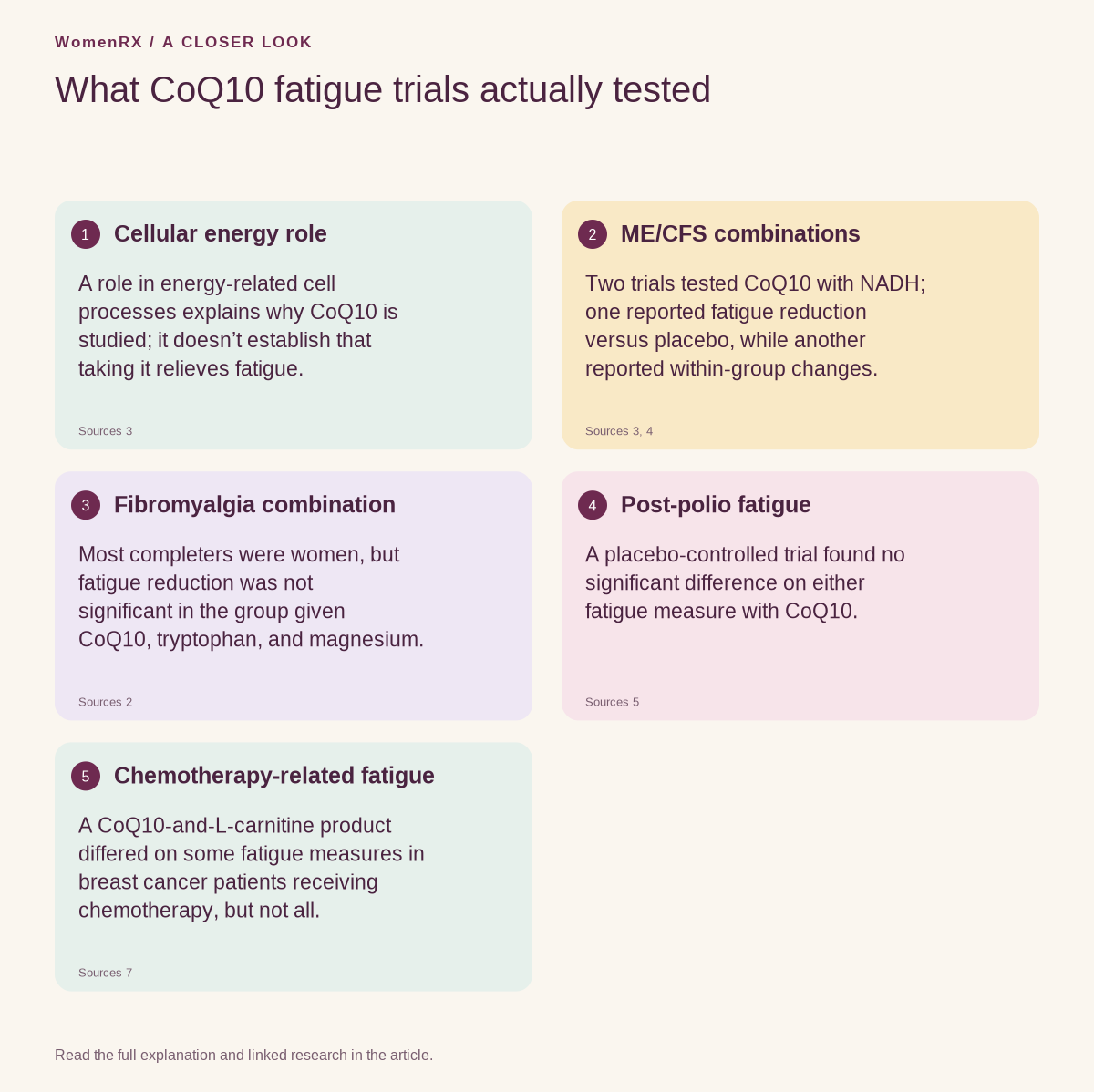
What CoQ10 fatigue trials actually tested
Cellular energy role: A role in energy-related cell processes explains why CoQ10 is studied; it doesn’t establish that taking it relieves fatigue.3
ME/CFS combinations: Two trials tested CoQ10 with NADH; one reported fatigue reduction versus placebo, while another reported within-group changes.34
Fibromyalgia combination: Most completers were women, but fatigue reduction was not significant in the group given CoQ10, tryptophan, and magnesium.2
Post-polio fatigue: A placebo-controlled trial found no significant difference on either fatigue measure with CoQ10.5
Chemotherapy-related fatigue: A CoQ10-and-L-carnitine product differed on some fatigue measures in breast cancer patients receiving chemotherapy, but not all.7
Read the figure as text
Compare the biological rationale with fatigue outcomes in specific diagnosed populations, and notice when a study tested CoQ10 alongside other ingredients.- Cellular energy role: A role in energy-related cell processes explains why CoQ10 is studied; it doesn’t establish that taking it relieves fatigue.3
- ME/CFS combinations: Two trials tested CoQ10 with NADH; one reported fatigue reduction versus placebo, while another reported within-group changes.34
- Fibromyalgia combination: Most completers were women, but fatigue reduction was not significant in the group given CoQ10, tryptophan, and magnesium.2
- Post-polio fatigue: A placebo-controlled trial found no significant difference on either fatigue measure with CoQ10.5
- Chemotherapy-related fatigue: A CoQ10-and-L-carnitine product differed on some fatigue measures in breast cancer patients receiving chemotherapy, but not all.7
More questions, answered
Does a study of CoQ10 plus another supplement show that CoQ10 works by itself?
No. Trials that combine CoQ10 with NADH, magnesium, tryptophan, or L-carnitine test the combination. They can’t identify CoQ10’s individual contribution to any change in fatigue. 2347
Sources you can check
- Fatigue: MedlinePlusAccessed 2026-09-25Return to first citation
- Effects of Coenzyme Q10, Tryptophan, and Magnesium Supplementation on Fatigue in Patients with Fibromyalgia - A Randomized Trial.Rosselló Aubach L, Fornós Roca X, Fernández Álvarez ME. · Journal of dietary supplements · 2025Return to first citation
- Effect of Dietary Coenzyme Q10 Plus NADH Supplementation on Fatigue Perception and Health-Related Quality of Life in Individuals with Myalgic Encephalomyelitis/Chronic Fatigue Syndrome: A Prospective, Randomized, Double-Blind, Placebo-Controlled Trial.Castro-Marrero J, Segundo MJ, Lacasa M, Martinez-Martinez A, Sentañes RS, Alegre-Martin J. · Nutrients · 2021Return to first citation
- Effect of coenzyme Q10 plus nicotinamide adenine dinucleotide supplementation on maximum heart rate after exercise testing in chronic fatigue syndrome - A randomized, controlled, double-blind trial.Castro-Marrero J, Sáez-Francàs N, Segundo MJ, Calvo N, Faro M, Aliste L, Fernández de Sevilla T, Alegre J. · Clinical nutrition (Edinburgh, Scotland) · 2016Return to first citation
- A randomized controlled trial of coenzyme Q10 for fatigue in the late-onset sequelae of poliomyelitis.Peel MM, Cooke M, Lewis-Peel HJ, Lea RA, Moyle W. · Complementary therapies in medicine · 2015Return to first citation
- Coenzyme Q10 as a treatment for fatigue and depression in multiple sclerosis patients: A double blind randomized clinical trial.Sanoobar M, Dehghan P, Khalili M, Azimi A, Seifar F. · Nutritional neuroscience · 2016Return to first citation
- Efficacy and safety of an amino acid jelly containing coenzyme Q10 and L-carnitine in controlling fatigue in breast cancer patients receiving chemotherapy: a multi-institutional, randomized, exploratory trial (JORTC-CAM01).Iwase S, Kawaguchi T, Yotsumoto D, Doi T, Miyara K, Odagiri H, Kitamura K, Ariyoshi K, Miyaji T, Ishiki H, Inoue K, Tsutsumi C, Sagara Y, Yamaguchi T. · Supportive care in cancer : official journal of the Multinational Association of Supportive Care in Cancer · 2016Return to first citation