CoQ10 Supplements: What the Evidence Can Tell You
CoQ10 has been studied for migraine and heart failure, but results for one condition or product form don’t establish a benefit for another.
CoQ10 is a substance your body makes, sold mainly as ubiquinone or ubiquinol. Research suggests possible benefits for migraine frequency and duration, while heart-failure findings remain uncertain. A small study found higher blood levels with one specific ubiquinol product, but that doesn’t prove ubiquinol works better for health outcomes. Fertility, pregnancy, and medication-interaction questions need separate evidence and a review of your actual medication list. 1 3 4
CoQ10 helps with energy-related processes inside cells and exists in two interconvertible forms: oxidized ubiquinone and reduced ubiquinol. Supplements use one form or the other, but a label describing the form doesn’t tell you whether the product improves a particular health outcome. That depends on evidence for that use, not just on absorption or a proposed mechanism. 4
What’s been studied
Migraine prevention has a promising but limited signal. A meta-analysis of six randomized trials with 371 adults found that CoQ10 reduced migraine attack frequency and duration compared with control, but did not significantly reduce headache severity. The review combined a small number of trials, so its findings are a reason for interest, not a guarantee that it will help an individual. 3
A separate randomized trial compared CoQ10 with amitriptyline in 72 children with migraine. After three months, the groups’ reported clinical outcomes did not significantly differ. That pediatric study is not evidence that the same result applies to adult women, and it doesn’t replace the adult evidence. 2
Heart-failure research isn’t a reason to self-treat. A systematic review of 26 trials involving 2,250 people with heart failure with reduced ejection fraction found a possible reduction in all-cause mortality, but the confidence interval included no effect. Short-term functional results were modest or unclear, and many trials had important risk-of-bias or applicability concerns. These findings don’t establish CoQ10 as a substitute for heart-failure treatment. 1
Evidence for other uses can’t be assumed from those results. For example, a randomized study of 54 healthy, recreationally active men found changes in one laboratory measure after six weeks of ubiquinol, but no improvement in measured exercise capacity. It also tells us little about outcomes in women or people with a health condition. 5
Ubiquinone or ubiquinol?
They’re different forms of CoQ10, and the body can convert between them. A 2026 crossover study in 12 healthy adults found higher blood exposure from a particular cocrystal ubiquinol product than from the ubiquinone product it was compared with. That was a small product-specific absorption study, not a trial showing that ubiquinol prevents migraine, helps heart failure, or is generally the better choice. 4
So, don’t treat “more absorbable” as the same as “more effective.” The study doesn’t settle how other formulations compare, or which form, if any, is preferable for a particular clinical use.
What this means for fertility and pregnancy
The migraine and heart-failure findings above don’t answer whether CoQ10 improves fertility or is appropriate during pregnancy. Those are different questions with different outcomes, and the cited studies don’t report pregnancy-specific results. Don’t use evidence for migraine or heart failure to infer a fertility benefit or pregnancy safety. 1 3
Safety and medication checks
The heart-failure review found no indication of increased adverse events in the included trials, but it also noted concerns about trial quality and available data. That result can’t establish that CoQ10 is safe for everyone or for every combination of supplements and medicines. In the small study of 12 healthy adults, neither tested formulation produced a reported adverse event, which is also too limited to settle broader safety questions. 1 4
The research summarized here doesn’t establish a reliable list of medication interactions. Before adding CoQ10, show a pharmacist or prescriber the exact product label and your medication list. Ask them to check your specific medicines and health conditions rather than relying on a general claim that a supplement is safe or that one form is superior. If you’re considering it for a diagnosed condition, ask how it would fit with the treatment already in place.
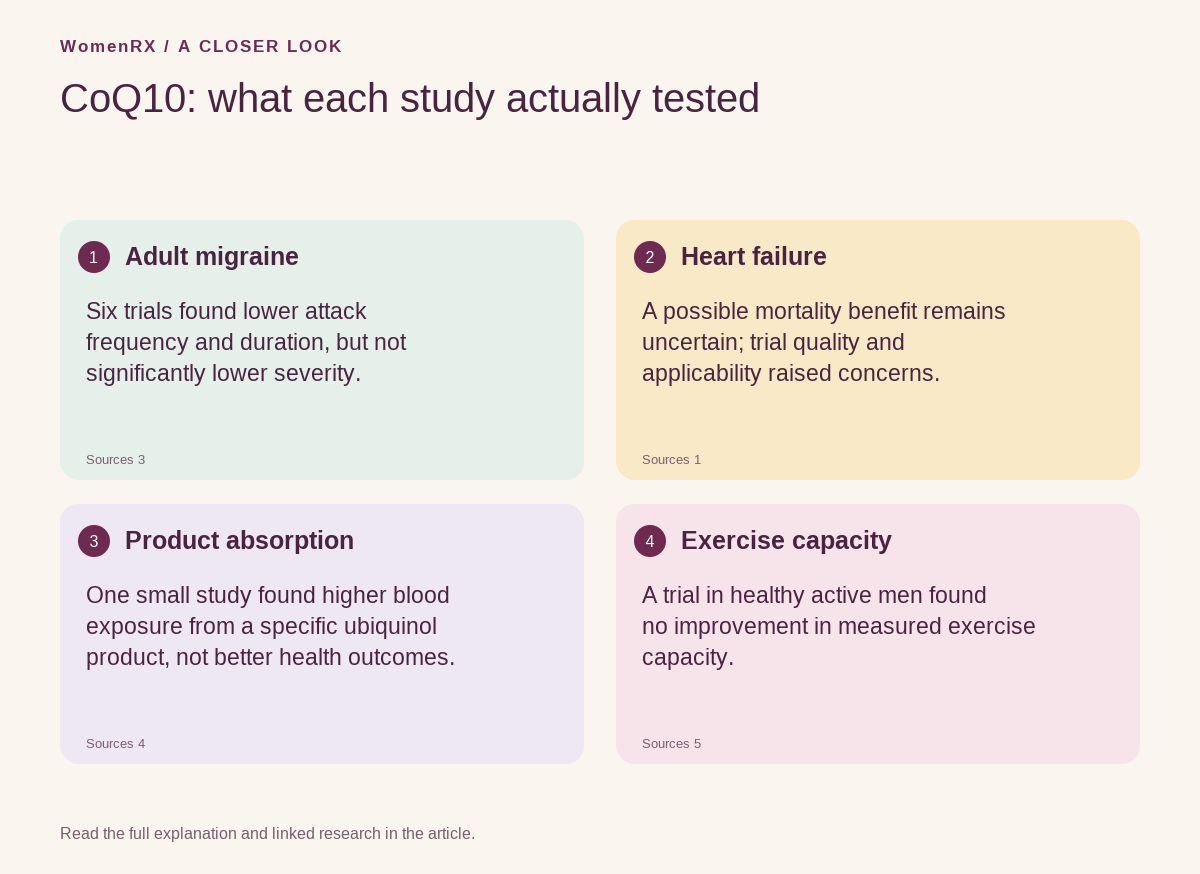
CoQ10: what each study actually tested
Adult migraine: Six trials found lower attack frequency and duration, but not significantly lower severity.3
Heart failure: A possible mortality benefit remains uncertain; trial quality and applicability raised concerns.1
Product absorption: One small study found higher blood exposure from a specific ubiquinol product, not better health outcomes.4
Exercise capacity: A trial in healthy active men found no improvement in measured exercise capacity.5
Read the figure as text
The population and outcome matter: evidence about migraine, heart failure, exercise, or absorption does not automatically transfer to another use.- Adult migraine: Six trials found lower attack frequency and duration, but not significantly lower severity.3
- Heart failure: A possible mortality benefit remains uncertain; trial quality and applicability raised concerns.1
- Product absorption: One small study found higher blood exposure from a specific ubiquinol product, not better health outcomes.4
- Exercise capacity: A trial in healthy active men found no improvement in measured exercise capacity.5
More questions, answered
Does taking a statin mean I should take CoQ10?
The heart-failure review found no evidence that statin use changed CoQ10’s treatment effect in the studies it analyzed. That doesn’t show that CoQ10 treats statin-related muscle symptoms or that everyone taking a statin needs it. 1
Is ubiquinol proven to work better than ubiquinone?
No. One small study found higher blood exposure with a specific ubiquinol product, but it did not compare health outcomes. Higher absorption alone doesn’t establish better clinical results. 4
Sources you can check
- Coenzyme Q10 to manage chronic heart failure with a reduced ejection fraction: a systematic review and economic evaluation.Claxton L, Simmonds M, Beresford L, Cubbon R, Dayer M, Gottlieb SS, Hartshorne-Evans N, Kilroy B, Llewellyn A, Rothery C, Sharif S, Tierney JF, Witte KK, Wright K, Stewart LA. · Health technology assessment (Winchester, England) · 2022Return to first citation
- A Comparative Study on the Efficacy of Coenzyme Q10 and Amitriptyline in the Prophylactic Treatment of Migraine Headaches in Children: A Randomized Controlled Trial.Yaghini O, Hoseini N, Ghazavi MR, Mansouri V, Nasiri J, Moosavian T, Salehi MM. · Advanced biomedical research · 2022Return to first citation
- Coenzyme Q10 supplementation for prophylaxis in adult patients with migraine-a meta-analysis.Sazali S, Badrin S, Norhayati MN, Idris NS. · BMJ open · 2021Return to first citation
- A Randomized, Double-Blind, Two-Treatment, Two-Period, Crossover Study Investigating the Systemic Bioavailability of a Novel Cocrystal Ubiquinol Formulation Compared with a Ubiquinone Formulation in Healthy Adults.Mei X, Zhu B, Soni K, Kasaraneni K, Panchal N. · Clinical pharmacology in drug development · 2026Return to first citation
- Effect of six weeks ubiquinol supplementation on mitochondrial respiratory function and exercise capacity in healthy males.Acton JP, Alsharif NS, Bond JW, Cocksedge SP, Mclellan AG, Peden DL, Funnell MP, Dugdale HF, James LJ, Ferguson RA, Clifford T, Bailey SJ. · European journal of applied physiology · 2026Return to first citation